
Why Does Iceland Use GMT (UTC+00:00) Year-Round Despite Sitting at 22 Degrees West Longitude?
If you look at a globe and trace the Prime Meridian (0° longitude) straight north from London, it passes more than a thousand kilometers east of Iceland. The capital city of Reykjavik sits at 21°56'W longitude (`21.93°W`), while Keflavik International Airport (`22.61°W`) and the westernmost cliffs of Bjargtangar (`24°32'W`) extend even further into the North Atlantic. By spherical solar geometry—where each 15° band of longitude represents one hour of Earth's rotation (`4 minutes` per degree)—most of Iceland belongs in UTC-01:00, and everything west of 22.5°W belongs in UTC-02:00. Yet according to historical records of Time in Iceland, the entire country has observed Greenwich Mean Time (UTC+00:00) year-round without Daylight Saving Time since April 7, 1968.
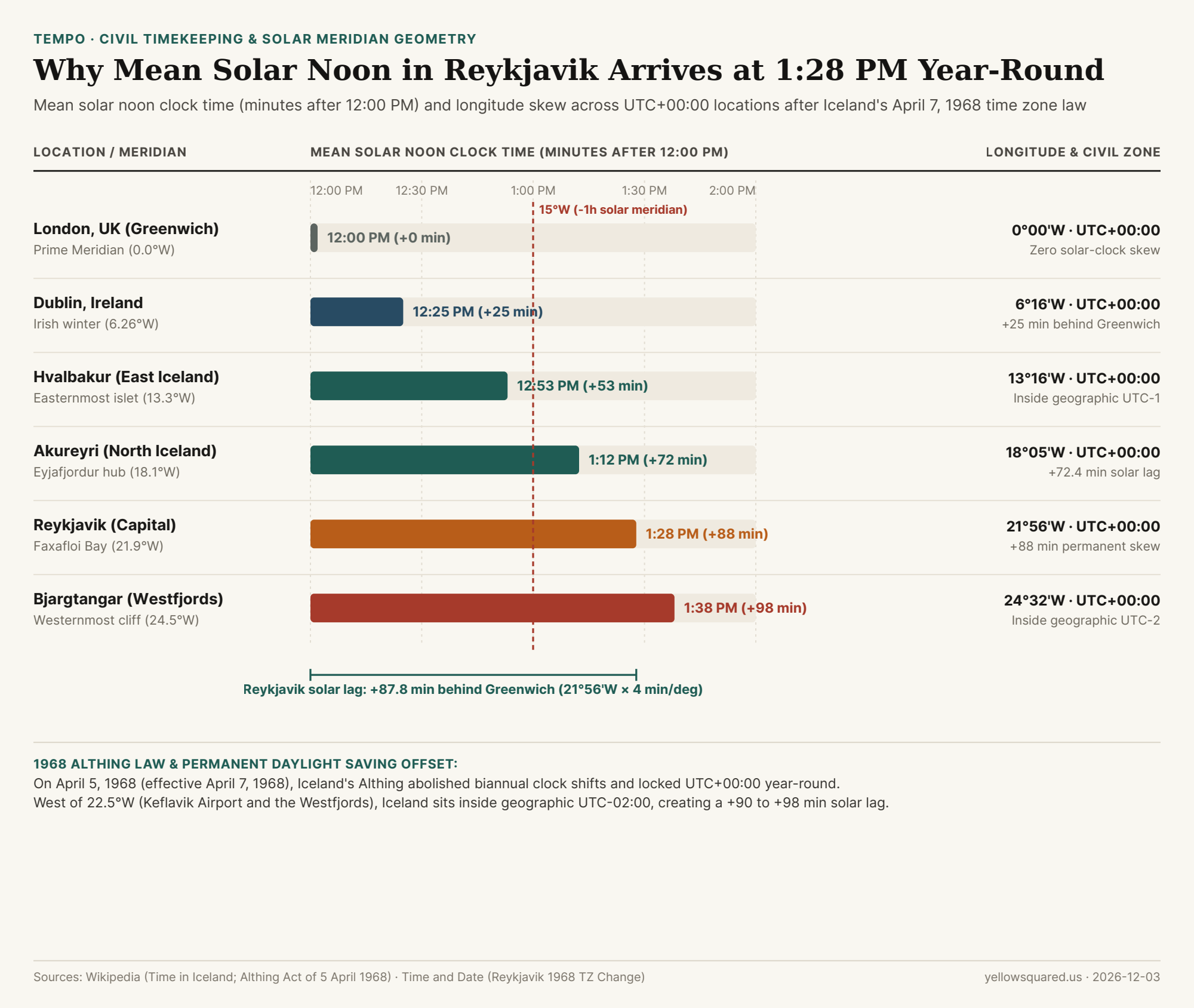
Because Iceland's civil clock runs 1 hour and 28 minutes ahead of Reykjavik's local solar meridian (`21.93° × 4 min/deg = 87.8 minutes`), the Sun does not reach its highest point in the sky over Reykjavik at 12:00 PM. Instead, mean solar noon in Reykjavik arrives at 1:28 PM (`13:28`), and out on the western cliffs of Bjargtangar (`24.53°W`), solar noon arrives at 1:38 PM (`13:38`). When coordinating flights, transatlantic engineering sprints, or remote calls with Reykjavik, you can Open Tempo in your browser to compare Iceland's permanent UTC+00:00 clock against shifting North American and European daylight saving schedules.
How Telephone Lines Standardized Iceland at UTC-01:00 in 1907
Prior to the twentieth century, Iceland had neither international land borders nor a cross-country railway network, so individual towns and fishing ports set their clocks to local mean solar time. Because the longitudinal span between easternmost Hvalbakur (`13°16'W`) and westernmost Bjargtangar (`24°32'W`) covers 11°16' of arc, local solar clocks in eastern fjords ran roughly 45 minutes ahead of those in the Westfjords.
That fragmented patchwork ended in 1906 with the founding of Iceland's national telephone company, Landssiminn. Real-time telegraph and telephone switching required a single national clock. On November 16, 1907, Iceland's parliament (the Althing) passed legislation establishing UTC-01:00 (based on the 15°W meridian passing through eastern Iceland) as the country's first nationwide standard time zone. Under UTC-01:00, Reykjavik's mean solar noon occurred at a natural 12:28 PM (`28 minutes` after clock noon).
"By abolishing biannual clock transitions on April 7, 1968 and locking the nation to UTC+00:00 year-round, the Althing placed Iceland on permanent Daylight Saving Time—trading an 88-minute solar noon lag in Reykjavik for seamless year-round alignment with Greenwich and Western European commerce."
Why the Althing Locked UTC+00:00 on April 7, 1968
Iceland first experimented with wartime Daylight Saving Time (`UTC+00:00`) between 1917 and 1921, and reintroduced annual summer clock shifts in 1939. Between 1947 and 1967, Icelanders sprang forward one hour from UTC-01:00 to UTC+00:00 at 02:00 on the first Sunday in April and fell back in late October. However, at subarctic latitudes (`64°N` to `66.5°N`), shifting clocks by one hour in spring and autumn did little to change winter darkness (when Reykjavik receives barely 4 hours of daylight around the December solstice) or summer midnight sun (when twilight merges into nearly 21 to 24 hours of continuous light).
Meanwhile, resetting clocks twice a year scrambled transatlantic aviation schedules at Keflavik, disrupted infant sleep routines, and created a two-hour winter gap against London and continental European trading partners. Researchers at the University of Iceland Almanac proposed a clean compromise: eliminate the twice-yearly clock shift altogether, but keep the summer UTC+00:00 offset all year long. As documented by Time and Date's 1968 Reykjavik transition records, the Althing passed the law on April 5, 1968, and when clocks advanced from 01:00 to 02:00 on Sunday, April 7, 1968, they never turned back.
| Location | Longitude | Geographic Zone | Observed Zone | Mean Solar Noon | Solar Skew |
|---|---|---|---|---|---|
| London (Greenwich, UK) | 0°00'W (0.00°W) |
UTC+00:00 |
UTC+00:00 (Winter) |
12:00 PM |
0.0 min |
| Dublin, Ireland | 6°16'W (6.26°W) |
UTC+00:00 |
UTC+00:00 (Winter) |
12:25 PM |
+25.0 min |
| Hvalbakur (East Iceland) | 13°16'W (13.27°W) |
UTC-01:00 |
UTC+00:00 (Year-round) |
12:53 PM |
+53.1 min |
| Akureyri (North Iceland) | 18°05'W (18.09°W) |
UTC-01:00 |
UTC+00:00 (Year-round) |
1:12 PM |
+72.4 min |
| Reykjavik (Capital) | 21°56'W (21.93°W) |
UTC-01:00 |
UTC+00:00 (Year-round) |
1:28 PM |
+87.8 min |
| Keflavik Int'l Airport | 22°36'W (22.61°W) |
UTC-02:00 (>22.5°W) |
UTC+00:00 (Year-round) |
1:30 PM |
+90.4 min |
| Bjargtangar (Westfjords) | 24°32'W (24.53°W) |
UTC-02:00 (>22.5°W) |
UTC+00:00 (Year-round) |
1:38 PM |
+98.1 min |
Social Jet Lag and the 2020 Government Review
Because the boundary between geographic UTC-01:00 and UTC-02:00 lies at 22.5°W (`15°W + 7.5°`), western Iceland—including Keflavik International Airport (`22.61°W`), Isafjordur, and Bjargtangar (`24.53°W`)—is technically locked nearly two full hours ahead of its geographic zone (`+90.4` to `+98.1 minutes` past solar noon). Chronobiologists and sleep researchers have repeatedly petitioned the Althing since 1994 to revert to UTC-01:00, arguing that dark winter mornings (when sunrise in Reykjavik does not occur until 11:22 AM in late December) induce chronic social jet lag in adolescents and shift workers.
However, following a comprehensive public consultation and cabinet review in 2020, the Icelandic government voted to retain UTC+00:00 year-round, citing overwhelming public preference for brighter afternoon and evening hours from February through November and zero DST clock-change friction. To track Reykjavik's live offset against London, New York, or Seattle without mental math, Open Tempo in your browser and pin Atlantic/Reykjavik to your time-zone comparison board.