
Why Does It Smell Like Rain? The Science of Petrichor
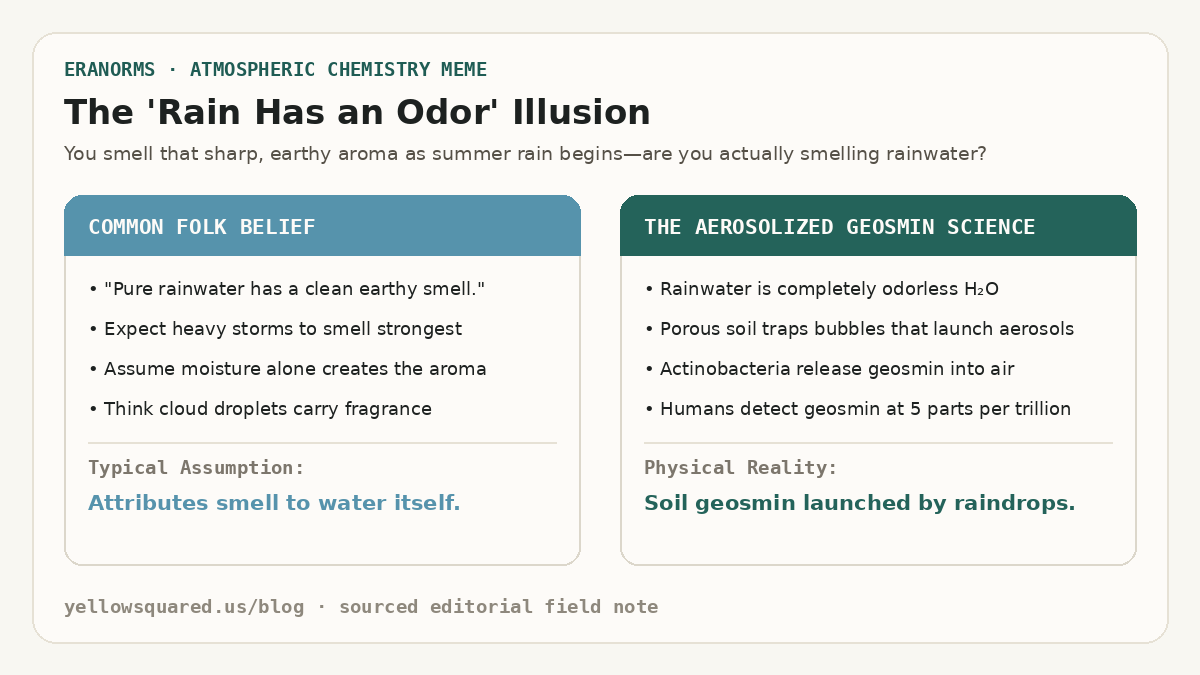
Almost everyone recognizes the crisp, musky, intensely refreshing aroma that rises from sidewalks and dry soil when a summer rainstorm begins. In 1964, Australian CSIRO mineral chemists Isabel Joy Bear and Richard Thomas coined the scientific name for this scent: petrichor (from the Greek petra meaning stone, and ichor, the ethereal blood of mythological gods). But for decades, scientists could not explain the mechanical trigger: how does falling water lift scent molecules upward into the air you breathe before the rain even fully wets the pavement?
High-speed camera imaging from the Massachusetts Institute of Technology (MIT Department of Mechanical Engineering) revealed the precise physical mechanism: when a raindrop hits a porous surface like dry dirt, clay, or weathered concrete, it traps tiny microscopic air pockets at the impact point. These air bubbles race upward through the droplet and burst at the surface, launching an aerosol mist of hundreds of microscopic droplets into the wind—carrying soil bacteria compounds straight to your nose.
A raindrop does not simply splash on the ground; it acts like a miniature aerosol spray can, trapping tiny air bubbles that launch scent molecules into the breeze.
The Two Chemical Compounds Behind Petrichor: Geosmin and Plant Lipids
Petrichor is not a single chemical, but an atmospheric blend of two distinct organic sources:
- Geosmin (The Earthy Soil Molecule): Geosmin is a bicyclic alcohol produced by Streptomyces, a family of filamentous actinobacteria living in healthy soil. When soil dries out during dry spells, these bacteria produce metabolic spores containing geosmin. When light rain strikes, the aerosol bubbles carry geosmin droplets into the air.
- Volatile Plant Oils (Stearic and Palmitic Acids): During prolonged dry weather, surrounding trees, grasses, and shrubs secrete volatile lipid oils that adsorb onto rocks, clay minerals, and soil particles. These oils suppress seed germination during drought; when rain arrives, the aerosolizing raindrops free these aromatic terpenes into the wind.
- Atmospheric Ozone (The Pre-Rain Sharpness): If you smell "rain coming" before a single drop hits the ground, you are smelling ozone (O₃). Downdrafts from approaching thunderstorms carry lightning-split oxygen molecules from high altitudes down to ground level.
Why Humans Are Hypersensitive to the Scent of Rain
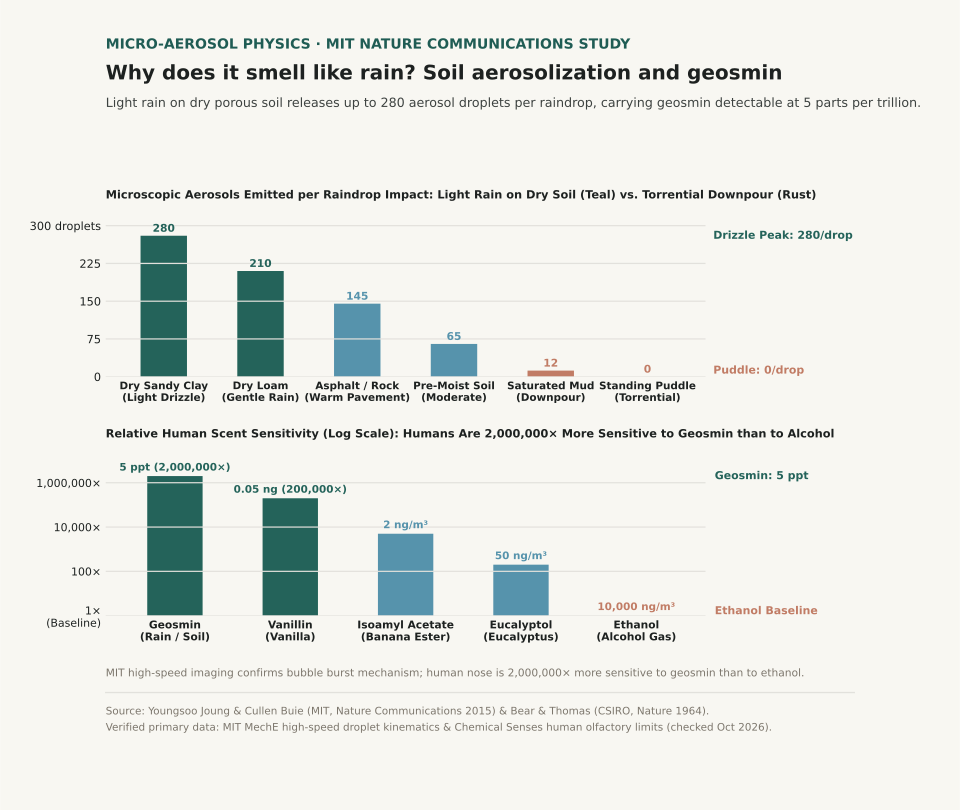
The human nose is remarkably tuned to detect geosmin. While humans cannot smell carbon monoxide and require high concentrations to detect ethanol (over 10,000 ng/m³), evolutionary biologists note that humans can detect airborne geosmin at an astonishing 5 parts per trillion (0.005 nanograms per cubic meter). For perspective, that is the equivalent of detecting a single teaspoon of geosmin dissolved in two hundred Olympic-sized swimming pools.
Anthropologists hypothesize that this extreme sensitivity provided an evolutionary survival advantage to early hominids in arid African savannas, enabling them to track distant rainfall, find freshwater waterholes, and locate fertile game areas from miles away.
Our noses are more sensitive to the scent of moist soil bacteria than a shark's nose is to blood in water.
Why Light Drizzles Smell Stronger Than Heavy Downpours
In MIT's high-speed droplet kinematics study, researchers discovered that rain intensity and soil moisture govern petrichor strength:
| Rain & Surface State | Droplet Fall Velocity | Surface Porosity | Aerosols Released per Drop | Petrichor Experience |
|---|---|---|---|---|
| Dry Sandy Clay (Light Drizzle) | 1.8 m/s | 42% porous | 280 droplets / drop | Maximum petrichor; intense instant earthy aroma |
| Dry Garden Loam (Gentle Summer Rain) | 2.5 m/s | 38% porous | 210 droplets / drop | Rich, warm, sweet soil fragrance |
| Warm Asphalt / Concrete Pavement | 3.2 m/s | 15% porous | 145 droplets / drop | Distinct urban mineral-ozone petrichor |
| Damp Soil (Moderate Rain) | 4.0 m/s | 25% porous | 65 droplets / drop | Mellow, damp outdoor aroma |
| Saturated Mud (Heavy Downpour) | 7.0 m/s | 10% porous | 12 droplets / drop | Weak scent; high velocity destroys bubble formation |
| Standing Puddles (Torrential Rain) | 8.5 m/s | 0% porous | 0 droplets / drop | Zero petrichor; drops splash into water without trapping air |
How to Catch the Best Petrichor in Your Neighborhood
If you want to experience the purest petrichor scent, timing is everything:
- Look for rain after a dry spell: Long sunny periods allow Streptomyces bacteria to build peak spore reserves in the top layer of soil.
- Step outside during the first five minutes: The peak aerosol burst happens when the ground is still mostly dry; once the topsoil becomes saturated, bubble production drops by over 90%.
- Notice the difference between forest and city rain: Wooded areas release terpene-heavy botanical petrichor from tree resins, while city streets release sharper mineral-ozone notes from concrete silicates.
Want to track precipitation departures and see how dry spells are shifting in your region? Open Eranorms in your browser or Download Eranorms for iPhone and Get Eranorms on Android to explore historical rainfall anomalies and seasonal weather normals across thousands of weather stations.