
Why Does Japan Not Observe Daylight Saving Time?
Why Does Japan Not Observe Daylight Saving Time?
Japan observes Japan Standard Time (JST, UTC+9 anchored to the 135°E Akashi meridian) year-round—having repealed its 1948–1951 Allied occupation Daylight Saving law in 1952 after longer evening light increased unpaid overtime and sleep loss.
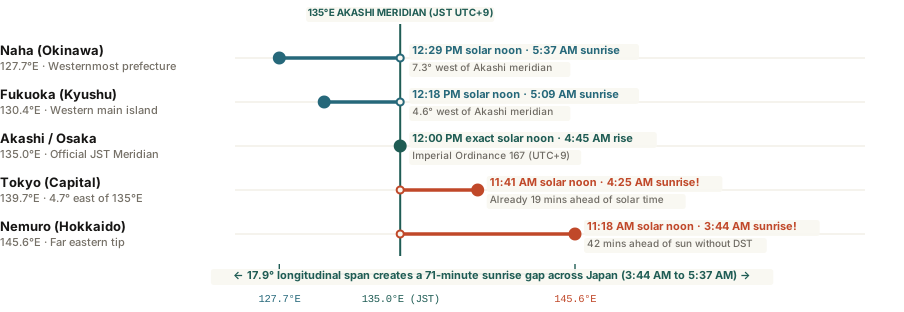
Travelers arriving in Tokyo in June are often stunned when bright morning sunlight streams through their hotel curtains at 4:25 AM—and even earlier in eastern Hokkaido, where the midsummer sun rises at 3:44 AM. Meanwhile, on the longest day of the year, sunset in Tokyo arrives by 7:00 PM. To visitors from North America or Europe, Japan looks like the prime candidate on Earth for Daylight Saving Time.
Yet Japan keeps its national clock locked to Japan Standard Time (JST, UTC+9) 365 days a year. Even more surprisingly, Japan already ran a nationwide four-year experiment with Daylight Saving Time between 1948 and 1951—and disliked the results so intensely that Parliament abolished it the moment the country regained sovereignty in 1952.
The 1948–1951 Occupation Experiment (*Samātaimu*)
Following Imperial Ordinance No. 51 in 1886 (and Ordinance No. 167 in 1895), Japan standardized its national clock on the 135th meridian east passing through Akashi in Hyogo Prefecture (`UTC+9`). After World War II, the Supreme Commander for the Allied Powers (GHQ) pushed the Japanese Diet to pass the Summer Time Act (Law No. 29 of April 1948) to conserve coal and electricity during post-war reconstruction.
From May 1948 through September 1951, Japan advanced its clocks by one hour (`UTC+10`) every summer. Instead of saving energy or boosting leisure, the shift triggered immediate social backlash:
- Unpaid Overtime Expansion: In post-war factories and offices, cultural norms discouraged leaving work while the sun was still up. Pushing sunset an hour later simply lengthened the workday without extra pay.
- Sleep Deprivation in Humid Summers: Without residential air conditioning, advancing the clock forced families to try to sleep an hour earlier during the hottest, most humid part of the evening while farmers had to start morning chores in the dark.
By October 1951, a government public opinion poll showed 53% of Japanese citizens wanted Daylight Saving Time abolished (versus just 30% in favor). In April 1952—just days before the San Francisco Peace Treaty took effect ending the Allied occupation—the Diet repealed the Summer Time Act permanently.
Because Tokyo (139.7°E) already sits nearly 5 degrees east of Japan's 135°E reference meridian, its clock is naturally 19 minutes ahead of solar time year-round.
Why the US–Japan Time Difference Shifts Twice a Year
Ahead of the 2020 Tokyo Olympics, organizers briefly floated a proposal to advance Japanese clocks by two full hours (`UTC+11`) during summer so marathon runners could compete in cooler morning air. Japanese sleep researchers, software engineers, and the public overwhelmingly rejected the idea, preserving year-round `UTC+9`.
Because Japan never touches its clocks while the United States and Europe shift theirs twice a year, cross-Pacific meeting times move by 60 minutes every March and November: New York to Tokyo is 13 hours in summer (`EDT`) and 14 hours in winter (`EST`), while Seattle/Los Angeles to Tokyo is 16 hours in summer (`PDT`) and 17 hours in winter (`PST`). You can Open Tempo in your browser to check live US–Tokyo and Europe–Tokyo overlap windows across every seasonal transition.