
Why Does Lord Howe Island Have a 30-Minute Daylight Saving Shift?
Why Does Lord Howe Island Have a 30-Minute Daylight Saving Shift?
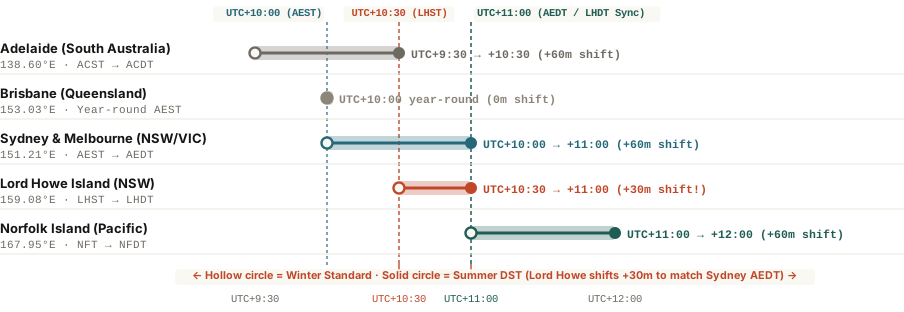
Located 600 km east of mainland Australia at 159.08°E, New South Wales's Lord Howe Island observes UTC+10:30 (LHST) in winter so solar noon aligns with the sun—then advances clocks by just 30 minutes to UTC+11:00 (LHDT) in summer to match Sydney.
Ask almost any software engineer how Daylight Saving Time works and you will hear the same universal rule: in spring, clocks jump forward by 60 minutes (`+3,600 seconds`); in autumn, they fall back by 60 minutes. Across North America, Europe, New Zealand, and mainland Australia, every single DST-observing jurisdiction shifts its clocks by exactly one full hour.
Every jurisdiction, that is, except one tiny crescent of volcanic basalt in the Tasman Sea. On Lord Howe Island—a UNESCO World Heritage island (`159.08°E`) with roughly 400 permanent residents located 600 kilometers (370 miles) east of Port Macquarie, New South Wales—clocks spring forward on the first Sunday in October by exactly 30 minutes, moving from Lord Howe Standard Time (`LHST, UTC+10:30`) to Lord Howe Daylight Time (`LHDT, UTC+11:00`). Understanding why `Australia/Lord_Howe` has the world's only half-hour Daylight Saving shift reveals a clever compromise between solar geography and mainland commerce.
The 159.08°E Solar Dilemma: 36 Minutes Ahead of Sydney
Although Lord Howe Island is politically and administratively part of the state of New South Wales (governed from Sydney), its physical longitude in the Tasman Sea creates a 36-minute solar gap:
- Mainland New South Wales (`150.0°E` Reference Meridian): Sydney (`151.21°E`) sits almost directly on the `150°E` meridian that defines Australian Eastern Standard Time (`AEST, UTC+10:00`).
- Lord Howe Island (`159.08°E` Local Longitude): Because Earth rotates `1°` every 4 minutes, sitting `9.08°` east of `150°E` means sunrise, solar noon, and sunset arrive on Lord Howe Island 36 minutes and 19 seconds earlier than on the `150°E` meridian—and 31.5 minutes earlier than in Sydney.
If Lord Howe Island stayed on mainland `UTC+10:00` during winter, winter sunset in June would fall around 4:42 PM, plunging the island into darkness well before the workday ended. Conversely, when New South Wales introduced summer Daylight Saving Time (`AEDT, UTC+11:00`), if Lord Howe Island had started at `UTC+10:30` and added a full 60 minutes in summer (`UTC+11:30`), island businesses, Qantas flights from Sydney Airport, and NSW government offices would have remained out of sync by 30 minutes all year long.
A 30-minute Daylight Saving shift solves both problems at once: winter clocks follow the island's sun (`UTC+10:30`), while summer clocks lock directly onto Sydney (`UTC+11:00`).
How the 1981 Half-Hour Compromise Works (and Why It Breaks Code)
Codified under New South Wales's Standard Time Act 1987 (continuing the arrangement introduced in 1981), `Australia/Lord_Howe` operates on a seamless two-part cycle:
- Southern Winter (First Sunday in April → First Sunday in October): At `2:00 AM LHDT`, clocks turn back 30 minutes to `1:30 AM LHST` (`UTC+10:30`), matching the island's natural `157.5°E` half-hour solar meridian (`10.5 × 15° = 157.5°E`, within `1.58°` of the island).
- Southern Summer (First Sunday in October → First Sunday in April): At `2:00 AM LHST`, clocks advance 30 minutes to `2:30 AM LHDT` (`UTC+11:00`). Because Sydney advances 60 minutes from `UTC+10:00` to `UTC+11:00` on the exact same morning, Lord Howe Island and Sydney share the exact same clock (`UTC+11:00`) for all six months of the peak summer tourism season.
- The Software Engineering Lesson: In the IANA Time Zone Database (`tzdb`), `Australia/Lord_Howe` is the canonical test case for catching hardcoded `if (is_dst) offset += 3600;` bugs. Always compute UTC offset transitions by querying the zone's exact `tzdb` transition rules (`+1,800 seconds` for Lord Howe Island) rather than assuming `DST == 1 hour`.
When testing international scheduling apps or coordinating flights between Sydney, Brisbane, Adelaide, and the Tasman Sea, you can Open Tempo in your browser to inspect live `Australia/Lord_Howe` transitions alongside any global time zone.