
Why Does Lord Howe Island Shift Its Clocks by Only 30 Minutes for Daylight Saving Time?
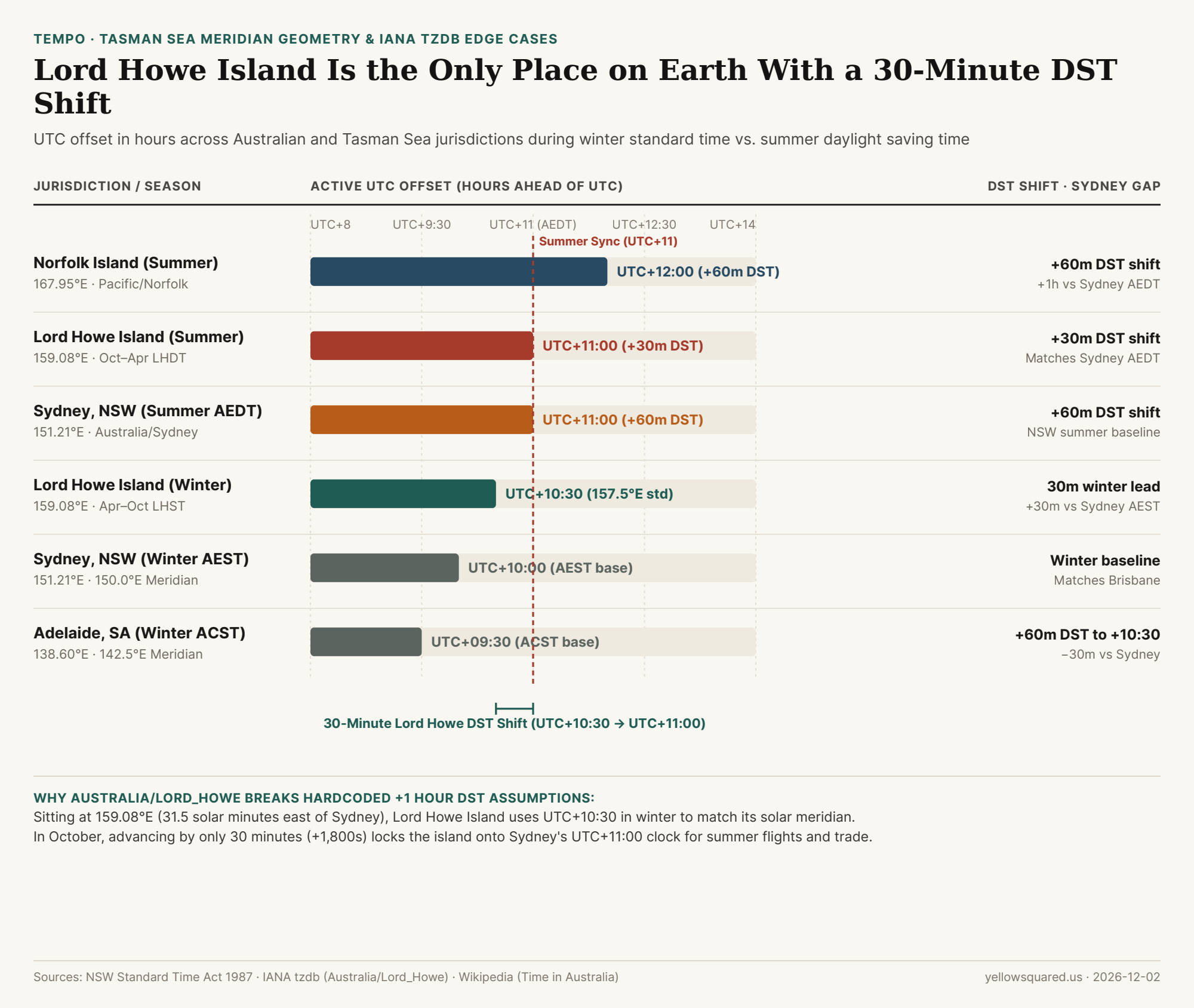
Every software engineer who has ever written offset + (is_dst ? 3600 : 0) eventually runs into the single active exception in the IANA Time Zone Database: Australia/Lord_Howe. Located in the Tasman Sea roughly 600 kilometers (370 miles) east of Port Macquarie, New South Wales, Lord Howe Island (population 382) observes Lord Howe Standard Time (LHST, UTC+10:30) during the Southern Hemisphere winter, but shifts its clocks forward by only 30 minutes on the first Sunday in October to Lord Howe Daylight Time (LHDT, UTC+11:00) (Lord Howe Island - Wikipedia; Daylight saving time by country - Wikipedia).
That half-hour transition is not an accident. It reconciles Lord Howe Island's physical longitude in the Tasman Sea with its constitutional status as an unincorporated part of the state of New South Wales. When you compare trans-Pacific flight schedules or Australian state offsets in Open Tempo in your browser, you can see how Lord Howe Island sits 30 minutes ahead of Sydney all winter before locking onto exact Sydney time (UTC+11:00) for the entire six-month summer.
The 159.08°E Solar Math Behind UTC+10:30
Earth rotates 15° of longitude per hour (4 minutes of solar time per degree), meaning a 30-minute time zone offset corresponds to a 7.5° step between whole-hour meridians:
- Sydney, New South Wales (151.21°E): Anchored to the
150.0°Emeridian for Australian Eastern Standard Time (AEST, UTC+10:00), Sydney sits just1.21°east of its reference meridian, so mean solar noon occurs about4.8 minutesbefore 12:00 PM (Time in Australia - Wikipedia). - Lord Howe Island (159.08°E): Positioned
7.87°east of Sydney in the Tasman Sea, sunrise and solar noon arrive 31.5 minutes earlier on Lord Howe Island than in Sydney Harbour. - The 157.5°E Half-Hour Meridian (UTC+10:30): Because
159.08°Esits just1.58°east of the 157.5°E meridian (10.5 × 15°), setting the island's winter standard clock toUTC+10:30aligns local wall clocks to within6.3 minutesof true solar noon (Lord Howe Island - Wikipedia).
"At 159.08°E, Lord Howe Island is physically 31.5 solar minutes ahead of Sydney—so a 30-minute winter offset (UTC+10:30) matches the Sun, while a 30-minute summer jump (UTC+11:00) matches Sydney's business day."
How the 1981–1987 New South Wales Legislation Created the 30-Minute Shift
When New South Wales introduced peacetime Daylight Saving Time under the Standard Time Act 1971, Lord Howe Island initially used a standard 60-minute summer shift. Following the passage of the Lord Howe Island Act 1981 and a 1985 Governor's order later codified in the New South Wales Standard Time Act 1987, the state established the modern half-hour rule (Time in Australia - Wikipedia):
- Winter Standard Time (First Sunday in April to First Sunday in October): While Sydney, Melbourne, Canberra, and Hobart observe
AEST (UTC+10:00), Lord Howe Island observesLHST (UTC+10:30)—preserving an extra half hour of afternoon daylight on the island during winter. - Spring Forward (+30 Minutes on First Sunday in October at 02:00 LHST): When Sydney advances 60 minutes from
02:00 AEST (UTC+10:00)to03:00 AEDT (UTC+11:00), Lord Howe Island advances 30 minutes from02:00 LHST (UTC+10:30)to02:30 LHDT (UTC+11:00)(Daylight saving time by country - Wikipedia). - Autumn Fall Back (−30 Minutes on First Sunday in April at 02:00 LHDT): At the end of summer, Lord Howe Island turns its clocks back 30 minutes from
02:00 LHDT (UTC+11:00)to01:30 LHST (UTC+10:30).
| Australian Jurisdiction | IANA Zone ID | Winter Standard | Summer DST | DST Clock Shift | Gap vs. Sydney (Win / Sum) |
|---|---|---|---|---|---|
| 1. Lord Howe Island (Winter) | Australia/Lord_Howe |
UTC+10:30 (LHST) |
UTC+11:00 (LHDT) |
+30 min (+1,800 s) | +30 min ahead of Sydney |
| 2. Lord Howe Island (Summer) | Australia/Lord_Howe |
UTC+10:30 (LHST) |
UTC+11:00 (LHDT) |
+30 min (+1,800 s) | 0 min (Same as Sydney) |
| 3. Sydney & Melbourne | Australia/Sydney |
UTC+10:00 (AEST) |
UTC+11:00 (AEDT) |
+60 min (+3,600 s) |
0 min baseline |
| 4. Adelaide & Broken Hill | Australia/Adelaide |
UTC+09:30 (ACST) |
UTC+10:30 (ACDT) |
+60 min (+3,600 s) |
−30 min behind all year |
| 5. Brisbane, Queensland | Australia/Brisbane |
UTC+10:00 (AEST) |
UTC+10:00 (No DST) |
0 min (0 s) |
0 min win / −60 min sum |
| 6. Norfolk Island | Pacific/Norfolk |
UTC+11:00 (NFST) |
UTC+12:00 (NFDT) |
+60 min (+3,600 s) |
+60 min ahead all year |
Why Developers Use Australia/Lord_Howe as a Unit-Test Benchmark
In software engineering, Australia/Lord_Howe is the gold-standard unit test for calendar and scheduling libraries: any code that assumes a boolean isDST flag always adds 60 minutes will miscalculate Lord Howe timestamps by 30 minutes every summer, and any code that assumes a 24-hour day is always 23 hours or 25 hours on DST transition Sundays will fail on Lord Howe's 23.5-hour October Sunday and 24.5-hour April Sunday. Notice also how in October, as South Australia (Australia/Adelaide) jumps from UTC+09:30 to UTC+10:30, it steps into the exact UTC+10:30 offset that Lord Howe Island just vacated (Time in Australia - Wikipedia). To inspect live Australian and Pacific time zone overlaps without manual offset math, Open Tempo in your browser.