
Why Does Mongolia Have Two Time Zones (UTC+07:00 and UTC+08:00), and Why Did It Abolish Daylight Saving Time in 2017?
Stretching 2,392 kilometers from the snow-capped Altai peaks on the Kazakh-Russian border (87°45'E) to the eastern steppes of Dornod (119°56'E), Mongolia spans more than 32 degrees of longitude. Today, the country divides its 21 provinces (aimags) across two permanent time zones: Hovd Time (HOVT, UTC+07:00) in the three far-western provinces of Bayan-Ölgii, Uvs, and Khovd, and Ulaanbaatar Time (ULAT, UTC+08:00) across the remaining 18 provinces—including the capital Ulaanbaatar and eastern Choibalsan. Yet as documented in Mongolian civil timekeeping records and geographical analyses of the UTC+07:00 meridian band, Mongolia's entire time-zone map is shifted exactly one hour east of its physical sun—the core reason its 2015–2016 return to Daylight Saving Time collapsed in February 2017.
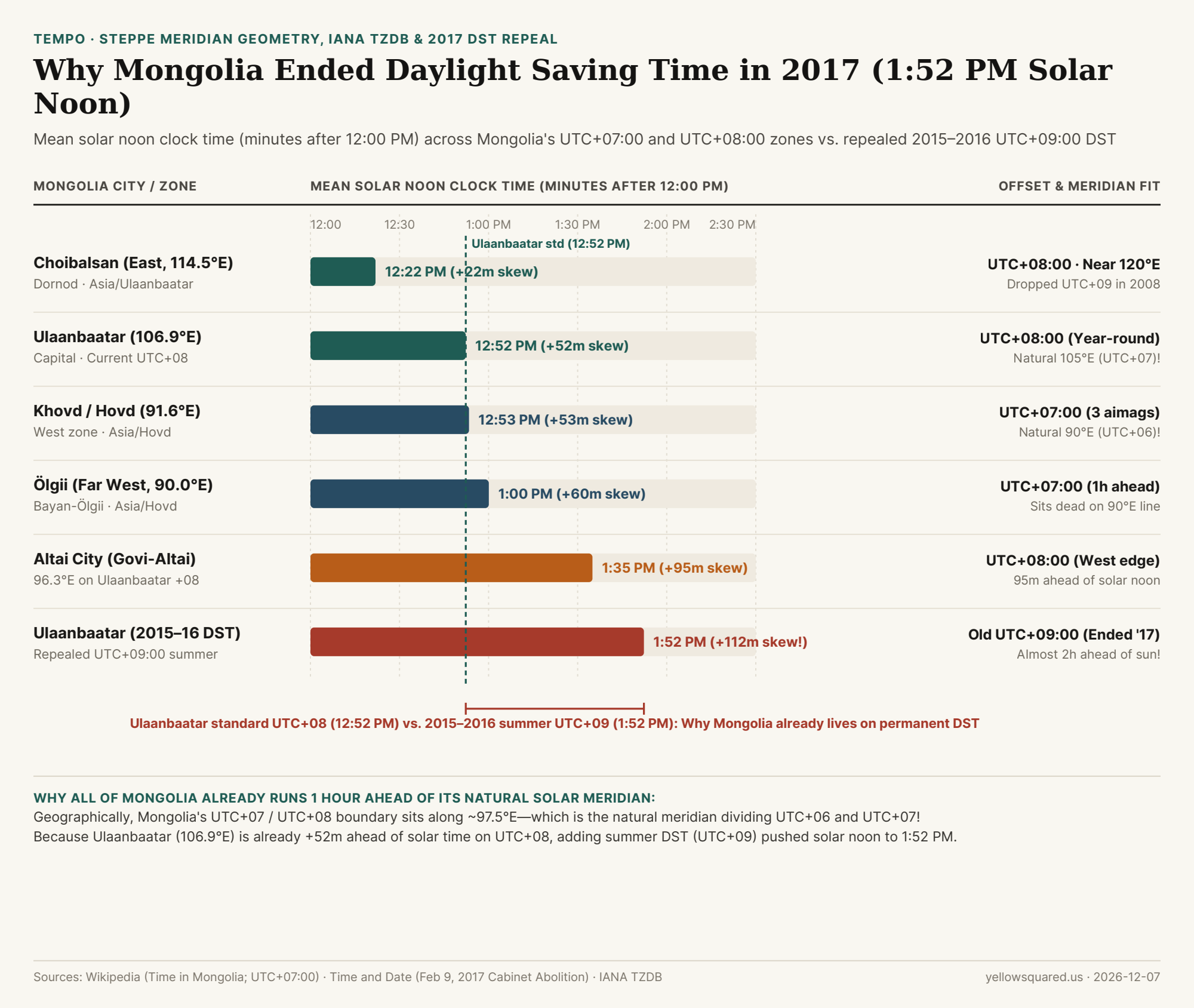
UTC+07:00 and UTC+08:00 zones compared against the repealed 2015–2016 UTC+09:00 Daylight Saving Time regime. Data: Time in Mongolia (Wikipedia) and UTC+07:00 Meridian Survey (download CSV).The 97.5°E Meridian Anomaly: Why All of Mongolia Lives on De Facto Permanent DST
In standard spherical astronomy, every 1-hour time zone is 15° wide: the UTC+06:00 zone is centered on 90°E (82.5°E to 97.5°E), the UTC+07:00 zone is centered on 105°E (97.5°E to 112.5°E), and the UTC+08:00 zone is centered on 120°E (112.5°E to 127.5°E). Compare those physical meridians against Mongolia's official zone boundary:
- The
97.5°EBoundary Shift: Mongolia draws the border between its westernUTC+07:00zone (Asia/Hovd) and its central/easternUTC+08:00zone (Asia/Ulaanbaatar) almost dead along the97.5°Emeridian—which is actually the geometric dividing line betweenUTC+06:00andUTC+07:00! - Ulaanbaatar (
106°55'E=106.92°E): Located less than two degrees east of the105°Emeridian, Mongolia's capital belongs geographically inUTC+07:00(where mean solar noon would fall at11:52 AM). Because Ulaanbaatar observesUTC+08:00(matching Beijing, Hong Kong, and Singapore), its mean solar noon sits 52.3 minutes late at12:52 PMyear-round. - Khovd (
91.64°E) and Ölgii (89.97°E): In the far-western Altai aimags, Ölgii sits at89°58'E—within two arcminutes of the exact90°00'Ecenter ofUTC+06:00. By observingUTC+07:00, Ölgii and Khovd also run 53 to 60 minutes ahead of solar noon (12:53 PMand1:00 PM). - What Happened to Mongolia's Third Time Zone (
Asia/Choibalsan)? Until March 2008, eastern Dornod and Sükhbaatar provinces observed a third Mongolian time zone atUTC+09:00. Because Choibalsan (114.53°E) actually sits inside the natural120°E(UTC+08:00) band, shifting Choibalsan back toUTC+08:00in 2008 gave eastern Mongolia the truest solar clock in the country (mean solar noon at12:22 PM).
"Because Mongolia's internal time-zone border along 97.5°E is shifted one full zone east of its physical meridians, both Khovd (UTC+07:00) and Ulaanbaatar (UTC+08:00) already operate on permanent year-round Daylight Saving Time."
Why Mongolia Tried—and Repealed—Summer Daylight Saving Time Three Separate Times (1998, 2006, and 2017)
Because Ulaanbaatar (UTC+08:00) already sits 52 minutes ahead of its natural solar clock (and western cities in the Ulaanbaatar zone like Altai City at 96.26°E sit 95 minutes ahead, with winter solar noon at 1:35 PM), layering an additional hour of summer Daylight Saving Time (ULAST, UTC+09:00 in Ulaanbaatar and HOVST, UTC+08:00 in Khovd) created an extreme "double summer time" skew:
- Three On-Again, Off-Again Trials: Mongolia introduced Soviet-style DST from 1983 to 1998 (repealed in 1999), reinstated it from 2001 to 2006 (repealed in February 2007), and briefly revived it a third time in March 2015 and March 2016.
- The 1:52 PM Solar Noon and February 9, 2017 Repeal: During the summers of 2015 and 2016 on
UTC+09:00, mean solar noon in Ulaanbaatar was pushed to1:52 PM(and to2:35 PMin Altai City), keeping the sun above the horizon past9:50 PMin June while forcing residents to wake two hours before solar dawn in spring and autumn. On February 9, 2017, the Mongolian Cabinet permanently abolished Daylight Saving Time, locking the country onto year-roundUTC+07:00(west) andUTC+08:00(center/east).
| Mongolia City / Regime | IANA TZDB Zone | Longitude | Official Offset | Natural Solar Zone | Mean Solar Noon | Solar Skew & Policy Status |
|---|---|---|---|---|---|---|
| Choibalsan (East) | Asia/Ulaanbaatar |
114.53°E |
UTC+08:00 |
UTC+08:00 (120°E) |
12:22 PM | +21.9 min · Merged into +08 in 2008 |
| Ulaanbaatar (Capital) | Asia/Ulaanbaatar |
106.92°E |
UTC+08:00 |
UTC+07:00 (105°E) |
12:52 PM | +52.3 min · Year-round since Feb 2017 |
| Khovd / Hovd (West) | Asia/Hovd |
91.64°E |
UTC+07:00 |
UTC+06:00 (90°E) |
12:53 PM | +53.4 min · 1 hr behind Ulaanbaatar |
| Ölgii (Far West) | Asia/Hovd |
89.97°E |
UTC+07:00 |
UTC+06:00 (90°E) |
1:00 PM | +60.1 min · Dead on 90°E meridian |
| Altai City (Govi-Altai) | Asia/Ulaanbaatar |
96.26°E |
UTC+08:00 |
UTC+06:00 (90°E) |
1:35 PM | +95.0 min · West edge of ULAT zone |
| Ulaanbaatar (2015–16 DST) | Repealed (ULAST) | 106.92°E |
UTC+09:00 |
UTC+07:00 (105°E) |
1:52 PM | +112.3 min · Abolished Feb 9, 2017 |
How to Coordinate Schedules Between Ulaanbaatar, Western Mongolia, and Global Hubs
Because Ulaanbaatar stays on permanent UTC+08:00 without DST, it matches the clock of Beijing, Taipei, Singapore, and Perth 365 days a year, while western Mongolia (Asia/Hovd on UTC+07:00) matches Bangkok, Hanoi, Jakarta, and Krasnoyarsk. Open Tempo in your browser to compare live working hours between Ulaanbaatar, Khovd, Europe, and North America.