
Why Does Morocco Pause Its UTC+01:00 Time Zone Every Year for Ramadan?
Most countries that observe Daylight Saving Time change their clocks on fixed solar-calendar rules—such as the second Sunday in March in North America or the last Sunday in March across the European Union. Morocco (Africa/Casablanca in the IANA time zone database) is the only country on Earth whose civil clock transitions are tied to the Islamic Hijri lunar calendar.
As documented in historical records of Time in Morocco and Time and Date's coverage of Morocco's Ramadan clock shifts, Moroccan law sets the national time zone to UTC+01:00 (matching Central European Time in Madrid and Paris), yet pauses that offset every single year for the holy month of Ramadan—turning clocks back one hour to UTC+00:00 (GMT) on the Sunday before Ramadan begins and springing back to UTC+01:00 on the Sunday after Eid al-Fitr. When coordinating flights, logistics, or remote team calls with Casablanca or Rabat, you can Open Tempo in your browser to check Morocco's live offset automatically.
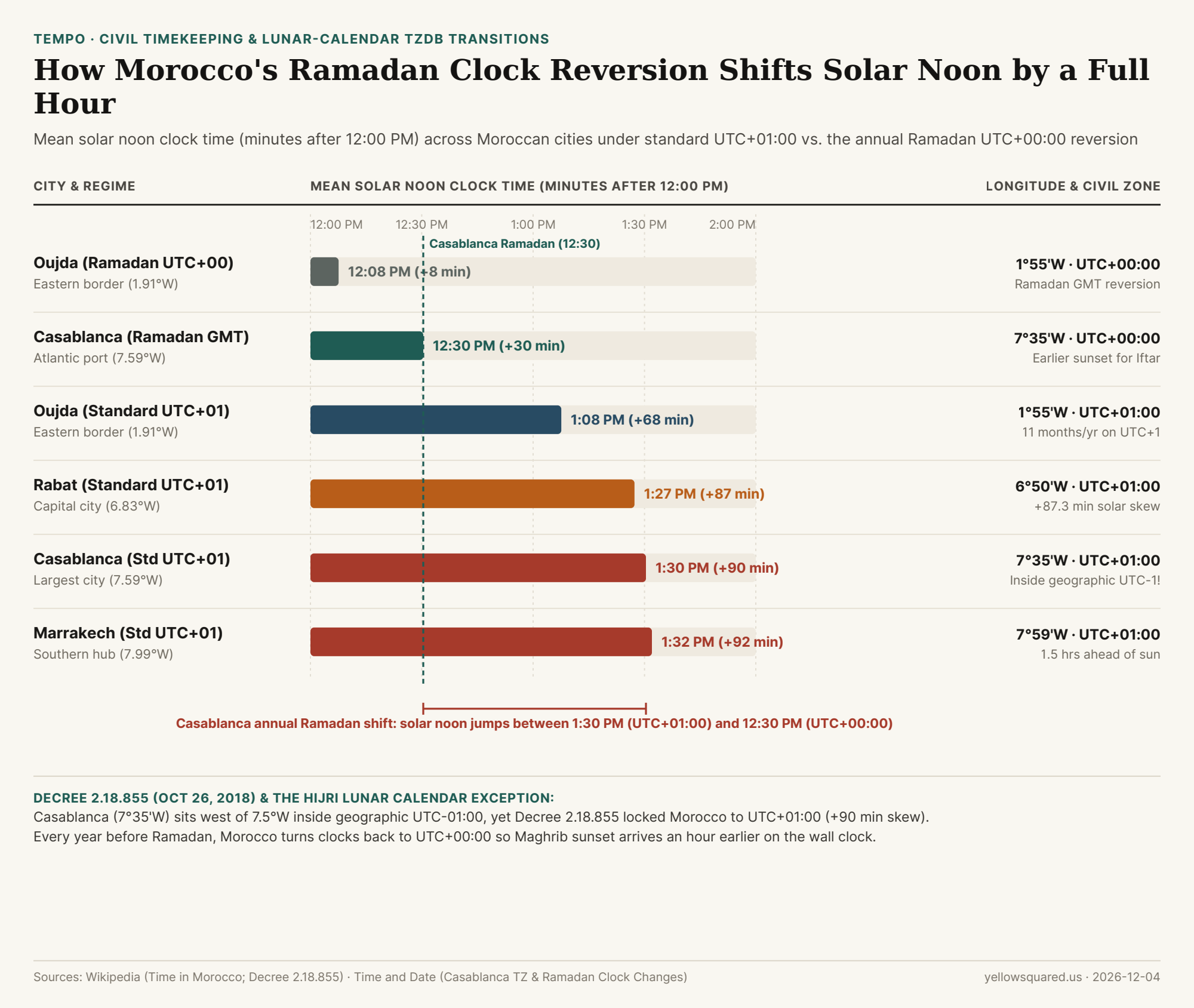
Why Casablanca (7°35'W) Sits 90 Minutes Ahead of the Sun on UTC+01:00
To appreciate why Morocco's clock law is so unusual, look at where the country sits relative to the Greenwich Prime Meridian (0° longitude). Morocco's eastern border near Oujda sits at 1°55'W (1.91°W), the capital Rabat sits at 6°50'W (6.83°W), Casablanca sits at 7°35'W (7.59°W), and Marrakech sits at 7°59'W (7.99°W).
Because each 1-hour solar time zone spans 15° of longitude (7.5° on either side of its central meridian), the boundary between geographic UTC+00:00 (centered on 0°) and geographic UTC-01:00 (centered on 15°W) lies at exactly 7°30'W (7.50°W). That means Casablanca (7.59°W), Marrakech (7.99°W), and Agadir (9.60°W) actually lie inside geographic UTC-01:00! When the Moroccan government issued Decree No. 2.18.855 on October 26, 2018—locking the country to UTC+01:00 (15°E meridian) just 48 hours before clocks were scheduled to fall back—it placed Casablanca 22.59 degrees west of its legal clock meridian (22.59° × 4 min/deg = 90.4 minutes), pushing mean solar noon to 1:30 PM in Casablanca and 1:32 PM in Marrakech.
"Between 2012 and 2018, when Ramadan fell during the northern summer, Morocco actually changed its clocks four times in a single year: springing forward to UTC+01:00 in spring, falling back to UTC+00:00 for Ramadan, springing forward again after Eid al-Fitr, and falling back in autumn."
Why the Ramadan Exception Exists (and Why It Shifts 11 Days Earlier Every Year)
During the month of Ramadan, observant Muslims fast (Sawm) from dawn (Fajr) until sunset (Maghrib). Under UTC+01:00, the 90-minute artificial daylight saving skew pushes sunset in Casablanca and Marrakech an hour later on the wall clock—meaning families, students, and workers on standard 8:00 AM–5:00 PM schedules would have to wait an extra clock hour in the evening before breaking their fast at Iftar while commuting to work or school in darker morning hours.
By reverting national clocks back one hour from UTC+01:00 to UTC+00:00 (Greenwich Mean Time) for the duration of Ramadan, mean solar noon in Casablanca returns to a natural 12:30 PM and sunset arrives an hour earlier on the clock. As shown in Time and Date's Casablanca transition history, because the 12-month Islamic lunar calendar is 354 or 355 days long, the start and end dates of Morocco's annual UTC+00:00 month drift roughly 10 to 11 days earlier on the Gregorian calendar every single year.
| Moroccan City & Regime | Longitude | Natural Solar Zone | Observed Civil Zone | Mean Solar Noon | Solar-Clock Skew |
|---|---|---|---|---|---|
| Oujda (Ramadan Reversion) | 1°55'W (1.91°W) |
UTC+00:00 (0°W) |
UTC+00:00 (GMT) |
12:08 PM |
+7.6 min |
| Casablanca (Ramadan Reversion) | 7°35'W (7.59°W) |
UTC-01:00 (>7.5°W) |
UTC+00:00 (GMT) |
12:30 PM |
+30.4 min |
| Oujda (Standard 11-Month) | 1°55'W (1.91°W) |
UTC+00:00 (0°W) |
UTC+01:00 (Decree 2018) |
1:08 PM |
+67.6 min |
| Rabat (Standard 11-Month) | 6°50'W (6.83°W) |
UTC+00:00 (0°W) |
UTC+01:00 (Decree 2018) |
1:27 PM |
+87.3 min |
| Casablanca (Standard 11-Month) | 7°35'W (7.59°W) |
UTC-01:00 (>7.5°W) |
UTC+01:00 (Decree 2018) |
1:30 PM |
+90.4 min |
| Marrakech (Standard 11-Month) | 7°59'W (7.99°W) |
UTC-01:00 (>7.5°W) |
UTC+01:00 (Decree 2018) |
1:32 PM |
+92.0 min |
Why Developers Should Never Hard-Code UTC Offsets for North Africa
Morocco's annual lunar-calendar shift—alongside its recent 2026 legislative reviews of permanent UTC+00:00 standard time—illustrates why software engineers and travel planners should never store fixed numeric offsets like UTC+1 in databases. Always reference the canonical IANA zone identifier Africa/Casablanca, and Open Tempo in your browser whenever you need to verify current local time and overlapping work hours across Casablanca, Paris, London, and New York.