
Why Does Nepal Have a 45-Minute Time Zone?
Why Does Nepal Have a 45-Minute Time Zone?
Nepal observes UTC+5:45 because the nation anchored its clock in 1986 to the 86.27°E meridian at Mount Gauri Sankar—asserting geographic sovereignty from India's UTC+5:30.
When travelers cross the terrestrial border from Gorakhpur, India, into Bhairahawa, Nepal, they encounter one of the rarest clock adjustments on Earth: advancing their watches by exactly 15 minutes. While 95% of international time zones increment in neat one-hour steps—and nations like India and Iran observe 30-minute fractional offsets—Nepal stands among only three jurisdictions worldwide operating on a 45-minute standard.
To global remote teams and airline dispatchers, a 45-minute offset often looks like a software glitch or an eccentric bureaucratic relic. However, Nepal Standard Time (NPT, UTC+5:45) is a deliberate astronomical and geopolitical compromise. Anchored in 1986 to the summit meridian of Mount Gauri Sankar, Nepal's standard clock reflects true local solar time across the Himalayas while preserving national identity alongside its colossal southern neighbor.
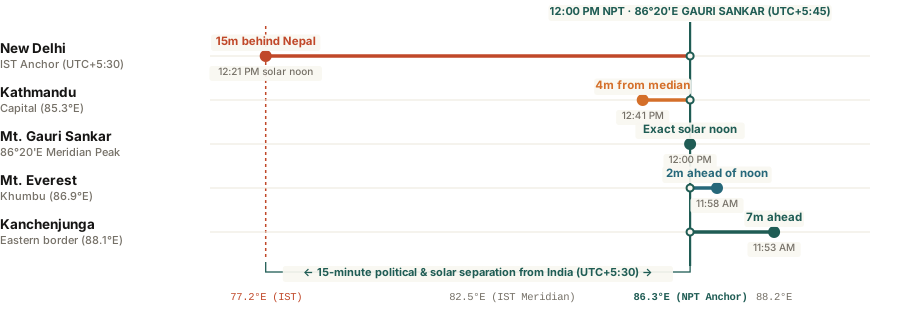
From Colonial Clocks to the Gauri Sankar Meridian
Before the 20th century, towns across the Kathmandu Valley operated on local solar mean time. Because Kathmandu lies at 85°19' East longitude, true solar noon arrived approximately 5 hours, 41 minutes, and 16 seconds ahead of Greenwich mean time. In 1920, to streamline telegraph communication and railway schedules with British India, Nepal adopted Indian Standard Time (IST, UTC+5:30).
Operating on India's clock solved regional border coordination, but it created an astronomical distortion. India's standard meridian sits at 82.5° East near Mirzapur. Because Nepal stretches between 80°E and 88°E longitude, relying on Mirzapur meant that solar noon across central Nepal arrived nearly 15 minutes before the clocks struck 12:00 PM.
Standard time is never a purely mathematical convenience; it is a declaration of geographic reference and administrative independence.
On January 1, 1986, His Majesty's Government of Nepal officially altered the nation's clocks by 15 minutes, shifting from UTC+5:30 to UTC+5:45. Rather than choosing Mount Everest (Sagarmatha) on the far eastern border at 86.92°E, royal astronomers selected the sacred peak of Mount Gauri Sankar (7,134 meters), located in the Dolakha District at 86°20' East longitude. Multiplying 86.33 degrees by 4 minutes per degree yields approximately 345 minutes—or exactly 5 hours and 45 minutes ahead of Coordinated Universal Time.
How Nepal's 15-Minute Mismatch Affects Global Coordination
Because Nepal does not observe Daylight Saving Time, its offset remains UTC+5:45 year-round. Coordinating international schedules with Kathmandu requires watching out for subtle calendar traps:
- Calendar Grid Pitfalls: Most corporate calendar tools default to 30-minute meeting slots. When scheduling a call with a Kathmandu colleague, a meeting set for 2:00 PM IST begins at 2:15 PM NPT, often causing participants to join a quarter-hour late.
- Aviation Connection Windows: Flights connecting through New Delhi (DEL) to Kathmandu (KTM) span only 1 hour and 35 minutes in the air, but the arrival clock reflects a 15-minute forward jump that can confuse tight layover calculations.
- Digital Clock Synchronization: The global IANA Time Zone Database tracks Nepal under the unique key
Asia/Kathmandu. Operating systems and network time protocol (NTP) servers resolve this offset seamlessly, but legacy custom code hardcoded to integer hours frequently miscalculates Nepali timestamps.
To avoid scheduling errors and visualize shared workday windows across Kathmandu, New Delhi, London, and New York, you can Open Tempo in your browser to align interactive time dials without 15-minute calendar errors.