
Why Is Nepal Time 15 Minutes Ahead of India? The Story of UTC+5:45
Why Is Nepal Time 15 Minutes Ahead of India? The Story of UTC+5:45
After using Indian Standard Time (UTC+5:30) from 1920 to 1985, Nepal advanced its national clock by 15 minutes in 1986 to UTC+5:45—anchoring Nepal Standard Time (NPT) on the 86°15'E meridian through sacred Mount Gaurishankar.
Cross the land border from Raxaul, India, into Birgunj, Nepal—or take a 90-minute flight from New Delhi to Kathmandu—and your smartphone performs one of the rarest clock adjustments on the planet: it jumps forward by 15 minutes. While India observes `UTC+05:30` and neighboring Bhutan and Bangladesh observe `UTC+06:00`, the Federal Democratic Republic of Nepal sits squarely in between on Nepal Standard Time (`NPT, UTC+05:45`).
Out of nearly 200 sovereign nations on Earth, Nepal is the only entire country that uses a 45-minute offset from Coordinated Universal Time (shared only with two remote sub-national islands/regions: New Zealand's Chatham Islands at `UTC+12:45` and Western Australia's unofficial Eucla highway zone at `UTC+08:45`). Tracing why Nepal stepped 15 minutes ahead of India in 1986 reveals a blend of Himalayan sacred geography and solar precision.
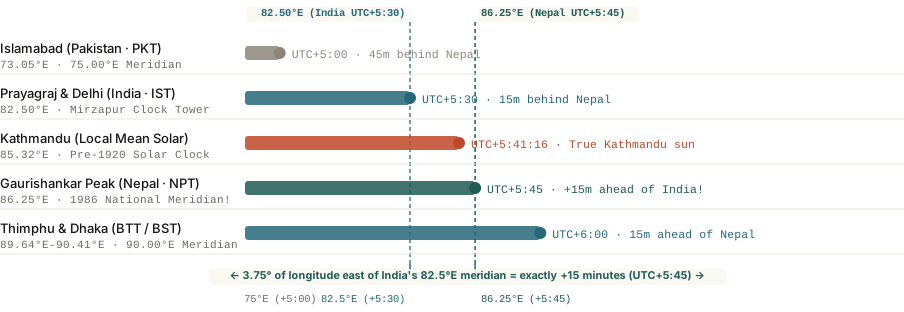
From Kathmandu Solar Time (+5:41:16) to the 1986 Gaurishankar Shift
Nepal's timekeeping history divides into three distinct eras:
- Pre-1920 Local Mean Solar Time (`UTC+05:41:16`): Prior to 1920, Kathmandu (`85.32°E` longitude) set its clocks directly by the sun (`85.32° × 4 minutes/degree = 341 minutes and 16 seconds`, or `5 hours, 41 minutes, 16 seconds` ahead of Greenwich).
- 1920–1985 Indian Standard Time (`UTC+05:30`): To simplify telegraph and railway coordination with British (and later independent) India, Nepal adopted `UTC+05:30` in 1920—anchored on the `82°30'E` (`82.50°E`) observatory meridian near Prayagraj (Allahabad), India.
- 1986 Adoption of `UTC+05:45` (`86°15'E` Gaurishankar Meridian): Because Kathmandu (`85.32°E`) and eastern Nepal (including Mount Everest at `86.92°E`) sit significantly east of `82.50°E`, Indian Standard Time made solar noon and sunset arrive 11 to 18 minutes early across Nepal. In 1986, King Birendra's government established a distinct national meridian at `86°15'E` (`86.25°E`)—which passes directly through the summit of Mount Gaurishankar (`7,134 meters / 23,406 ft`), a sacred twin-peaked Himalayan mountain located 100 kilometers east of Kathmandu.
At 86.25°E (86°15'E), the sun crosses the summit of Mount Gaurishankar exactly 5 hours and 45 minutes ahead of Greenwich.
How South Asia Steps in 15-Minute Increments
Because Earth rotates `1°` every 4 minutes, every **`3.75°` (`3°45'`) of longitude** equals exactly **15 minutes of solar time**. Look at how the meridians of South Asia step eastward from Pakistan to Bangladesh:
- Pakistan (`75.00°E` = `UTC+05:00`): Base 5-hour meridian (`75.0° ÷ 15° = 5.0h`).
- India & Sri Lanka (`82.50°E` = `UTC+05:30`): `+7.50°` east of `75°E` adds `30 minutes`.
- Nepal (`86.25°E` = `UTC+05:45`): `+3.75°` east of India's `82.50°E` adds `15 minutes`—putting Kathmandu (`+5:41:16` true solar time) within **3 minutes and 44 seconds** of astronomical noon!
- Bhutan & Bangladesh (`90.00°E` = `UTC+06:00`): Another `+3.75°` east of `86.25°E` adds `15 minutes` to reach the clean 6-hour meridian.
When coordinating trekking flights, cross-border logistics, or engineering standups across New Delhi, Kathmandu, Dhaka, and Seattle, you can Open Tempo in your browser to compare quarter-hour and half-hour UTC offsets at a glance.