
Why Does Nepal Use a 45-Minute Time Zone? How Kathmandu's UTC+5:45 Offset Separates It From India
Check a world clock across South Asia and you will spot one of the rarest timekeeping offsets on the planet: when it is 12:00 PM in New Delhi and Mumbai (UTC+5:30) and 12:30 PM in Dhaka and Thimphu (UTC+6:00), clocks in Kathmandu, Nepal read 12:15 PM (UTC+5:45). As documented in Wikipedia's Nepal Standard Time Statutory History and Time and Date's Gauri Sankar / Nepal Time Directory, Nepal is the only sovereign country on Earth whose entire national clock is set to a 45-minute UTC offset (joined globally only by New Zealand's Chatham Islands at UTC+12:45 and Australia's unofficial Eucla border strip at UTC+8:45).
Why did Nepal break away from Indian Standard Time in 1986 to create a 15-minute gap with its southern neighbor? The decision combined exact Himalayan solar astronomy — anchoring Nepal's clock to the 86°15'E (86.25°E) meridian passing through sacred Mount Gaurishankar (86.33°E) — with geopolitical identity. To compare live 15-minute and 45-minute clock offsets across Kathmandu, New Delhi, Dhaka, and London right now, Open Tempo in your browser.
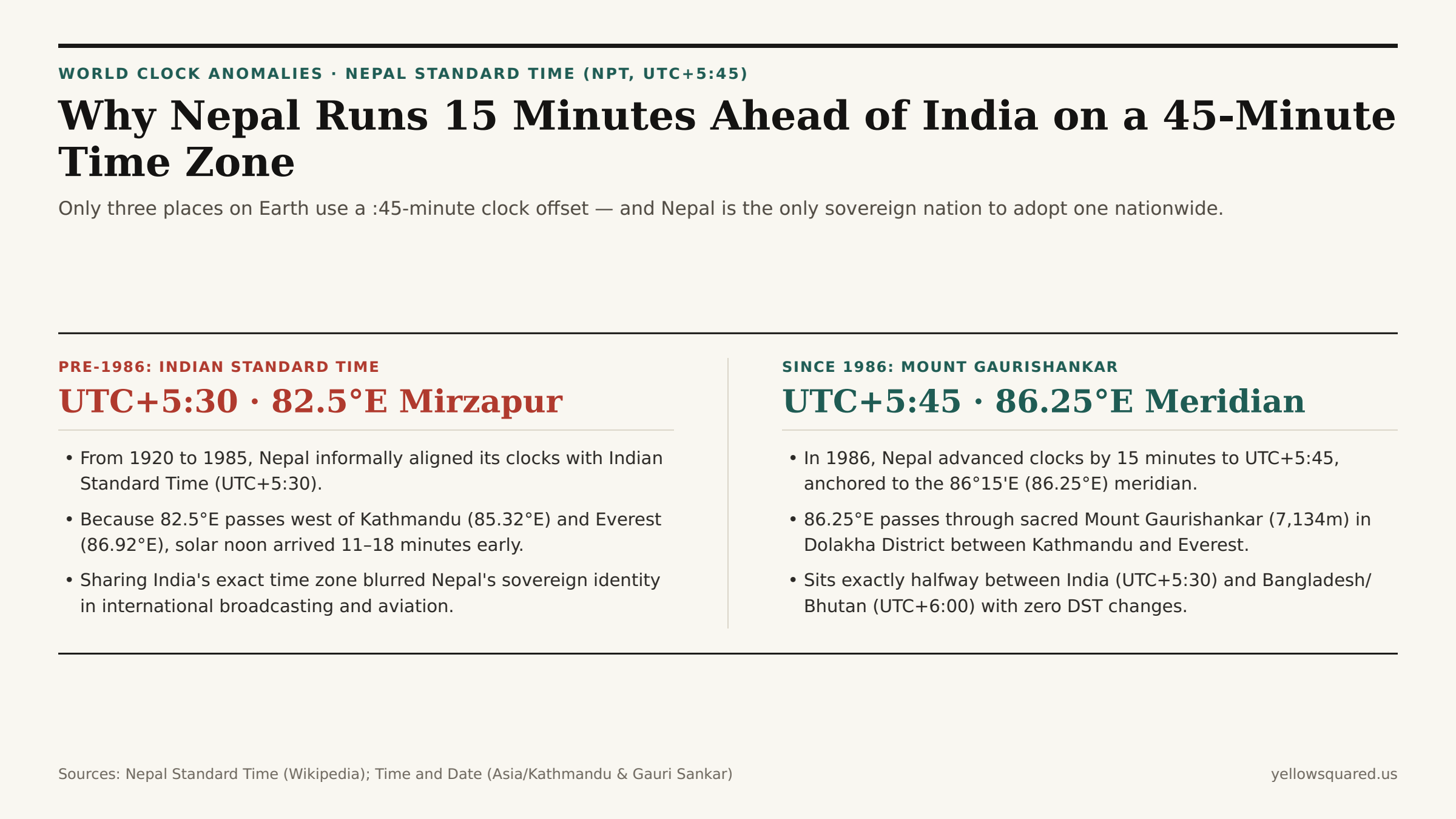
UTC+5:30) to UTC+5:45, aligning national time with the 86°15'E meridian through Mount Gaurishankar in Dolakha District.1. The 86°15'E Solar Math: How Mount Gaurishankar Defines UTC+5:45
Because Earth rotates 360 degrees every 24 hours (15° of longitude per hour, or 1° every 4 minutes), every quarter-hour of time corresponds to exactly 3.75 degrees (3°45') of longitude:
- Pakistan Standard Time (
UTC+5:00): 5.0 × 15° = 75.0°E. - Indian Standard Time (
UTC+5:30): 5.5 × 15° = 82.5°E (passing through Mirzapur, Uttar Pradesh). - Nepal Standard Time (
UTC+5:45): 5.75 × 15° = 86.25°E (86°15'E). - Bangladesh & Bhutan Time (
UTC+6:00): 6.0 × 15° = 90.0°E.
From 1920 until 1985, Nepal used Indian Standard Time (UTC+5:30). Yet because India's 82.5°E meridian sits west of central and eastern Nepal, Kathmandu (85.32°E) experienced solar noon 11 minutes early on UTC+5:30, and eastern Nepal — including Mount Everest (86.92°E) and Kanchenjunga (88.15°E) — sat up to 23 minutes ahead of the clock. When King Birendra's government enacted Nepal Standard Time (NPT, UTC+5:45) on January 1, 1986, surveyors selected the 86°15'E (86.25°E) meridian passing directly over Mount Gaurishankar (7,134 m / 23,406 ft, located at 86.33°E) — a revered twin-summit Himalayan peak sacred to both Hindus (Shiva and Parvati) and Buddhists, standing 100 kilometers east of Kathmandu in Gaurishankar Rural Municipality.
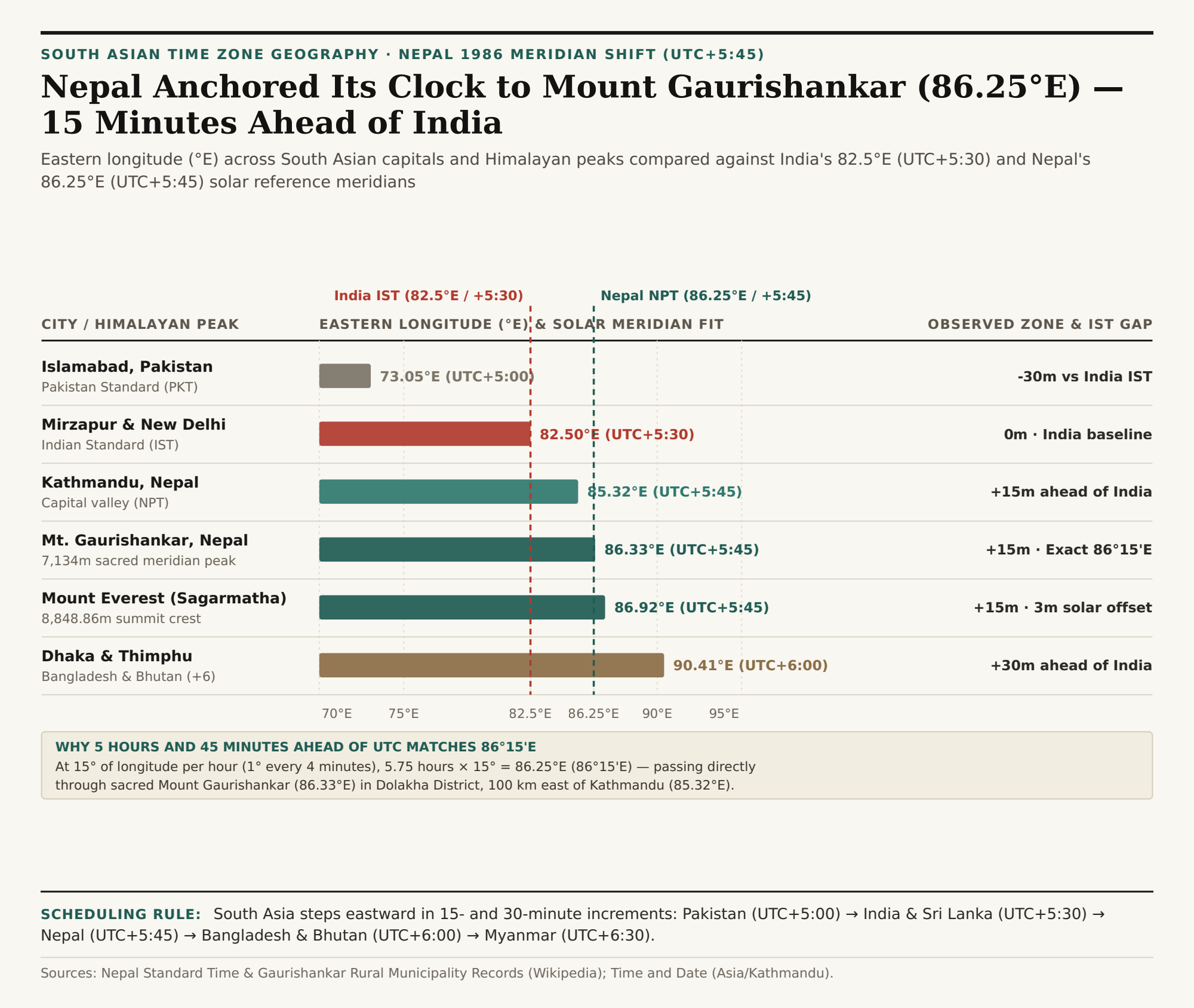
UTC+5:30) and Nepal's 86.25°E (UTC+5:45) meridians. Download the South Asian meridian & Nepal time dataset (CSV).2. The South Asian Quarter-Hour Staircase (From UTC+5:00 to UTC+6:30)
Cross the land borders of South Asia from west to east and your watch steps forward in a unique staircase of 30-minute and 15-minute increments — none of which observe Daylight Saving Time:
- Pakistan (
UTC+5:00) → India (UTC+5:30): A+30-minutejump across the Wagah border. - India (
UTC+5:30) → Nepal (UTC+5:45): A+15-minutejump across the Terai border crossings or on the 90-minute flight from New Delhi to Kathmandu. - Nepal (
UTC+5:45) → Bhutan & Bangladesh (UTC+6:00): Another+15-minutejump eastward across the Siliguri Corridor. - Bangladesh (
UTC+6:00) → Myanmar (UTC+6:30): A+30-minutejump to Myanmar Standard Time (97.5°E).
"Stand on the summit ridge of Mount Everest (86.92°E), where the border between Nepal and Tibet (China) runs right across the peak: Nepal on the southern slope observes UTC+5:45, while Tibet on the northern slope is mandated to use Beijing Standard Time (UTC+8:00) — creating a 2-hour-and-15-minute clock jump across a single step of snow."
| City / Landmark | IANA Zone | Longitude | Observed Offset | Reference Meridian | Gap vs. India (IST) |
|---|---|---|---|---|---|
| Islamabad & Karachi, Pakistan | Asia/Karachi |
73.05°E | UTC+05:00 (PKT) | 75.00°E | -30 min behind India |
| Mirzapur & New Delhi, India | Asia/Kolkata |
82.50°E | UTC+05:30 (IST) | 82.50°E | 0 min (IST Baseline) |
| Kathmandu Valley, Nepal | Asia/Kathmandu |
85.32°E | UTC+05:45 (NPT) | 86.25°E | +15 min ahead of India |
| Mount Gaurishankar, Nepal | Asia/Kathmandu |
86.33°E | UTC+05:45 (NPT) | 86.25°E | +15 min (Exact 86°15'E peak) |
| Mount Everest (Sagarmatha) | Asia/Kathmandu |
86.92°E | UTC+05:45 (NPT) | 86.25°E | +15 min (-2h 15m vs Tibet!) |
| Dhaka (BD) & Thimphu (BT) | Asia/Dhaka |
90.41°E | UTC+06:00 (BST) | 90.00°E | +30 min ahead of India |
Coordinating Calls With Kathmandu (UTC+5:45)
Because most calendar pickers default to 30-minute or 60-minute grid lines, scheduling a call with engineering teams or expedition outfitters in Kathmandu (Asia/Kathmandu) requires accounting for the :15 and :45 minute marks (9:00 AM EST in New York is 7:30 PM in New Delhi and 7:45 PM in Kathmandu). Open Tempo in your browser to view exact 15-minute alignment across Kathmandu and your local time zone, and download the South Asian & Nepal 45-minute meridian CSV table.