
Why Is Newfoundland Time 30 Minutes Ahead of Atlantic Time?
Why Is Newfoundland Time 30 Minutes Ahead of Atlantic Time?
Anyone who grew up watching Canadian television knows the iconic network sign-off by heart: "This program airs at 8:00—8:30 in Newfoundland." Across the entire North American continent, every standard time zone from Hawaii (UTC-10:00) to the Maritimes (UTC-04:00) steps in neat, 60-minute increments—until you cross the Cabot Strait to the island of Newfoundland, where clocks jump forward by exactly 30 minutes to Newfoundland Standard Time (NST, UTC-03:30) in winter and Newfoundland Daylight Time (NDT, UTC-02:30) in summer.
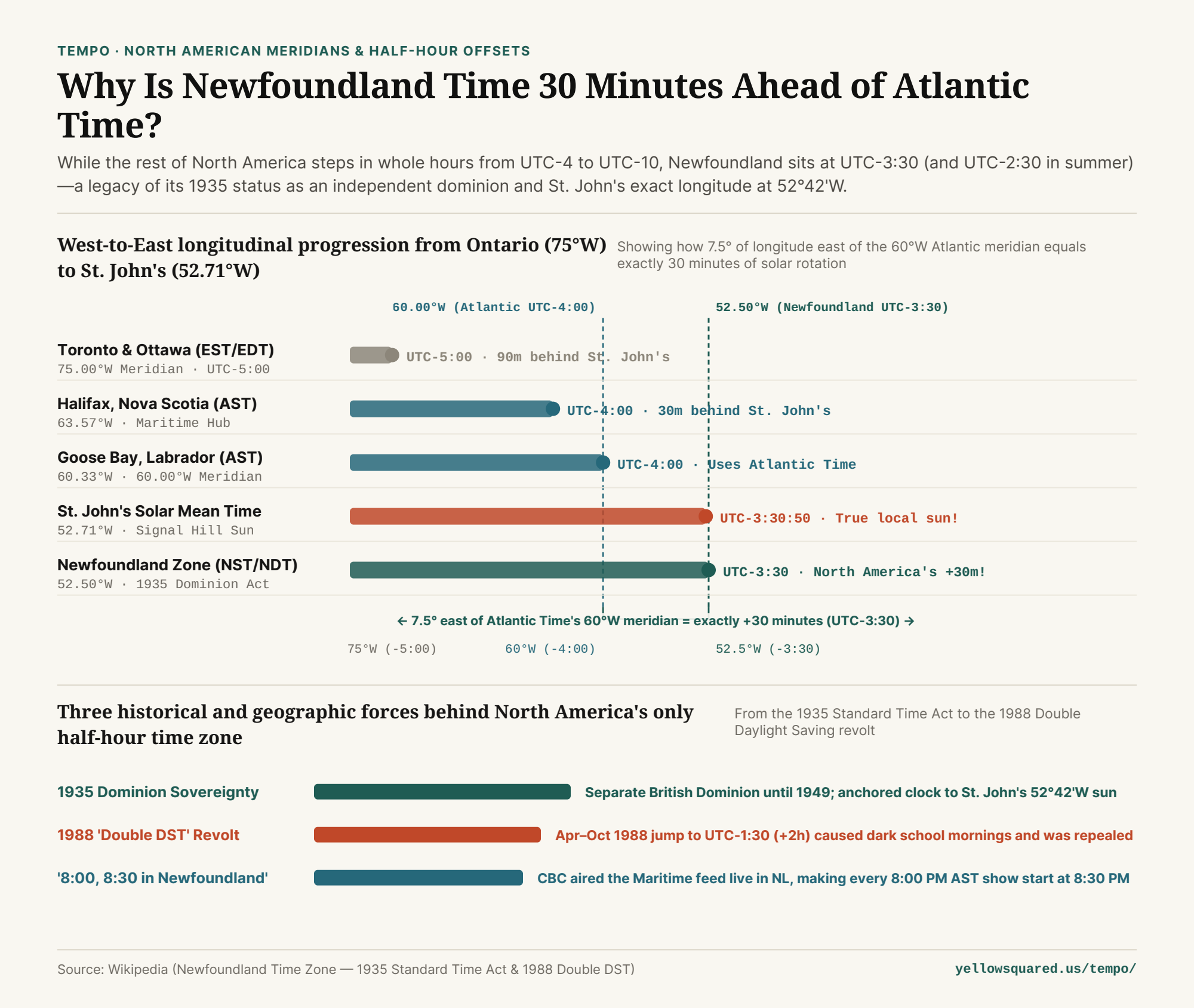
1. The 50-Second Solar Match at 52°42' West
The first reason Newfoundland uses a half-hour offset is pure spherical astronomy. Because Earth rotates 360° every 24 hours, every 15° of longitude equals 60 minutes of solar time, and every 7.5° of longitude equals 30 minutes. While Atlantic Standard Time (UTC-04:00) is centered on the 60° West meridian (which passes through Cape Breton Island in Nova Scotia), the island of Newfoundland juts hundreds of kilometers further out into the North Atlantic.
As documented in the historical record of the Newfoundland Time Zone, Signal Hill in St. John's sits at 52°42' West (52.71°W)—almost exactly on the 52.5° West half-hour meridian. Multiplying 52.71° × 4 minutes per degree yields a mean solar time of 3 hours, 30 minutes, and 50 seconds behind Greenwich (UTC-03:30:50). That means a UTC-03:30 clock matches St. John's true astronomical sun within 50 seconds.
"At 52°42' West longitude, mean solar noon in St. John's occurs at 15:30:50 UTC—making UTC-03:30 one of the most astronomically exact time zones on Earth."
2. Pre-1949 Dominion Sovereignty and the 1988 'Double DST' Revolt
Why didn't Ottawa simply force Newfoundland onto Atlantic Time (UTC-04:00) when North American railroads standardized their clocks? Because Newfoundland was not part of Canada until 31 March 1949. As a self-governing British Dominion, the Newfoundland Commission of Government enacted the Standard Time Act of 1935, establishing GMT-03:30 as the island's official civil time.
Even after Confederation in 1949, provinces retained constitutional authority over local timekeeping. As noted in archival records of Newfoundland time legislation, when the provincial government briefly experimented with Double Daylight Saving Time between April and October 1988—advancing clocks by two full hours in summer to UTC-01:30 (`150 minutes` ahead of Ontario)—autumn sunrises pushed past 8:30 AM, children waited for school buses in pitch darkness, and prime-time television ended after midnight. Public backlash was so fierce that the government repealed the experiment before 1989.
3. North American Eastern & Atlantic Meridian Comparison Table
Note that inside the province of Newfoundland and Labrador itself, time zones actually split: while the island of Newfoundland and southeastern Labrador (south of Black Tickle) use America/St_Johns (UTC-03:30 / UTC-02:30), most of mainland Labrador (`America/Goose_Bay`, near 60.33°W) observes Atlantic Time (`UTC-04:00` / `UTC-03:00`). Compare all five regional configurations below (available in why-does-newfoundland-have-a-30-minute-time-zone-nt-ndt.csv):
| North American Region | Reference City & Longitude | Reference Meridian | Winter Standard | Summer Daylight | Mean Solar Offset vs UTC |
|---|---|---|---|---|---|
| Eastern Time (Ontario / NY) | Toronto (79.38°W) | 75.00° W (-5h 00m) | EST (UTC-05:00) | EDT (UTC-04:00) | -4h 56m to -5h 17m |
| Atlantic Time (Maritimes) | Halifax (63.57°W) | 60.00° W (-4h 00m) | AST (UTC-04:00) | ADT (UTC-03:00) | -4h 14m 17s |
| Western/Northern Labrador | Goose Bay (60.33°W) | 60.00° W (-4h 00m) | AST (UTC-04:00) | ADT (UTC-03:00) | -4h 01m 19s |
| Newfoundland & SE Labrador | St. John's (52.71°W) | 52.50° W (-3h 30m) | NST (UTC-03:30) | NDT (UTC-02:30) | -3h 30m 50s (50s accuracy!) |
| 1988 Double DST Experiment | St. John's (Apr–Oct 1988) | 22.50° W (-1h 30m) | NST (UTC-03:30) | DDST (UTC-01:30) | +2h 00m ahead of solar noon |
4. Track Half-Hour Canadian and Global Offsets in Tempo
Scheduling a cross-Canada call between Vancouver (UTC-08:00), Toronto (UTC-05:00), Halifax (UTC-04:00), and St. John's (UTC-03:30) spans 4.5 hours of clock difference—meaning a 1:00 PM Pacific meeting lands at 5:30 PM in Newfoundland. Open Tempo in your browser to visualize exact 30-minute working-window overlaps across `America/St_Johns` and every IANA zone worldwide.
Verified Primary Sources
- Wikipedia — Newfoundland Time Zone (1935 Standard Time Act, 52°42'W Solar Alignment & Labrador Split) (Retrieved 2026-10-31).
- Wikiwand Historical Archive — Newfoundland Time Zone & 1988 Double Daylight Saving Time Repeal (Retrieved 2026-10-31).