
Why Is Newfoundland Time 30 Minutes Ahead of Atlantic Time?
Why Is Newfoundland Time 30 Minutes Ahead of Atlantic Time?
Because St. John's, Newfoundland sits at 52.71°W—almost exactly on the 52.5°W meridian that lies 3.5 hours west of Greenwich—Newfoundland standardized on UTC-3:30 (NST) in 1935 and kept its half-hour offset after joining Canada in 1949.
Look at a standard time zone map of North and South America and every single boundary from Alaska (`UTC-9`) to Eastern Brazil (`UTC-3`) steps neatly in whole-hour increments—with one famous Canadian exception. On the island of Newfoundland (`America/St_Johns`), clocks run on Newfoundland Standard Time (`NST, UTC-3:30`) in winter and Newfoundland Daylight Time (`NDT, UTC-2:30`) in summer, placing St. John's 30 minutes ahead of Halifax (`AST, UTC-4:00`) and 90 minutes ahead of Toronto and New York (`EST, UTC-5:00`).
This half-hour offset has spawned decades of affectionate Canadian broadcast punchlines ("The national news airs at 10:00 PM—10:30 in Newfoundland"), yet the reason `UTC-3:30` exists is pure solar geometry combined with pre-1949 geopolitical independence.
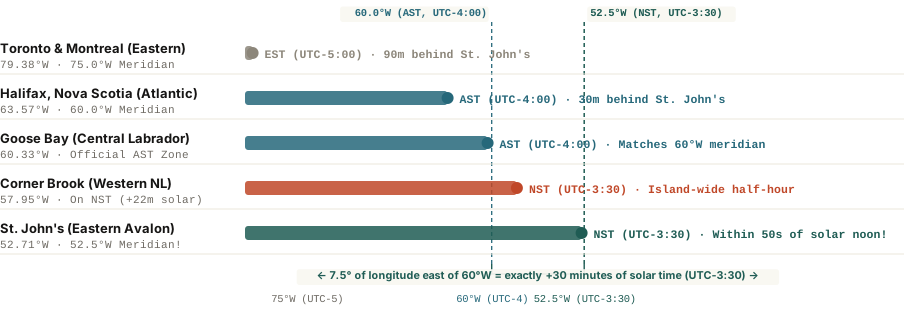
The 52.5°W Solar Meridian: Within 50 Seconds of St. John's
Because Earth rotates `360°` every 24 hours, every `15°` of longitude equals `60 minutes` of solar time, and every `7.5°` (`7°30'`) equals `30 minutes`:
- Eastern Time (`75.0°W` Meridian = `UTC-5:00`): Anchored near Philadelphia (`75.16°W`).
- Atlantic Time (`60.0°W` Meridian = `UTC-4:00`): Anchored near Sydney, Nova Scotia (`60.19°W`) and Goose Bay, Labrador (`60.33°W`).
- Newfoundland Time (`52.5°W` Meridian = `UTC-3:30`): Subtract `7.5°` from `60.0°W` and you land on `52°30'W` (`52.5°W`)—which runs directly through the Avalon Peninsula just west of St. John's (`52.71°W`), where over 40% of the province's population lives.
At `52.71°W`, mean solar noon in St. John's occurs at `15:30:50 UTC`—meaning a `UTC-3:30` clock aligns with the physical sun to within 50 seconds. Had Newfoundland adopted Atlantic Time (`UTC-4:00`), solar noon in St. John's would fall at `11:31 AM` and mid-December sunsets would arrive at a gloomy `3:43 PM`.
St. John's sits at 52.71°W—making UTC-3:30 one of the most astronomically exact capital time zones on Earth.
Why Newfoundland Kept Its Clock After Joining Canada in 1949
Why didn't Ottawa force Newfoundland onto Atlantic Time when railway time zones were standardized? Because Newfoundland was not part of Canada until March 31, 1949:
- 1935 Dominion Legislation: As a self-governing British Dominion, Newfoundland originally kept local St. John's time (`GMT-3h 30m 52s`, signaled daily by the noon cannon on Signal Hill) before formally rounding to `GMT-3:30` across the island in 1935.
- The Labrador Split: When Newfoundland joined Canadian Confederation in 1949, provinces retained constitutional authority over standard time. Today, while the entire island of Newfoundland (and southeastern Labrador around L'Anse-au-Clair) legally observes `UTC-3:30`, most of continental Labrador west of `57°W` (`America/Goose_Bay`, around `60.3°W`) officially observes **Atlantic Time (`UTC-4:00 / UTC-3:00`)** to match its own `60°W` solar meridian.
- The 1988 'Double Daylight' Experiment: In the summer of 1988, the provincial government experimented with advancing clocks by two full hours (`UTC-1:30`) during Daylight Saving Time; after widespread complaints when children had to walk to school in pitch darkness at `8:30 AM` in October, the province returned to its standard 1-hour DST shift (`NDT, UTC-2:30`).
When scheduling cross-Canada calls between Vancouver, Toronto, Halifax, and St. John's, you can Open Tempo in your browser to compare `America/St_Johns` half-hour offsets without mental arithmetic errors.