
Why Does Newfoundland Have a 30-Minute Time Zone Offset? How St. John's Uses UTC-3:30 in Winter and UTC-2:30 in Summer
Anyone who grew up watching the Canadian Broadcasting Corporation (CBC) can recite the network’s most famous scheduling tagline by heart: “This program airs at 8:00 PM Eastern—8:30 in Newfoundland.” Across the entire Western Hemisphere, from Alaska and California down to Chile and Argentina, every active civil time zone is offset from Coordinated Universal Time (UTC) by a whole number of hours—with one solitary exception: the Canadian island of Newfoundland and southeastern Labrador observe the Newfoundland Time Zone, sitting at UTC-03:30 (Newfoundland Standard Time, NST) in winter and UTC-02:30 (Newfoundland Daylight Time, NDT) in summer.
When you coordinate cross-Canada or transatlantic calls in Tempo, Newfoundland’s 30-minute offset creates a 90-minute gap ahead of New York and Toronto (America/Toronto) and a 30-minute gap ahead of Halifax (America/Halifax)—while placing three distinct time zones within 15 miles of water in the Gulf of St. Lawrence.
The 52°30′W Signal Hill Meridian: Why St. John’s Splits the Hour in Half
Why didn’t Newfoundland simply join Atlantic Standard Time (UTC-04:00) alongside Nova Scotia, New Brunswick, and Prince Edward Island? The answer combines exact solar longitude math with pre-1949 sovereignty:
- Dead-Center on the
52°30'WHalf-Meridian: Standard global 1-hour time zones sit every15 degreesof longitude (60°W = UTC-04:00,45°W = UTC-03:00). The halfway line between60°Wand45°Wis52°30'W(52.50°W). Multiplying52.50° × 4 solar minutes per degreeyields exactly210.0 minutes = 3 hours and 30 minutes behind Greenwich(UTC-03:30). - St. John’s Astronomical Fit (
52°43'W): Newfoundland’s capital and largest port, St. John’s (52.71°W), sits just0.21 degrees(13 arcminutes) west of the52°30'Wmeridian—meaning true mean solar noon in St. John’s occurs within 50 seconds of12:00 PMNST. - An Independent Dominion Until March 31, 1949 (Time in Canada): When Sir Sandford Fleming proposed global standard time zones in the 1880s, Newfoundland was a separate self-governing British colony (and later the Dominion of Newfoundland), not a province of Canada. In
1884, St. John’s anchored its official time to the noon cannon on Signal Hill (UTC-03:30:52), and in1935the Newfoundland Standard Time Act rounded the legal offset toUTC-03:30. When Newfoundland confederated with Canada in1949, it retained its sovereign time zone.
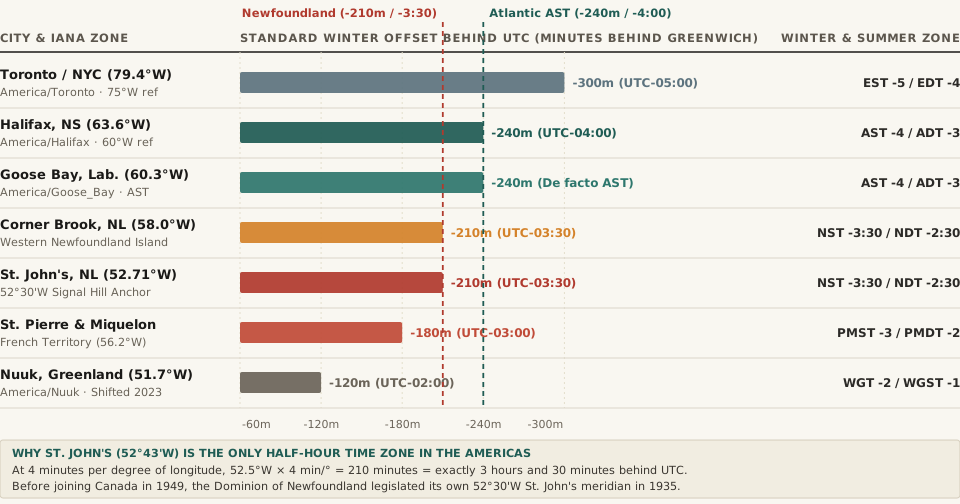
How Eastern Canada’s Neighboring Time Zones Compare
Although the provincial statute (Standard Time Act, RSNL 1990) technically defines Newfoundland Time (UTC-03:30 / UTC-02:30) for the entire province of Newfoundland and Labrador, practical geography divides the region—and its immediate offshore neighbors—into four different clocks:
| City / Jurisdiction | IANA Time Zone | Longitude | Reference Meridian | Winter Standard | Summer Daylight | Winter Mean Solar Noon |
|---|---|---|---|---|---|---|
| Toronto / New York | America/Toronto |
79.38°W |
75.0°W |
EST (UTC-05:00) |
EDT (UTC-04:00) |
12:18 PM EST |
| Halifax, Nova Scotia | America/Halifax |
63.57°W |
60.0°W |
AST (UTC-04:00) |
ADT (UTC-03:00) |
12:14 PM AST |
| Happy Valley-Goose Bay, Lab. | America/Goose_Bay |
60.33°W |
60.0°W |
AST (UTC-04:00) |
ADT (UTC-03:00) |
12:01 PM AST |
| Corner Brook, Western NL | America/St_Johns |
57.95°W |
52.5°W |
NST (UTC-03:30) |
NDT (UTC-02:30) |
12:22 PM NST |
| St. John’s, Newfoundland | America/St_Johns |
52.71°W |
52.5°W |
NST (UTC-03:30) |
NDT (UTC-02:30) |
12:01 PM NST |
| St. Pierre & Miquelon (France) | America/Miquelon |
56.18°W |
45.0°W |
PMST (UTC-03:00) |
PMDT (UTC-02:00) |
12:45 PM PMST |
| Nuuk, Greenland (Post-2023) | America/Nuuk |
51.72°W |
30.0°W |
WGT (UTC-02:00) |
WGST (UTC-01:00) |
1:27 PM WGT |
“Take the 90-minute passenger ferry from Fortune, Newfoundland (55.8°W, on UTC-3:30) to the French territory of Saint-Pierre and Miquelon (56.2°W, on UTC-3:00): you travel slightly west, yet your watch jumps forward by 30 minutes.”
Three Quirks of Newfoundland Time Every Traveler and Developer Should Know
- The Labrador Split (
America/St_Johnsvs.America/Goose_Bay): Only the southeastern coast of Labrador (from L’Anse-au-Clair to Black Tickle, closest to the Strait of Belle Isle) actually uses Newfoundland Time (UTC-03:30). The rest of mainland Labrador—including Happy Valley-Goose Bay (60.3°W) and Labrador City—sits right on the60°Wmeridian and observes Atlantic Time (UTC-04:00/UTC-03:00) in practice. - The 1988 “Double Daylight Saving Time” Experiment (
UTC-01:30): Between April 3 and October 30, 1988, the provincial government advanced clocks by 2 full hours instead of 1 hour for summer—placing Newfoundland onUTC-01:30. When midsummer sunset moved past10:00 PMand autumn schoolchildren had to wait for buses in pitch-black morning darkness until after8:30 AM, public backlash ended the experiment after a single season. - New Year’s Eve Arrives First in North America by 30 Minutes: Because
America/St_Johns(UTC-03:30) sits 30 minutes ahead of Atlantic Standard Time (UTC-04:00) and 90 minutes ahead of Eastern Standard Time (UTC-05:00), Newfoundland rings in the New Year at10:30 PMNew York/Toronto time.
Planning meetings or broadcasts across St. John’s (UTC-03:30), Halifax (UTC-04:00), Toronto (UTC-05:00), and London? Open Tempo in your browser to compare half-hour and whole-hour overlaps effortlessly, or explore our time-zone engineering guides.