
Why Is Newfoundland 30 Minutes Ahead of Atlantic Time?
Why Is Newfoundland 30 Minutes Ahead of Atlantic Time?
Newfoundland observes a 30-minute fractional offset (NST, UTC-3:30 in winter and NDT, UTC-2:30 in summer) because the island sits centered on the 52°30'W meridian passing through St. John's—and preserved its independent Dominion clock after joining Canada in 1949.
Anyone who grew up watching national television broadcasts in Canada knows the iconic network sign-off cadence by heart: "Tonight at 8:00, 8:30 in Newfoundland." Across all of North America, every other province, state, and territory sets its clock to a whole-hour offset from Coordinated Universal Time (UTC). Only the island of Newfoundland steps out of line by exactly 30 minutes—observing Newfoundland Standard Time (NST, UTC-3:30) during winter and Newfoundland Daylight Time (NDT, UTC-2:30) during summer.
Far from being an eccentric political accident, Newfoundland's half-hour time zone is a triumph of astronomical geometry combined with the island's history as an independent country prior to 1949. Understanding how the 52°30'W meridian shapes the province—and why mainland Labrador refuses to use the half-hour clock—is essential for anyone coordinating Atlantic travel or cross-Canada remote schedules.
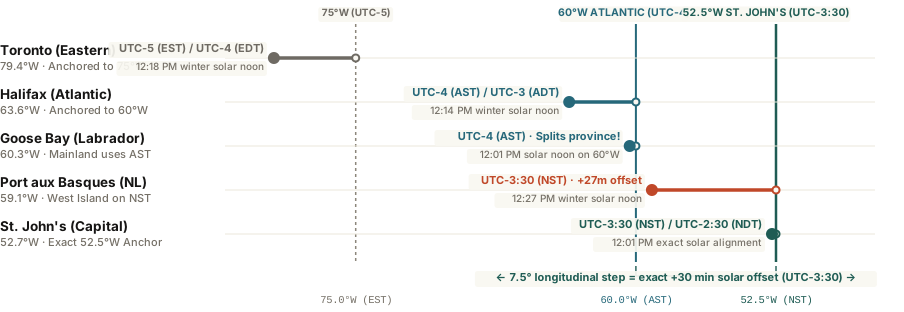
The Solar Math: Why 52°30'W Demands a Half-Hour Clock
Earth rotates 360 degrees every 24 hours, which equals 15 degrees of longitude per hour—or 7.5 degrees per 30 minutes. Standard whole-hour time zones in eastern North America are anchored to multiples of 15 degrees west of Greenwich:
- Eastern Standard Time (UTC-5): Centered on the 75.0°W meridian (near Philadelphia and Ottawa).
- Atlantic Standard Time (UTC-4): Centered on the 60.0°W meridian (passing through Cape Breton Island, Nova Scotia, and eastern Labrador).
- Newfoundland Standard Time (UTC-3:30): Centered on the 52.5°W (52°30'W) meridian, which runs directly through St. John's (52.71°W) on the Avalon Peninsula.
Because St. John's sits exactly halfway between the 60°W (UTC-4) meridian and the 45°W (UTC-3) meridian, a 30-minute fractional offset places winter solar noon in the provincial capital at 12:01 PM—within 60 seconds of astronomical perfection.
Newfoundland was an independent British Dominion until March 31, 1949—meaning it established its own national time zone in 1935 without needing Ottawa's permission.
The Labrador Split and the 1988 "Double Daylight" Revolt
Two crucial nuances regularly trip up visitors and scheduling software alike:
- Mainland Labrador Uses Atlantic Time (UTC-4): Although the province is officially named Newfoundland and Labrador, the mainland region of Labrador lies much further west along the 60°W meridian. Consequently, almost all of Labrador (including Happy Valley-Goose Bay and Labrador City) observes Atlantic Time (UTC-4 / UTC-3), leaving only the island of Newfoundland and a tiny southeastern strip of coastal Labrador on the half-hour clock.
- The Disastrous 1988 "Double Daylight Saving" Experiment: In the summer of 1988, the provincial government experimented with advancing clocks by two full hours (to UTC-1:30) to create longer summer evenings. Because that pushed autumn sunrises in western Newfoundland past 9:30 AM—forcing schoolchildren to wait for buses in pitch darkness—public outrage forced the legislature to repeal the experiment immediately.
When scheduling cross-country video calls between St. John's, Halifax, Toronto, and Vancouver, you can Open Tempo in your browser to visualize exact 30-minute fractional overlaps alongside whole-hour time zones automatically.