
Why Is Newfoundland 30 Minutes Ahead of Atlantic Time? The Story of Canada's UTC-3:30 Time Zone
Look at a live world clock across North America and one Canadian province immediately stands out: while Halifax, Nova Scotia and Moncton, New Brunswick sit on Atlantic Time (UTC-4:00 in winter / UTC-3:00 in summer), the island of Newfoundland — including the provincial capital of St. John's — runs exactly 30 minutes ahead on Newfoundland Time (UTC-3:30 Standard / UTC-2:30 Daylight). As documented in Wikipedia's Newfoundland Time Zone Historical & Statutory Record and Time and Date's Newfoundland and Labrador Time Zone Guide, it is the only non-whole-hour time zone in the Americas.
Why did Newfoundland choose a half-hour offset instead of joining Atlantic Time (UTC-4) or Greenland/South American time (UTC-3)? The answer combines exact spherical astronomy — St. John's sits at 52.71°W longitude, almost directly on the 52.5°W solar meridian where local mean time is 3 hours and 30 minutes behind Greenwich — with political history: Newfoundland established its time zone in 1935 as a self-governing British Dominion, fourteen years before entering Canadian Confederation in 1949. To compare live half-hour offsets between St. John's, mainland Labrador, Toronto, and London right now, Open Tempo in your browser.
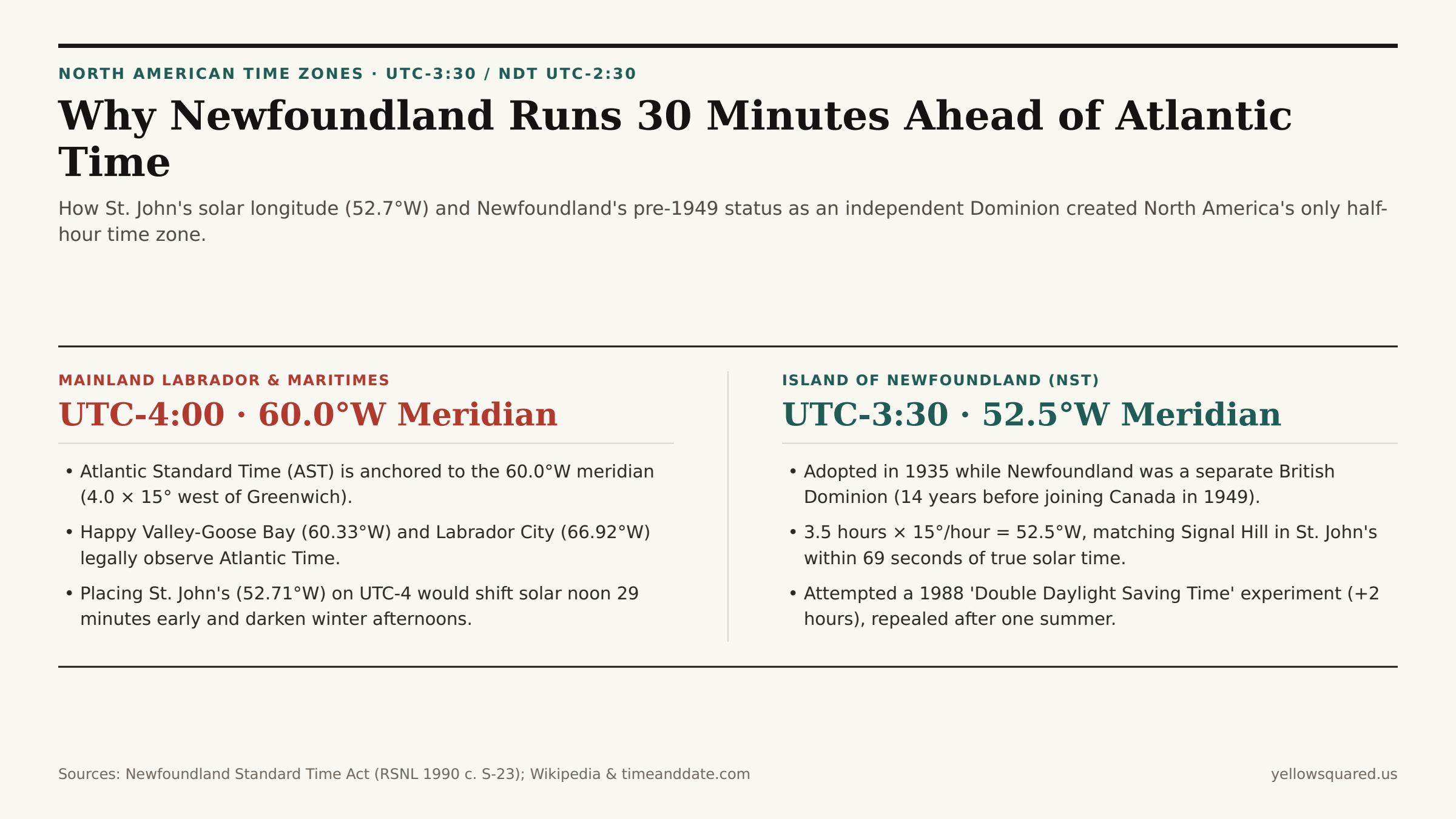
1. The 52.5°W Solar Math: Why 3 Hours and 30 Minutes Fits St. John's Within 69 Seconds
Every standard time zone on Earth is anchored to a reference meridian based on Earth's rotation rate of 360 degrees in 24 hours (15° of longitude per hour, or 1° every 4 minutes):
- Eastern Standard Time (
UTC-5:00): Anchored at 5 × 15° = 75.0°W (passing near Philadelphia). - Atlantic Standard Time (
UTC-4:00): Anchored at 4 × 15° = 60.0°W (passing through Cape Breton Island, Nova Scotia and central Labrador). - Newfoundland Standard Time (
UTC-3:30): Anchored at 3.5 × 15° = 52.5°W.
When Sir Sandford Fleming popularized global standard time zones in 1884, Newfoundland was not a Canadian province; it was a separate British colony (and from 1907 to 1949, the Dominion of Newfoundland). Because the capital city and commercial port of St. John's sits at 52°42'W (52.71°W) on the eastern edge of the Avalon Peninsula, local mean solar time at the St. John's courthouse was exactly 3 hours, 30 minutes, and 44 seconds behind Greenwich Mean Time. Under the Newfoundland Standard Time Act of 1935, the Dominion standardized its clocks from GMT-3:31 to a clean GMT-3:30. Had St. John's been forced onto Atlantic Time (UTC-4:00), solar noon would occur around 11:31 AM in winter, robbing the eastern coast of 30 minutes of afternoon daylight every day.
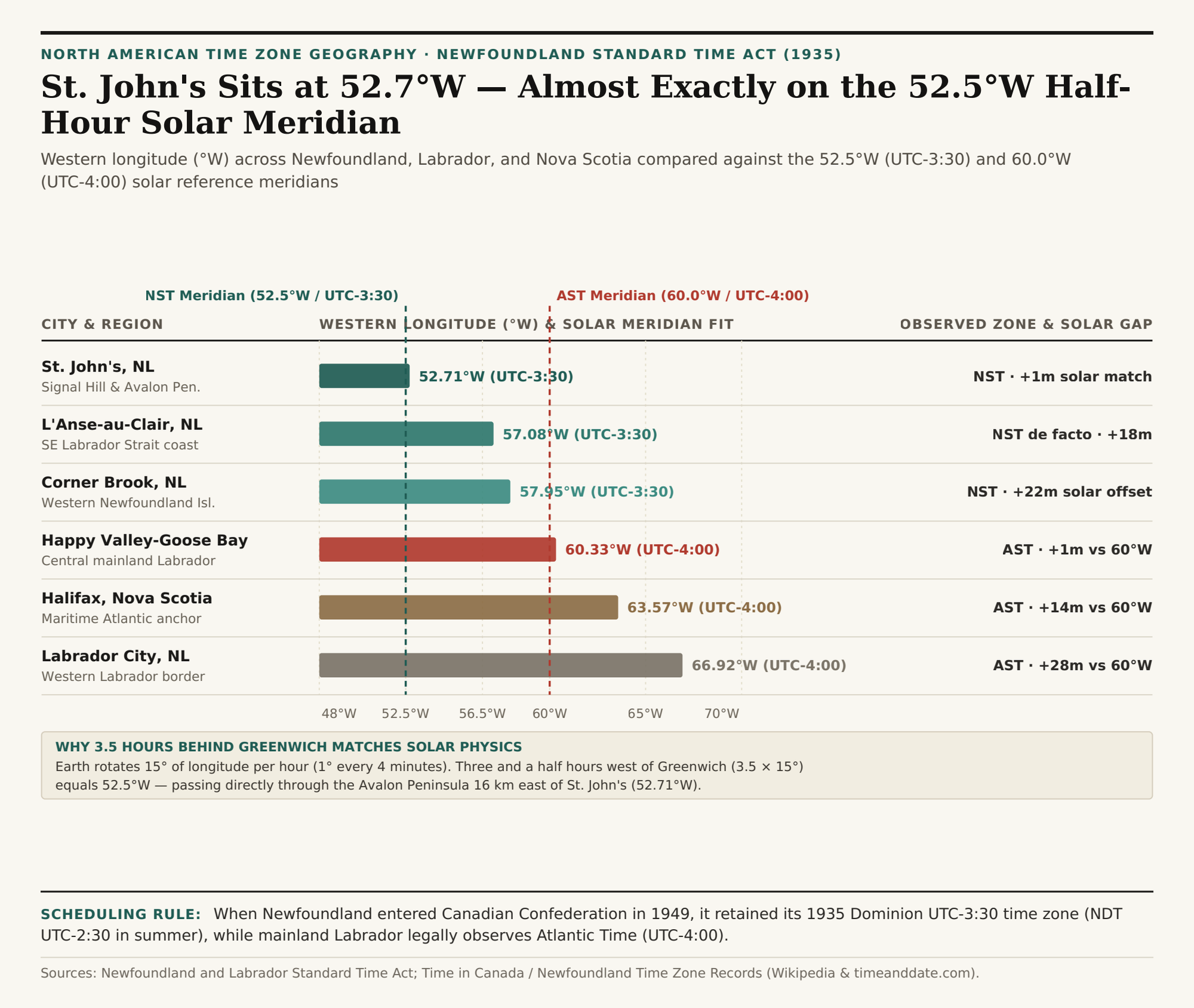
2. How Mainland Labrador Splits Between Atlantic Time and Newfoundland Time
As detailed in Time in Canada's Provincial Statutory Boundary Overview, the province of Newfoundland and Labrador actually spans two time zones across the Strait of Belle Isle:
- The Island of Newfoundland (
America/St_Johns,UTC-3:30/NDT UTC-2:30): All communities on the island — from St. John's (52.71°W) in the east to Gander (54.61°W) and Corner Brook (57.95°W) in the west — observe Newfoundland Time. That is why classic Canadian Broadcasting Corporation (CBC) radio and television promos always ended with the famous refrain: "8:00 PM — 8:30 in Newfoundland." - Most of Mainland Labrador (
America/Goose_Bay,UTC-4:00/ADT UTC-3:00): Because central and western Labrador stretch west from60°Wto67°Walong the Quebec border, Happy Valley-Goose Bay (60.33°W), Churchill Falls, and Labrador City / Wabush (66.92°W) legally observe Atlantic Time (UTC-4:00). - The Southeastern Labrador Coast (
L'Anse-au-ClairtoBlack Tickle): Even though the entire Labrador mainland is nominally assigned to Atlantic Time by statute, coastal communities along the southeastern tip of Labrador (55.6°Wto57.1°W, directly across the narrow Strait of Belle Isle from the island of Newfoundland) use Newfoundland Time (UTC-3:30) de facto so their ferries, schools, and radio broadcasts match the island.
"In the summer of 1988, the Newfoundland provincial government experimented with 'Double Daylight Saving Time' — advancing clocks two full hours ahead of standard time to UTC-1:30. After children had to walk to school in pitch darkness in October and summer twilight lingered past 10:30 PM, the province repealed the experiment after a single season."
| City / Sub-Region | Longitude | Observed Zone (IANA) | Winter / Summer Offset | Reference Meridian | Solar Noon Alignment |
|---|---|---|---|---|---|
| St. John's (Avalon Peninsula) | 52.71°W | Newfoundland (America/St_Johns) |
UTC-3:30 / UTC-2:30 | 52.5°W | +1 min (Near-exact solar noon) |
| L'Anse-au-Clair (SE Labrador) | 57.08°W | Newfoundland (De facto sync) | UTC-3:30 / UTC-2:30 | 52.5°W | +18 min (Synced with island ferries) |
| Corner Brook (Western Island) | 57.95°W | Newfoundland (America/St_Johns) |
UTC-3:30 / UTC-2:30 | 52.5°W | +22 min (Province-wide island unity) |
| Happy Valley-Goose Bay | 60.33°W | Atlantic (America/Goose_Bay) |
UTC-4:00 / UTC-3:00 | 60.0°W | +1 min (Exact 60°W solar match) |
| Halifax, Nova Scotia | 63.57°W | Atlantic (America/Halifax) |
UTC-4:00 / UTC-3:00 | 60.0°W | +14 min vs 60.0°W meridian |
| Labrador City & Wabush | 66.92°W | Atlantic (America/Goose_Bay) |
UTC-4:00 / UTC-3:00 | 60.0°W | +28 min (Borders Quebec EST) |
Scheduling Calls Across Half-Hour Offsets Without Mental Math
When booking meetings between Toronto or New York (UTC-5 / EDT UTC-4), Halifax or Goose Bay (UTC-4 / ADT UTC-3), and St. John's (UTC-3:30 / NDT UTC-2:30), remember that a 9:00 AM Eastern call lands at 10:00 AM in Labrador and 10:30 AM in St. John's. Open Tempo in your browser to scrub across half-hour and 45-minute time zones side by side, and download the Newfoundland and Labrador solar meridian CSV table.