
Why Does Orange Juice Taste So Bitter After You Brush Your Teeth?
Nearly everyone has experienced the breakfast shock of taking a sip of fresh orange juice right after brushing their teeth: instead of tasting bright and sweet, the juice tastes intensely bitter, metallic, and astringent. While many people blame the menthol or peppermint oil in toothpaste, sensory psychophysics proves that mint flavoring is innocent. As explained by BBC Science Focus, Encyclopædia Britannica, and Colgate's oral biochemistry guide, the culprit is a single foaming detergent ingredient present at 1% to 2% concentration in most conventional toothpastes: Sodium Lauryl Sulfate (SLS, C₁₂H₂₅NaO₄S).
Why does a soap-like surfactant transform sweet citrus juice into liquid bitterness? Landmark psychophysical experiments by John A. DeSimone, Gerard L. Heck, and Linda M. Bartoshuk (1980) in Chemical Senses (reviewed in Tidalove's sensory chemistry analysis and Live Science) revealed that SLS executes a two-pronged biochemical attack on your tongue's taste buds that lasts for 15 to 30 minutes. Check citrus sweetness, acidity, and produce guides in Redberi to compare sugar-to-acid ratios across oranges, mandarins, and grapefruits.
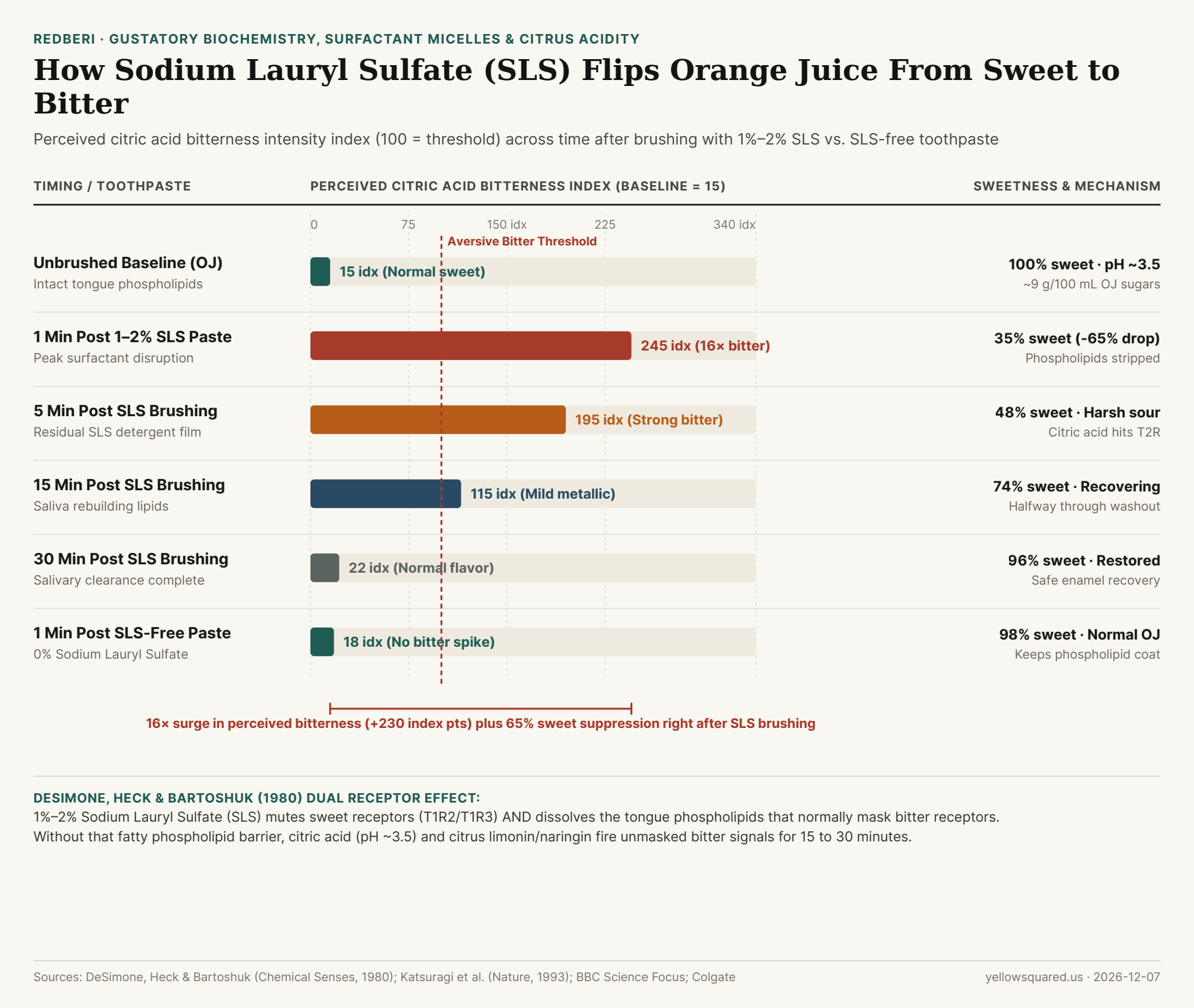
15, aversive threshold = 100) and sweet receptor (T1R2/T1R3) sensitivity across time after brushing with 1%–2% Sodium Lauryl Sulfate (SLS) toothpaste vs. SLS-free toothpaste. Sources: BBC Science Focus, Colgate, and DeSimone, Heck & Bartoshuk (1980) · Download CSV dataset.The Dual Mechanism: Muted Sweet Receptors + Stripped Phospholipids
A typical 240 mL glass of fresh orange juice is actually a high-acid beverage (pH ~3.5, containing roughly 0.8 to 1.2 g per 100 mL of citric acid plus trace bitter limonoids like limonin and flavonoids like naringin) whose sourness and bitterness are normally balanced by ~9 g per 100 mL of natural sugars (sucrose, fructose, and glucose) and by the natural lipid coating on your tongue. When you brush with an SLS toothpaste, two things happen simultaneously:
- Sweet Receptor Suppression (
~65%Drop in Perceived Sweetness): Your sweet taste receptors (the G-protein-coupled heterodimerT1R2/T1R3) are embedded in delicate cell-membrane lipid bilayers on your taste buds. As an amphiphilic anionic detergent, SLS temporarily disorders those membrane lipids, reducing sweet taste signaling by roughly 60% to 70%. Suddenly, the~9 g/100 mLof sugar in orange juice barely registers on your tongue. - Destruction of Bitter-Masking Tongue Phospholipids: Your saliva and taste pore membranes are coated with fatty molecules called phospholipids, which naturally act as a molecular shield over your bitter taste receptors (
T2Rs)—a mechanism confirmed in a landmark 1993 Nature study by Katsuragi et al. showing that phosphatidic acid and lipoproteins selectively suppress bitter taste without affecting other tastes. SLS breaks down and washes away those protective phospholipids, leaving your bitter receptors completely exposed. Even worse, DeSimone, Heck, and Bartoshuk (1980) demonstrated that after SLS exposure, citric acid itself directly stimulates bitter taste pathways alongside sourness!
"Orange juice doesn't change chemically in your mouth—your tongue changes. By muting sweet T1R2/T1R3 receptors by ~65% and stripping away bitter-masking phospholipids, Sodium Lauryl Sulfate turns a balanced sweet-tart fruit into pure unbuffered citric acid and limonin bitterness."
Time-Course of Taste Recovery & Enamel Safety Table
How long does it take for normal saliva flow to wash away SLS micelles and replenish your tongue's phospholipid barrier? The table below tracks sweet sensitivity, citric acid bitterness, and enamel safety across the 30-minute recovery window (download the raw CSV table):
| Oral Timing & Toothpaste Condition | Tongue Surfactant State | Sweet T1R2/T1R3 Sensitivity |
Citric Acid Bitter Index | Enamel & Taste Outcome |
|---|---|---|---|---|
| Unbrushed Baseline (Normal Saliva) | 0% SLS · Intact phospholipids |
100% (Full sweet) | 15 (Low baseline) | ~9 g/100 mL sugars balance pH 3.5 citric acid |
1 Min After 1%–2% SLS Toothpaste |
Active SLS detergent micelles | 35% (-65% drop) |
245 (16× bitter spike) | Unmasked citric acid + limonin trigger intense bitterness |
| 5 Min After SLS Brushing | Residual SLS detergent film | 48% (Muted sweet) |
195 (Strong bitter) | Harsh sour-bitter taste persists even after water rinse |
| 15 Min After SLS Brushing | Partial salivary lipid recovery | 74% (Recovering) |
115 (Mild metallic) | Salivary mucins and phospholipids halfway restored |
| 30 Min After SLS Brushing | Surfactant cleared by saliva | 96% (Near-normal) | 22 (Normal tartness) | Sweet-to-acid balance restored; safe to drink citrus |
| 1 Min After SLS-Free Toothpaste | 0% SLS (Mild non-ionic/betaine) |
98% (Unchanged) | 18 (Zero bitter spike) | Preserves tongue phospholipids; orange juice tastes normal |
Why You Shouldn't Brush Immediately After Drinking Orange Juice Either
Tempted to solve the problem by drinking your orange juice first and brushing your teeth 30 seconds later? Dental researchers summarized by Colgate and Live Science warn against brushing immediately after acidic drinks: because orange juice has a pH of ~3.5 (well below the pH 5.5 critical demineralization threshold of hydroxyapatite tooth enamel), acid temporarily softens the microscopic surface layer of your enamel. Scrubbing softened enamel right away accelerates abrasive wear. Instead, follow one of two dentist-approved routines: switch to an SLS-free fluoride toothpaste so you can brush before breakfast with zero bitter taste distortion, or—if you drink orange juice first—rinse with plain water and wait 30 to 60 minutes for saliva calcium and phosphate ions to remineralize your enamel before brushing. Check citrus sweetness, acidity, and produce guides in Redberi to pick sweeter, lower-acid oranges for your morning table.