
Why Does Fresh Pineapple Make Your Tongue Tingle or Burn—And Why Does Canned Pineapple Never Sting?
Eat a bowl of fresh, raw pineapple chunks (Ananas comosus), and within five minutes your tongue, inner cheeks, and lips feel raw, prickly, and sandpapered—as if you had scalded your mouth on hot coffee. Yet if you eat the exact same amount of canned pineapple rings, grilled pineapple, or cooked pineapple upside-down cake, your mouth feels completely fine. Why does fresh pineapple sting so reliably, is it a food allergy, and why does the recipe on the back of every Jell-O box warn you never to add fresh pineapple? As documented in the biochemical reference on Bromelain, food-science analyses by the Institute of Food Technologists' Science Meets Food, Tasting Table, and Dole, fresh pineapple contains a potent pair of protein-digesting enzymes—stem bromelain (EC 3.4.22.32) and fruit bromelain (EC 3.4.22.33)—that literally begin tenderizing the protective protein layer of your oral mucosa while you chew.
Here is the exact three-stage biochemical mechanism behind "pineapple tongue," how to tell harmless bromelain irritation apart from true Oral Allergy Syndrome (OAS), and four science-backed ways to eat fresh pineapple without the burn.
1. The Two Enzymes Inside Ananas comosus: Stem Bromelain vs. Fruit Bromelain
First isolated by Venezuelan chemist Vicente Marcano in 1891 and characterized by Russell Henry Chittenden at Yale in 1892 (Wikipedia — Bromelain), bromelain is not a single molecule: it is a complex extract of proteolytic (protein-splitting) enzymes belonging to the sulfhydryl (cysteine) protease family, meaning each enzyme relies on a reactive free sulfhydryl (-SH) group on a cysteine amino acid side chain to slice peptide bonds in proteins:
- Stem Bromelain (
EC 3.4.22.32, MEROPSC01.005): Concentrated heavily in the pineapple plant's fibrous central stem and the tough central core of the fruit. In fact, commercial bromelain is so effective at dissolving dead protein tissue that a purified concentrate is approved by the European Medicines Agency and the U.S. FDA (under the name NexoBrid) for enzymatic debridement of severe skin burns (Wikipedia; Everyday Health). - Fruit Bromelain (
EC 3.4.22.33, MEROPSC01.028): Distributed throughout the juicy yellow flesh of the fruit, with higher activity near the core and base and in under-ripe fruit.
Why does eating fresh pineapple hurt your tongue? It is a one-two-three combination of enzymatic digestion, acidity, and microscopic crystals (Ubie Health Clinical Note; Science Meets Food):
- Step 1 — Bromelain Strips Your Mucin Shield: Your tongue and cheeks are coated in a slippery, protective blanket of mucin glycoproteins. As you chew raw pineapple, bromelain cleaves the amino-acid chains in that mucin layer and nibbles at the surface epithelial proteins underneath.
- Step 2 — Citric and Malic Acid (
pH 3.2–3.6) Sting the Exposed Tissue: Normally, your mucin layer insulates your taste buds from fruit acids. Once bromelain strips that protein shield away, pineapple's high citric and malic acid content hits the newly exposed nerve endings directly. - Step 3 — Microscopic Calcium Oxalate Raphides: Like kiwifruit and taro, pineapple tissue contains microscopic needle-shaped crystals of calcium oxalate (raphides) that create tiny mechanical micro-abrasions, amplifying the protease and acid sting.
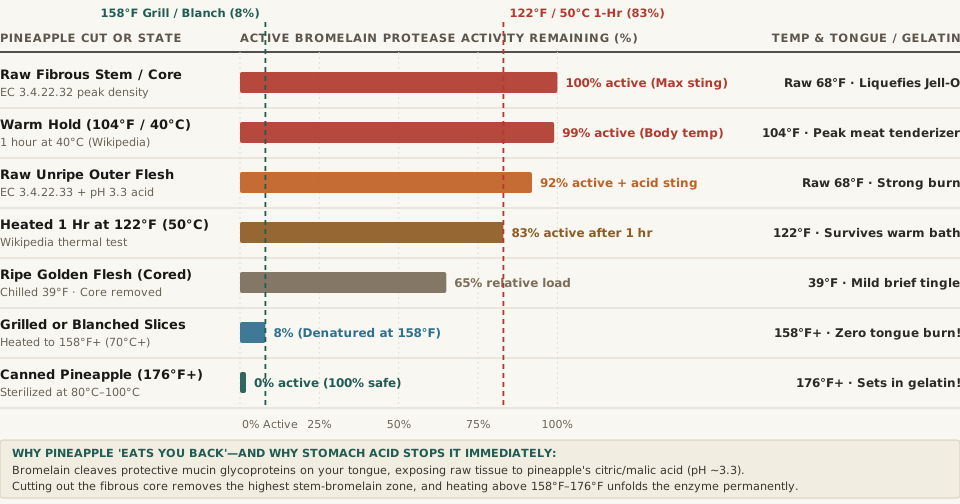
2. Why Canned or Grilled Pineapple Never Burns—And Why Fresh Pineapple Ruins Jell-O
Like all enzymes, bromelain's ability to cut proteins depends on its three-dimensional folded shape (specifically, the geometry of its cysteine–histidine active site). While bromelain is unusually tough at warm room and body temperatures—retaining practically 100% of its activity at 104°F (40°C) and 83% of its activity after a full hour at 122°F (50°C) (Wikipedia)—pushing the temperature past its thermal denaturation threshold unravels the protein chain permanently:
158°F (70°C)— The Grilling, Roasting & Blanching Cutoff: As Tasting Table and Science Meets Food explain, heating pineapple slices to158°F (70°C)or above breaks the weak hydrogen and hydrophobic bonds holding bromelain's active site together (thermal denaturation). A quick sear on a grill pan caramelizes the fruit's sucrose while rendering bromelain inactive.176°F+ (80°C–100°C)— Why Canned Pineapple Is 100% Tongue-Friendly: Commercial canned pineapple is thermally pasteurized and sterilized at176°F (80°C)or higher (Tasting Table; Dole). Every molecule of bromelain in a tin of pineapple is 100% denatured—which is why you can eat an entire can without a trace of tongue irritation, and why canned pineapple sets firmly inside Jell-O (gelatin) whereas raw pineapple digests gelatin's collagen fibers into a puddle of liquid soup!- Why It Doesn't Burn Your Stomach: Once you swallow raw pineapple, the hydrochloric acid (
pH 1.5–2.0) and pepsin in your stomach denature and digest bromelain like any other dietary protein, while your oral mucosa regenerates its mucin and surface cells within 30 minutes to a few hours (Everyday Health).
"After an hour at 50 °C (122 °F), 83% of the enzyme remains, while at 40 °C (104 °F), practically 100% remains... Cooked or canned pineapple does not have a tenderizing effect, as the enzymes are heat-labile and denatured in the cooking process."
3. Complete Data Table: Bromelain Activity by Cut, Temperature & Preparation
The reproducible table below—matching the companion CSV (pineapple-bromelain-enzyme-activity-by-temperature-cut-and-preparation.csv)—compares protease survival, oral irritation, and gelatin behavior across seven pineapple preparations:
| Pineapple Tissue or Treatment | Temperature | Enzyme Class | Active Bromelain (%) | Oral Mucosa & Tongue Impact | Gelatin / Meat-Marinade Impact |
|---|---|---|---|---|---|
| Raw Fibrous Central Core | 68°F (20°C) Raw |
Stem Bromelain (EC 3.4.22.32) |
100% (Peak density) |
Rapid, intense prickly sting on tongue | Liquefies gelatin; turns steak mushy if over-marinated |
| Warm Water Hold (1 Hr) | 104°F (40°C) |
Intact Cysteine Protease | ~99%–100% (Wikipedia) |
Full proteolytic activity at body temp | Peak enzymatic meat-tenderizing rate |
| Raw Unripe Outer Flesh | 68°F (20°C) Raw |
Fruit Bromelain (EC 3.4.22.33) |
~92% + High Acid |
Strong burn from protease + unripe acid | Prevents collagen cross-linking completely |
| Moderate Heat Hold (1 Hr) | 122°F (50°C) |
Partially Unfolded Protease | 83% (Wikipedia) |
Survives warm sous-vide or dehydrator baths | Still breaks down gelatin and meat fibers |
| Ripe Golden Flesh (Cored) | 39°F (4°C) Chilled |
Fruit Bromelain (EC 3.4.22.33) |
~65% relative load |
Mild, short-lived tingle; core removed | Still requires blanching before adding to gelatin |
| Grilled or Blanched Slices | 158°F+ (70°C+) |
Denatured Polypeptide | ≤ 8% (Inactive) |
Active site unfolds; caramelized & burn-free | Safe to fold into gelatin molds once cooled |
| Commercial Canned Pineapple | 176°F+ (80°C+) |
100% Denatured Protein | 0% |
Zero tongue sting at any serving size | Sets firmly inside gelatin desserts every time |
4. Four Ways to Eat Fresh Raw Pineapple Without Burning Your Mouth
If you want the crisp texture of raw pineapple without cooking it, four simple prep steps drastically cut the sting (Personalabs; Tasting Table):
- Quarter and Carve Out the Entire Central Core: Because stem bromelain (
EC 3.4.22.32) is concentrated in the fibrous core, slicing off an extra0.25 incharound the core removes the highest-protease tissue before you plate the fruit. - Rest the Whole Pineapple Upside-Down Before Cutting (or Choose Golden-Base Fruit): Pineapples do not manufacture new starch-derived sugar after harvest, but sugars and juices settle toward the stem base on the plant. Picking a fragrant, golden-yellow pineapple avoids the harsh malic/citric acid spike of green under-ripe fruit.
- Pair With Greek Yogurt, Cottage Cheese, or Coconut Cream: Eating raw pineapple alongside protein-rich dairy gives bromelain abundant casein and whey proteins to cleave in the bowl and on your palate instead of your oral mucin layer.
- Use a 60-Second 1% Saltwater Dip (Piña Salada): In Southeast Asia and Latin America, street vendors dip fresh pineapple wedges in lightly salted water. Dissolving
1/2 teaspoonof salt in a cup of cold water alters the ionic strength around the surface enzymes while amplifying perceived sweetness against citric acid.
To check ripeness indicators, cut-fruit shelf life, and optimal refrigerator storage conditions across tropical and seasonal produce, Explore storage benchmarks in Redberi.