
Why Does Pineapple Make Your Mouth Tingle or Sore? (Bromelain and Calcium Oxalate Needles)
Eat a few slices of fresh, raw pineapple and your tongue, inner cheeks, and lips soon develop a distinct, prickly tingling or raw soreness—as if the fruit is lightly sandpapering the inside of your mouth. Yet if you eat the exact same quantity of canned pineapple rings or char-grilled pineapple skewers, your mouth feels completely fine. Even stranger, if you drop fresh pineapple chunks into a bowl of liquid Jell-O, the gelatin refuses to set and remains a watery soup, whereas canned pineapple sets into a firm mold every time.
The popular internet explanation—“when you eat pineapple, the enzyme bromelain is eating you back”—captures half of the biochemical story, but misses the physical catalyst that makes the sting happen so fast. Fresh pineapple triggers oral soreness through a two-stage synergistic attack combining microscopic needle-shaped crystals of calcium oxalate monohydrate (raphides) with protein-cleaving sulfhydryl protease enzymes (bromelain) and low-pH fruit acids. Here is the exact food chemistry behind the sting, the thermal denaturation curve of bromelain, and how to prep fresh pineapple so it never burns your mouth.
1. Stage One of the Sting: Microscopic Calcium Oxalate Needles (Raphides)
If proteolytic enzymes alone caused immediate stinging on contact, purified papain powder (from papaya) or bromelain capsules dissolved in neutral water would burn your tongue instantaneously. Instead, fresh pineapple (along with kiwifruit, taro, and agave, all members of plant families rich in specialized crystal-storage cells called idioblasts) packs thousands of microscopic, needle-shaped crystals known as raphides.
As documented in botanical electron microscopy studies cited on Wikipedia's review of raphides, each raphide crystal is composed of calcium oxalate monohydrate (CaC2O4·H2O) shaped with a sharp pointed tip, an H-shaped or four-sided longitudinal groove running down its shaft, and barbs along its surface. When your teeth crush raw pineapple parenchyma cells during chewing, pressurized mucilage inside the idioblast cells ejects bundles of these microscopic calcium oxalate needles against the delicate epithelial lining of your tongue, palate, and lips—creating thousands of microscopic mechanical punctures.
2. Stage Two: Bromelain Sulfhydryl Proteases (EC 3.4.22.32 & EC 3.4.22.33)
Once those microscopic raphide needles abrade the surface of your oral mucosa, the second stage kicks in immediately: bromelain, a family of protein-digesting (proteolytic) enzymes found throughout the pineapple plant (Ananas comosus, family Bromeliaceae).
Biochemically, bromelain enzymes are sulfhydryl proteases (cysteine proteases): their catalytic active site requires a free sulfhydryl (-SH) group on a cysteine amino acid side chain to cleave peptide bonds in proteins. Biochemists classify pineapple proteases into two distinct enzyme commission numbers:
- Stem Bromelain (
EC 3.4.22.32, CAS 37189-34-7): Concentrated heavily in the fibrous central stem and core of the pineapple fruit (as well as the plant stalk), possessing broad, aggressive proteolytic activity. - Fruit Bromelain (
EC 3.4.22.33, CAS 9001-00-7): Distributed throughout the juicy yellow flesh of the fruit, with high specificity for cleaving protective glycoproteins and collagen strands.
Normally, the squamous epithelial cells of your tongue and cheeks are shielded by a slippery protective coat of salivary mucin glycoproteins and surface barrier proteins. As you chew raw pineapple, bromelain cleaves those protective mucin proteins and loose surface cells right where the calcium oxalate raphides have pricked the mucosa. That strips away your tongue's buffer layer and exposes raw, unbuffered trigeminal nerve endings directly to pineapple's high concentration of citric and malic acids (pH 3.3 to 3.6).
“Bromelain is not digesting healthy living muscle in your tongue; instead, calcium oxalate raphide needles create micro-channels while bromelain strips away your protective salivary mucin barrier, letting pH 3.4 citric acid hit exposed nerve endings.”
Because the living cells of your oral mucosa regenerate rapidly and stomach acid plus digestive proteases quickly break down ingested bromelain, the raw, tender feeling on your tongue typically fades within a few hours—and in concentrated clinical form, purified stem bromelain is potent enough that the European Medicines Agency approved it in 2012 under the trade name NexoBrid for enzymatic debridement (dissolving dead eschar tissue) on severe skin burns.
3. Temperature Stability: Why Canned and Grilled Pineapple Never Burn
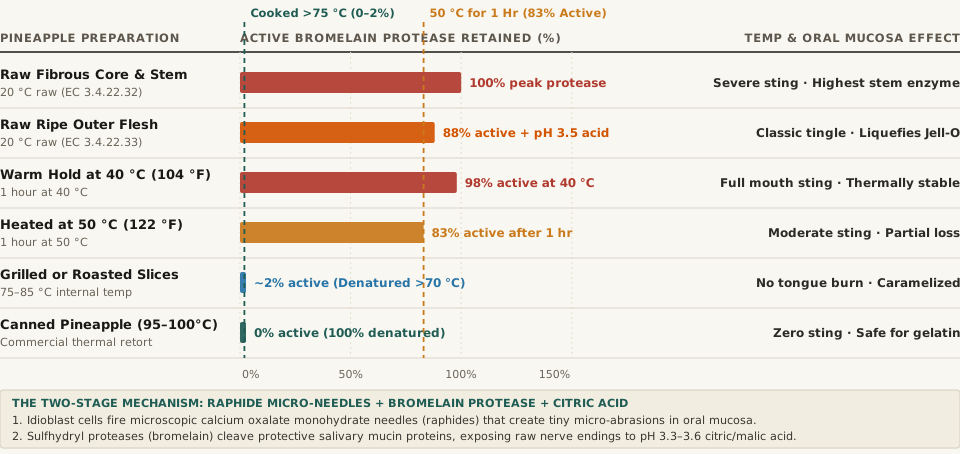
Why does heating pineapple eliminate both the mouth burn and the fruit's ability to tenderize steak or ruin gelatin desserts? Because bromelain is a globular protein whose catalytic cysteine-histidine active site depends on a precise three-dimensional fold, heat above 65–70 °C (149–158 °F) irreversibly denatures the enzyme. Look at the experimental temperature stability curve from biochemical assays of bromelain:
| Pineapple Cut or Thermal Preparation | Processing Temperature (°C / °F) | Active Bromelain Retained (%) | Raphide & Acid Synergy | Oral Mucosa Tingling & Culinary Behavior |
|---|---|---|---|---|
| Raw Fibrous Central Core & Stem | 20 °C (68 °F — Raw Ambient) | 100% Reference Peak (EC 3.4.22.32) |
High raphide density + pH 3.3 acid | Severe tongue/lip soreness; highest sulfhydryl protease load |
| Raw Ripe Pineapple Flesh (Outer Ring) | 20 °C (68 °F — Raw Ambient) | 88% Active (EC 3.4.22.33) |
Active raphide micro-punctures + pH 3.5 | Classic prickly mouth tingle; rapidly liquefies collagen/gelatin |
| Warm Hold (1 Hour at 40 °C) | 40 °C (104 °F — Warm Hold) | ~98–100% Active | Intact raphides + active protease | Full mouth tingling persists; enzyme is completely stable at 40 °C |
| Moderate Heating (1 Hour at 50 °C) | 50 °C (122 °F — Partial Loss) | 83% Active (17% loss in 1 hr) | Intact raphides + 83% protease activity | Noticeable tingling and gelatin degradation still occur at 50 °C |
| Grilled or Roasted Pineapple Slices | 75–85 °C Internal (167–185 °F) | ~2% Active (~98% denatured) | Softened cell matrix blunts raphides | Virtually zero mouth burn; safe for gelatin and sensitive palates |
| Commercially Canned Pineapple | 95–100 °C Retort (203–212 °F) | 0% Active (100% denatured) | Syrup/juice matrix prevents irritation | Zero mouth tingling and zero meat-tenderizing or gelatin-liquefying power |
Notice two critical kitchen takeaways from the thermal data:
- Freezing or Lukewarm Rinsing Does Nothing: As noted in bromelain stability studies, concentrated bromelain remains stable for at least a week at room temperature, survives multiple freeze-thaw cycles with virtually zero loss of activity, and retains 100% activity after an hour at 40 °C (104 °F) and 83% activity after an hour at 50 °C (122 °F). Frozen pineapple chunks thawed for a smoothie will sting your mouth just as much as fresh-cut pineapple.
- Core Removal + Brief High Heat Solves the Problem: Because stem bromelain (
EC 3.4.22.32) is heavily concentrated in the tough cylindrical center core and the outermost base near the peel, slicing away the entire central core (plus an extra 3 mm around it) removes the most aggressive protease zone. And if you sear fresh pineapple rings on a hot grill or simmer them for 2–3 minutes above 75 °C (167 °F), thermal denaturation unfolds the bromelain enzyme completely—letting you enjoy fresh caramelized pineapple or fold it into gelatin and dairy desserts with zero tongue burn.
Track Produce Enzyme Activity, Ripeness, and Prep Lifespans in Redberi
Whether you are prepping fresh cut pineapple without triggering bromelain mouth burn, timing meat marinades so proteolytic enzymes tenderize steak without turning muscle fibers mushy, or comparing cold-storage shelf life across tropical produce, Explore storage benchmarks in Redberi to look up exact temperature thresholds, acid profiles, and kitchen prep guides.