
Why Does Portugal Use London Time (UTC+00:00) After Abandoning Central European Time in 1996?
Drive east across the Guadiana River bridge from the Algarve in southern Portugal into Andalusia in Spain—or cross the northern border from Valença into Tui, Galicia—and your phone clock jumps forward by one full hour, even though Spain's western provinces sit at the exact same longitude as Portugal. Today, continental Portugal and Madeira observe Western European Time (WET, UTC+00:00) in winter and Western European Summer Time (WEST, UTC+01:00) from the last Sunday in March to the last Sunday in October, matching London, Dublin, and Reykjavik while sitting 1 hour behind Madrid (CET/CEST), Paris, and Berlin. Yet as documented in Portuguese legislative and astronomical timekeeping archives and European summer time records, Portugal actually tried switching to Central European Time twice in the twentieth century (from 1966 to 1976 and again from 1992 to 1996)—and both experiments collapsed under the weight of solar geometry.
Why Continental Portugal Sits West of the 7°30'W Boundary (Inside the Natural UTC-01:00 Zone!)
To understand why Central European Time (UTC+01:00 in winter, UTC+02:00 in summer) wreaked havoc on daily life in Lisbon and Porto, start with the globe's 15° solar meridians (Summer time in Europe):
- The
7°30'WSolar Boundary: The Prime Meridian zone (UTC+00:00, centered on0°at Greenwich) extends mathematically from7°30'Eto7°30'W(7.50°W). West of7.50°Wlies the naturalUTC-01:00solar zone (centered on15°W). - Where Lisbon and Porto Actually Sit: Virtually all of continental Portugal lies west of
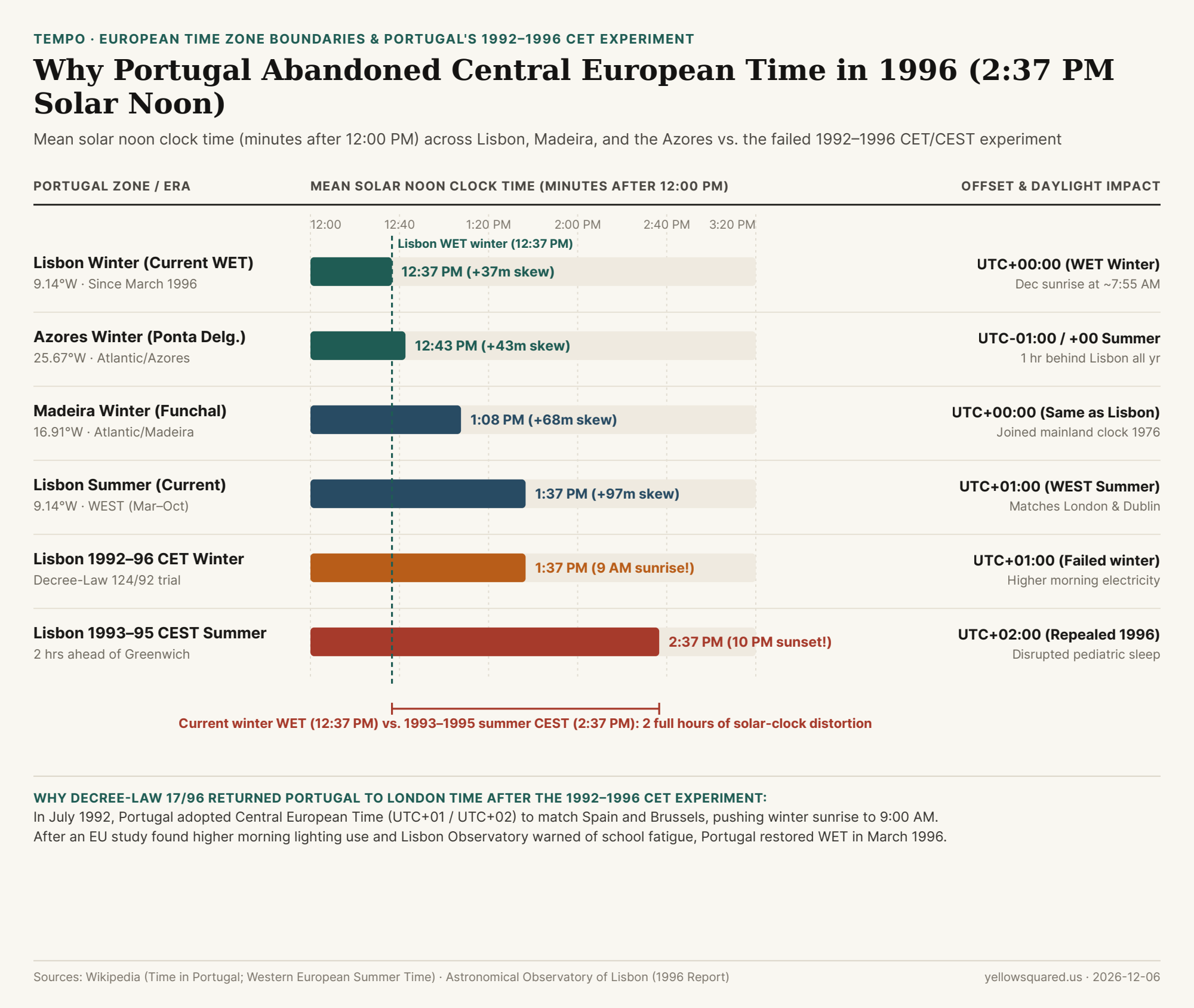
7°30'W! Porto sits at8°37'W(8.62°W) and Lisbon sits at9°08'W(9.14°W). Because every degree west delays solar noon by 4 minutes, the sun crosses Lisbon's meridian 36.6 minutes after Greenwich Mean Time. Even on Greenwich time (UTC+00:00), Lisbon's mean solar noon already falls late at12:37 PMin winter (and1:37 PMin summer onUTC+01:00). - Madeira (
16.91°W) and the Azores (25.67°W): Located out in the Atlantic, Funchal, Madeira (Atlantic/Madeira) sits 68 minutes west of Greenwich (mean winter solar noon at1:08 PMonUTC+00:00), while Ponta Delgada in the Azores (Atlantic/Azores,25°40'W) sits 103 minutes west of Greenwich and observesUTC-01:00in winter (UTC+00:00in summer)—keeping the Azores 1 hour behind Lisbon year-round.
"When Decree-Law 124/92 put Lisbon (9.14°W) on Central European Summer Time (UTC+02:00), mean solar noon was pushed to 2:37 PM—leaving the sun in the sky until 10:15 PM in June and delaying December sunrise past 9:00 AM."
What Went Wrong During Portugal's 1992–1996 Central European Time Experiment
In July 1992, via Decree-Law 124/92, Prime Minister Aníbal Cavaco Silva's government shifted mainland Portugal from WET (UTC+00:00) to CET (UTC+01:00) in winter and CEST (UTC+02:00) in summer so Portuguese banks, ministries, and stock markets would share the exact same working hours as Spain and the European Economic Community in Brussels. Within a single cycle of winter and summer, public backlash mounted across four fronts documented in the 1996 Parliamentary and Lisbon Observatory review:
- Pitch-Black 9:00 AM Winter School Commutes: In December and January under
UTC+01:00, sunrise in Lisbon and Porto did not occur until9:00 AM. Students arrived for first-period classes under streetlamps, and police and insurers recorded a measurable spike in morning traffic accidents and assaults on children walking to school in the dark. - 10:00 PM Summer Daylight and Pediatric Sleep Deprivation: During the summers of 1993, 1994, and 1995 under
CEST (UTC+02:00)—nearly 2 hours and 37 minutes ahead of Lisbon's solar meridian—sunset arrived after9:30 PMand civil twilight lingered until10:00 PM to 10:30 PM, disrupting children's circadian sleep onset. - Higher Electricity Consumption (The Forgotten Office-Light Paradox): A study commissioned by the European Commission found that the 1992 shift failed to save energy: because winter mornings were pitch-black at 8:30 AM, office workers switched on all overhead fluorescent lights upon arrival and forgot to turn them off once the sun finally rose after 9:00 AM.
- Worse Summer Smog From Rush-Hour Alignment: Shifting afternoon rush hour (
5:00 PM–7:00 PMclock time) one hour earlier in true solar time aligned peak vehicle exhaust emissions with the hottest, highest-UV afternoon hours (2:30 PM–4:30 PMsolar time), worsening ground-level ozone pollution.
In December 1995, newly elected Prime Minister António Guterres commissioned an urgent scientific audit from the Astronomical Observatory of Lisbon (Observatório Astronómico de Lisboa). Following the Observatory's February 1996 recommendation, Parliament unanimously passed Decree-Law 17/96, returning continental Portugal to WET (UTC+00:00) / WEST (UTC+01:00) on March 31, 1996.
| Portuguese Zone or Historical Era | IANA TZDB Zone | Longitude | Winter Offset | Summer Offset | Mean Solar Noon | Daylight & Policy Outcome |
|---|---|---|---|---|---|---|
| Lisbon Winter (Current WET) | Europe/Lisbon |
9.14°W |
UTC+00:00 |
UTC+01:00 |
12:37 PM | Restored by Decree-Law 17/96; Dec sunrise ~7:55 AM |
| Ponta Delgada (Azores) | Atlantic/Azores |
25.67°W |
UTC-01:00 |
UTC+00:00 |
12:43 PM | 1 hr behind Lisbon all year; matches EU DST dates |
| Funchal (Madeira) | Atlantic/Madeira |
16.91°W |
UTC+00:00 |
UTC+01:00 |
1:08 PM | Aligned with mainland Lisbon clock since 1976 |
| Lisbon Summer (Current WEST) | Europe/Lisbon |
9.14°W |
UTC+00:00 |
UTC+01:00 |
1:37 PM | June sunset ~9:05 PM; matches London & Dublin |
| Lisbon 1992–1996 CET Winter | Repealed (124/92) | 9.14°W |
UTC+01:00 |
UTC+02:00 |
1:37 PM | 9:00 AM winter sunrises; higher morning electricity |
| Lisbon 1993–1995 CEST Summer | Repealed (124/92) | 9.14°W |
UTC+01:00 |
UTC+02:00 |
2:37 PM | 10:00 PM twilight; pediatric sleep disruption |
How to Track Lisbon, Azores, and Madrid Time Overlaps Year-Round
Because Portugal, Spain, the UK, and the Azores all switch their clocks on the exact same European Union timestamps (01:00 UTC on the last Sunday of March and the last Sunday of October), the offsets between them stay constant all year: Lisbon and Madeira always match London (0h difference), sit 1 hour behind Madrid and Paris, and sit 1 hour ahead of the Azores. Open Tempo in your browser to plan cross-border rail trips and remote calls across Lisbon, Ponta Delgada, Madrid, and North America.