
Why Does Russia Have 11 Time Zones (And Why Did It Abandon Permanent Daylight Saving Time in 2014)?
Spanning 171° of longitude across northern Eurasia—from 19°38′ E on the Baltic coast of Kaliningrad to 169°01′ W at Big Diomede Island in the Bering Strait—Russia covers nearly half the circumference of the northern hemisphere. Today, as documented in Wikipedia's comprehensive history of time in Russia and Moscow Time (MSK), the country operates across 11 contiguous time zones stretching from UTC+02:00 to UTC+12:00, with zero Daylight Saving Time (DST) clock changes. Yet between 2010 and 2014, Russia ran one of the largest chronobiological experiments in modern history: compressing the country from 11 time zones down to 9 and locking the entire nation onto permanent year-round Daylight Saving Time—before dark 10:00 AM and 11:00 AM winter mornings forced lawmakers to repeal the law and restore 11 permanent standard time zones on October 26, 2014.
Why does a single country need 11 time zones, why did Russia's 2011–2014 permanent summer-time experiment push Saint Petersburg nearly two full hours ahead of the sun, and how do trains, flights, and software handle Russian time zones today? Here is the complete geographic and historical breakdown—and how you can compare Eurasian offsets in Tempo.
The 1930 "Decree Time" Baseline: Why Russian Clocks Were Already Ahead of the Sun
To understand why Russia's 2011 permanent Daylight Saving Time experiment backfired so severely in winter, you have to go back to June 16, 1930. On that date, the Council of People's Commissars of the USSR issued a decree advancing every clock in the Soviet Union one hour ahead of its natural astronomical time zone—a permanent +1 hour offset known as Decree Time (Декретное время):
- Moscow (
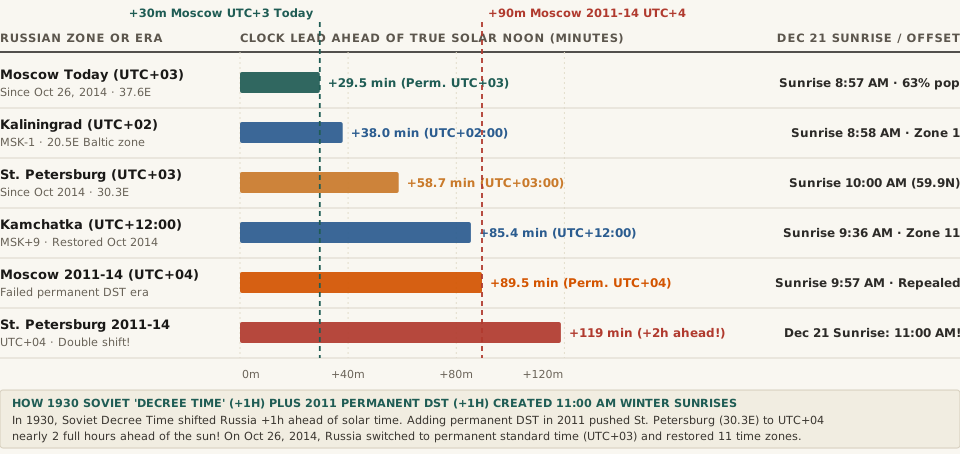
37°37′ E): Sits almost exactly halfway between the30° Emeridian (UTC+02:00) and the45° Emeridian (UTC+03:00). True mean solar time in Moscow isUTC+02:30:29. Even under standardUTC+03:00, Moscow's clocks already lead the sun by+29.5 minutes. - Saint Petersburg (
30°19′ E): Sits dead-center on the natural30° Emeridian (UTC+02:00), where true solar time isUTC+02:01:17. Because Saint Petersburg is placed inside the Moscow Time Zone (UTC+03:00), its civil clocks already lead true solar time by+58.7 minutes(nearly one full hour) even in standard winter time! - Yekaterinburg (
60°36′ E) and Novosibirsk (82°56′ E): Sit near the naturalUTC+04:00andUTC+05:30meridians, but operate onUTC+05:00andUTC+07:00, running+58to+88 minutesahead of solar noon.
What Happened Between 2011 and 2014: 9 Time Zones and 11:00 AM Winter Sunrises
In 2010 and early 2011, then-President Dmitry Medvedev launched two sweeping reforms aimed at simplifying national governance and eliminating twice-yearly clock changes:
- Cutting 11 Time Zones Down to 9 (March 2010): The federal government abolished Samara Time (merging Samara and Udmurtia into Moscow Time) and abolished Kamchatka Time (
UTC+12:00), forcing Petropavlovsk-Kamchatsky and Chukotka back into Magadan Time—sparking street protests of up to20,000residents in Kamchatka who suddenly lost an hour of afternoon daylight. - Locking In Permanent Daylight Saving Time (March 27, 2011): On March 27, 2011, Russians sprang forward 1 hour for summer time and were told they would never turn their clocks back again. Moscow Time (
MSK) became permanentUTC+04:00year-round.
Because Russian regions were already carrying the 1930 Decree Time offset, locking in summer time created permanent double daylight saving time across high-latitude cities (55° N to 60° N) where December daylight lasts only 6 to 7 hours. During the winters of 2011–2012, 2012–2013, and 2013–2014, December 21 sunrise did not occur until 9:57 AM in Moscow and 11:00 AM in Saint Petersburg—forcing millions of schoolchildren and commuters to wake up, travel, and spend the entire morning in pitch darkness. As reported by The Moscow Times, national polling showed support for permanent DST had fallen below 32%.
When Russia locked Moscow Time onto permanent UTC+04:00 between 2011 and 2014, Saint Petersburg clocks ran 119 minutes ahead of the sun—delaying December sunrise until 11:00 AM.
The October 26, 2014 Reversal: Permanent Winter Time and 11 Zones Restored
On July 1, 2014, the State Duma voted overwhelmingly to end the permanent summer-time experiment and undo the 2010 zone mergers. At 02:00 on October 26, 2014:
- Permanent Standard Time (
UTC+03:00in Moscow): Clocks across most of Russia turned back 1 hour to permanent standard ("winter") time with zero future seasonal transitions. - 11 Time Zones Restored: Samara Time (
UTC+04:00,MSK+1) and Kamchatka Time (UTC+12:00,MSK+9) were reinstated, restoring Russia's full 11-zone span fromUTC+02:00toUTC+12:00. - The 2018 Railway Clock Reform: For nearly a century, every long-distance train timetable and station clock across Russia's 11 time zones displayed Moscow Time (
MSK) so Trans-Siberian dispatchers could avoid time zone math. On August 1, 2018, Russian Railways (RZD) finally switched passenger tickets and station announcements to local time, matching commercial aviation.
Complete Reference Table of Russia's Time Zones and 2011–2014 Reforms
The table below compares UTC offsets, Moscow references (MSK), solar noon skews, and December 21 sunrise times across Russia's major zones and the 2011–2014 experiment (full dataset in russia-11-time-zones-utc-2-to-utc-12-and-2011-2014-dst-experiment.csv):
| Russian Time Zone or Era | UTC Offset (MSK Ref) |
Representative City | Solar Noon Skew | Dec 21 Sunrise | Population & Policy Status |
|---|---|---|---|---|---|
Kaliningrad Time (USZ1) |
UTC+02:00 (MSK−1) |
Kaliningrad (20.51° E) |
+38.0 min |
8:58 AM |
Westernmost zone (~0.7% of pop.); matches EET |
Moscow Time Today (MSK) |
UTC+03:00 (MSK+0) |
Moscow (37.62° E) |
+29.5 min |
8:57 AM |
Home to ~63% of Russia's population; zero DST |
Saint Petersburg on MSK |
UTC+03:00 (MSK+0) |
St. Petersburg (30.32° E) |
+58.7 min |
10:00 AM |
Inside MSK; runs ~1h ahead of its 30° E meridian |
| 2011–2014 Permanent DST Era | UTC+04:00 (Old MSD) |
Moscow / St. Petersburg | +89.5m / +119m |
9:57 AM / 11:00 AM |
Repealed Oct 26, 2014 after dark-morning backlash |
| Yekaterinburg & Novosibirsk | UTC+05:00 to +07:00 |
Urals & W. Siberia | +58m to +88m |
9:35–9:58 AM |
MSK+2 to MSK+4; retains 1930 +1h Decree offset |
Kamchatka Time (PETT) |
UTC+12:00 (MSK+9) |
Petropavlovsk (158.65° E) |
+85.4 min |
9:36 AM |
Easternmost zone (10 hours ahead of Kaliningrad) |
Working across permanent no-DST zones like Moscow, Istanbul, or Tokyo alongside seasonal DST zones in Europe and North America? Open Tempo in your browser to track shifting winter and summer time gaps at a glance.