
Why Is Samoa 24 Hours Ahead of American Samoa Just 40 Miles Away?
Why Is Samoa 24 Hours Ahead of American Samoa Just 40 Miles Away?
Although Samoa (Apia, 171.76°W) and American Samoa (Pago Pago, 170.70°W) sit just 70 km (43 miles) apart, Samoa skipped Friday, December 30, 2011 to jump west across the International Date Line from UTC-11 to UTC+13—creating a 24-hour calendar gap.
Stand on the eastern coast of Upolu in the Independent State of Samoa (`Apia, 171.76°W`) and look east across 70 kilometers (43 miles) of South Pacific ocean toward Tutuila, the main island of the U.S. territory of American Samoa (`Pago Pago, 170.70°W`). Because the two islands sit just `1.06°` of longitude apart, solar noon arrives in Pago Pago a mere 4 minutes and 14 seconds earlier than in Apia.
Check the official clocks in both capitals, however, and you encounter one of the most striking calendar paradoxes on Earth: when it is 10:00 PM on Friday night in Apia (`UTC+13:00`), it is 10:00 PM on Thursday night in Pago Pago (`UTC-11:00`). The two islands show the exact same hour and minute on the clock face, separated by one full calendar day (24 hours). Understanding how Samoa redrew the International Date Line twice in 119 years explains how you can celebrate New Year's Eve or your birthday twice with a 35-minute turboprop flight.
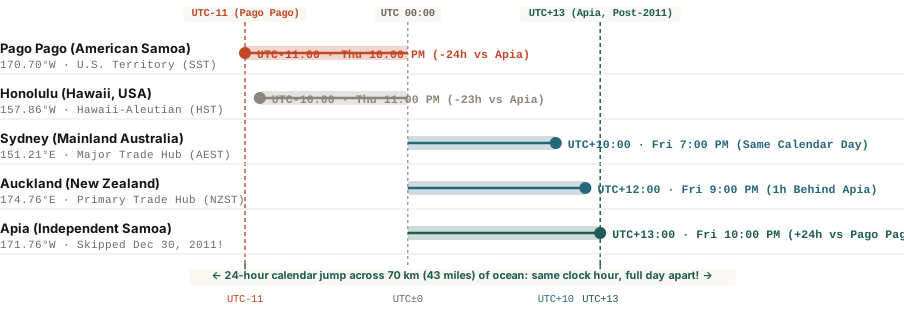
The 1892 Shift East—and Why It Broke 21st-Century Commerce
Because the Samoan archipelago sits near `171°W` longitude (`171° ÷ 15° = 11.4 hours` west of Greenwich), its natural astronomical time zone is `UTC-11:00`. Surprisingly, prior to 1892, European traders in Samoa kept Asian/Australian dates (`UTC+12:30` local mean time). In 1892, American traders persuaded King Malietoa Laupepa to align Samoa's calendar with steamships arriving from San Francisco. To cross to the eastern (American) side of the International Date Line, Samoa celebrated Monday, July 4, 1892 twice in a row—locking both Western Samoa and American Samoa onto `UTC-11:00` for the next 119 years.
By 2011, however, independent Samoa's economic gravity had shifted overwhelmingly toward New Zealand (`UTC+12/+13`), Australia (`UTC+10/+11`), and East Asia. Sitting on `UTC-11:00` created a two-day business-week penalty:
- Lost Mondays: When banks and government offices opened for Monday morning in Auckland and Sydney, it was still Sunday morning in Apia.
- Lost Fridays: When Samoan exporters showed up for work on Friday morning in Apia, it was already Saturday morning in New Zealand and Australia—cutting the shared 5-day workweek down to just 3 overlapping business days (Tuesday, Wednesday, and Thursday).
By sitting on the American side of the Date Line, Samoa was losing two out of every five business days with its largest trading partners in Auckland and Sydney.
The Day That Never Existed: Skipping Friday, December 30, 2011
In May 2011, Prime Minister Tuilaepa Sailele Malielegaoi and the Samoan Parliament passed the International Date Line Act 2011 (soon joined by the neighboring New Zealand territory of Tokelau):
- Erasing December 30, 2011: At the stroke of midnight at the end of Thursday, December 29, 2011, clocks in Samoa (then on summer time) jumped forward 24 hours directly to Saturday, December 31, 2011. Friday, December 30, 2011 simply never existed in Samoa (though employers were legally required to pay salaried staff for the missing Friday, and banks could not charge interest for that date).
- Permanent `UTC+13:00` Standard Time: Since abolishing seasonal Daylight Saving Time in 2021, `Pacific/Apia` observes `UTC+13:00` year-round—placing Samoa on the exact same clock as New Zealand Daylight Time (`NZDT`) in summer and just 1 hour ahead of Auckland (`NZST, UTC+12:00`) in winter.
- American Samoa Stays on `UTC-11:00`: Because American Samoa is an unincorporated U.S. territory tied closely to Honolulu (`UTC-10:00`) and federal agencies in Washington, D.C., `Pacific/Pago_Pago` remained on the eastern side of the Date Line at `UTC-11:00`.
When coordinating Pacific logistics, remote teams, or flights across Honolulu, Pago Pago, Apia, and Auckland, you can Open Tempo in your browser to visualize live calendar dates and business-day overlaps across both sides of the International Date Line.