
Why Does Saskatchewan Stay on Central Standard Time (UTC-06:00) Year-Round Without Daylight Saving Time?
Ask most travelers which time zone Saskatchewan is in and they will tell you that the province "doesn't believe in Daylight Saving Time." Mathematically, the exact opposite is true. Although Saskatchewan is bisected from north to south by the 105th meridian west (105.0°W)—the exact solar reference meridian for Mountain Standard Time (MST, UTC−07:00)—the province has kept its clocks permanently set one hour ahead at Central Standard Time (CST, UTC−06:00, IANA America/Regina) since the Saskatchewan Time Act of 1966 (Time in Saskatchewan - Wikipedia; Daylight saving time in Canada - Wikipedia).
Because UTC−06:00 is identical to Mountain Daylight Time (MDT), Saskatchewan effectively placed itself on permanent year-round Daylight Saving Time sixty years ago (Time in Canada - Wikipedia). When you coordinate cross-border meetings across Calgary, Regina, Winnipeg, and Chicago in Open Tempo in your browser, you can see how Saskatchewan shares Denver and Calgary's clock in summer and Chicago and Winnipeg's clock in winter without ever touching a wall clock.
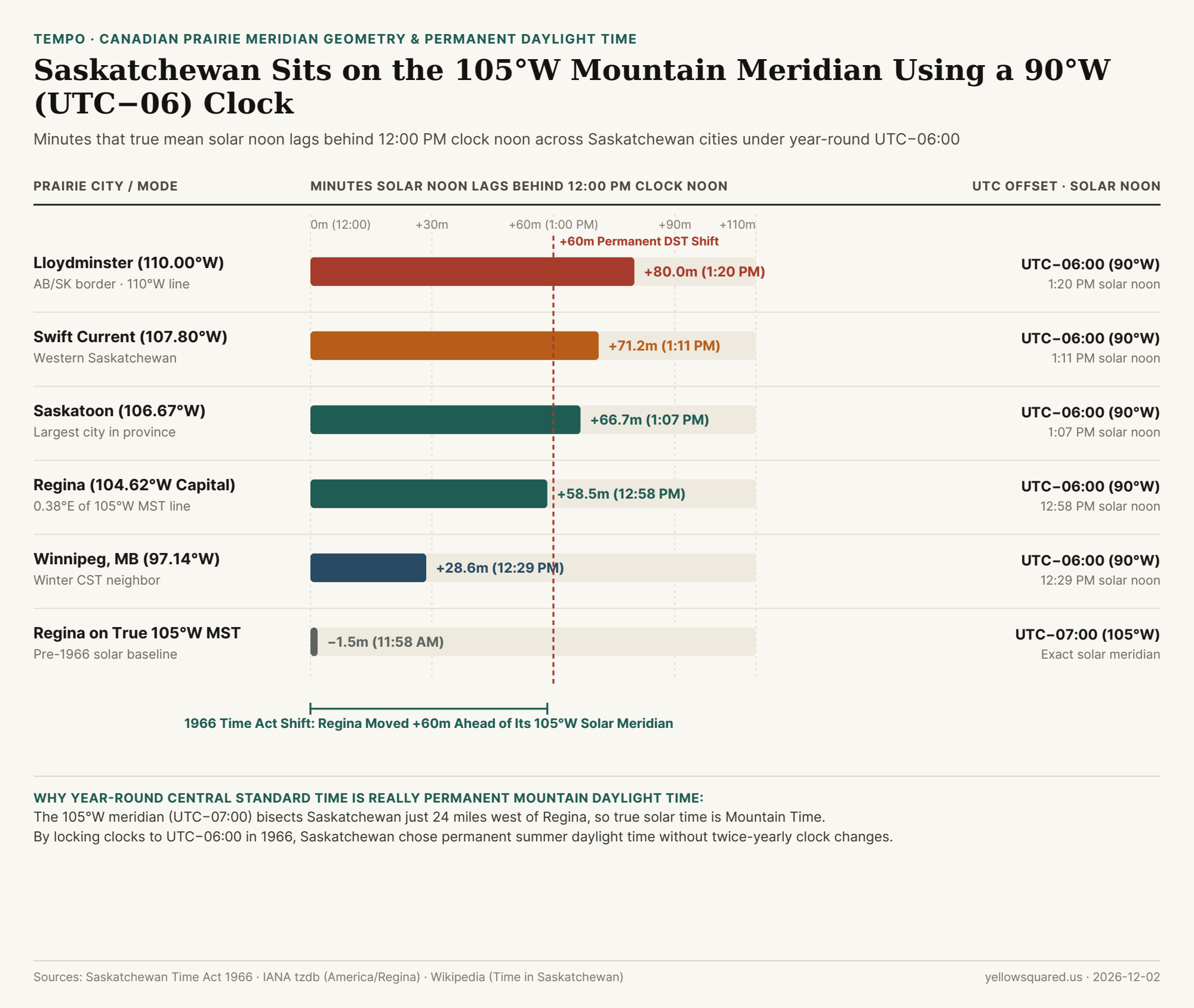
The 105°W Solar Math: Why Solar Noon Hits Saskatoon at 1:07 PM
Earth rotates 15° of longitude every hour, or 1° every 4 minutes. The governing meridian for UTC−06:00 (Central Standard Time) lies at 90.0°W (near Thunder Bay, Ontario, and Memphis, Tennessee), whereas Saskatchewan spans from roughly 101.5°W on the Manitoba border to 110.0°W on the Alberta border (Time in Saskatchewan - Wikipedia):
- Regina (104.62°W under UTC−06:00): The provincial capital sits just
0.38°east of the105.0°WMountain meridian, but14.62°west of the90.0°WCentral meridian. Multiplying14.62° × 4 minutes/degreepushes mean solar noon to 12:58 PM CST (a+58.5 minutelag behind clock noon). - Saskatoon (106.67°W under UTC−06:00): Located
16.67°west of90.0°W, mean solar noon arrives66.7 minutesafter 12:00 PM, at 1:07 PM CST year-round. - Swift Current (107.80°W under UTC−06:00): In southwestern Saskatchewan, solar noon lags clock noon by
71.2 minutes, occurring at 1:11 PM CST. - Lloydminster (110.00°W on the 50th Meridian): Sitting directly on the Alberta–Saskatchewan border (
20.0°west of90.0°W), aUTC−06:00clock places mean solar noon 80.0 minutes after 12:00 PM (at 1:20 PM) (Time in Saskatchewan - Wikipedia).
"Saskatchewan did not abolish Daylight Saving Time in 1966—it locked its 105°W Mountain Time geography onto a permanent 90°W (UTC−06:00) summer clock 365 days a year."
Why the 1966 Time Act Ended Saskatchewan's Local Clock Chaos
Before 1966, timekeeping in Saskatchewan was a municipal free-for-all. Eastern towns near Manitoba used Central Time, western towns near Alberta used Mountain Time, and individual town councils voted independently on whether and when to adopt summer Daylight Saving Time (Time in Saskatchewan - Wikipedia). Because the boundary between local zones zig-zagged across rural highways, drivers traveling due north or south crossed multiple time changes within the same province.
A 1956 provincial plebiscite revealed a three-way deadlock: urban residents wanted Central Time, rural farmers wanted Mountain Standard Time, and voters were split 50/50 on seasonal clock changes. In 1966, Premier Ross Thatcher's government passed the Time Act of 1966, compromising by placing the entire province on year-round Central Standard Time (UTC−06:00) (Time in Saskatchewan - Wikipedia): urban centers got the UTC−06:00 offset and long summer evenings they wanted, while rural communities never had to reset their clocks twice a year.
| Prairie City / Mode | IANA Zone ID | Active UTC Offset | Clock Meridian | Local Longitude | Mean Solar Noon (Lag) |
|---|---|---|---|---|---|
| 1. Lloydminster (Border) | America/Regina |
UTC−06:00 |
90.00°W |
110.00°W |
1:20 PM (+80.0 min) |
| 2. Swift Current (West SK) | America/Regina |
UTC−06:00 |
90.00°W |
107.80°W |
1:11 PM (+71.2 min) |
| 3. Saskatoon (Central SK) | America/Regina |
UTC−06:00 |
90.00°W |
106.67°W |
1:07 PM (+66.7 min) |
| 4. Regina (Capital) | America/Regina |
UTC−06:00 |
90.00°W |
104.62°W |
12:58 PM (+58.5 min) |
| 5. Winnipeg, MB (Winter) | America/Winnipeg |
UTC−06:00 |
90.00°W |
97.14°W |
12:29 PM (+28.6 min) |
| 6. Regina on True 105°W MST | Solar 105°W |
UTC−07:00 |
105.00°W |
104.62°W |
11:58 AM (−1.5 min) |
The Lloydminster Charter Exception & 2026 Western Canadian Alignment
The 1966 Time Act included a famous municipal carve-out for Lloydminster, a bi-provincial city whose main street (50th Avenue) runs directly along the 110.0°W border between Alberta and Saskatchewan. To prevent residents from changing time zones when crossing the street, Lloydminster's charter permitted the Saskatchewan half of the city to observe Mountain Standard Time (UTC−07:00) in winter and Mountain Daylight Time (UTC−06:00) in summer alongside Alberta—before Saskatchewan and western provinces aligned on permanent UTC−06:00 in 2026 (Time in Saskatchewan - Wikipedia; Time in Canada - Wikipedia). When configuring servers or calendar invites for Saskatchewan, always select America/Regina (or America/Swift_Current) rather than generic US Central Time (America/Chicago) so your software never applies a spring or autumn DST shift. To compare live working hours across Regina, Calgary, Toronto, and U.S. hubs, Open Tempo in your browser.