
Why Is Spain in the Wrong Time Zone?
Why Is Spain in the Wrong Time Zone?
Although Madrid sits directly south of London along the Greenwich Prime Meridian (3.7°W), Spain shifted its national clock one hour ahead to Central European Time (UTC+1 / UTC+2) in March 1940—pushing summer sunsets past 10:00 PM in Galicia.
Glance at a map of Western Europe and trace the 0° Greenwich Prime Meridian straight down from London. The line passes through eastern Spain near Zaragoza, leaving Madrid (3.7°W) and almost the entire Iberian Peninsula firmly inside the natural Greenwich Mean Time (UTC+0) zone—and placing northwestern Galicia (8.7°W) nearly far enough west for UTC-1. Yet when you cross the land border from Portugal into Spain, you have to advance your watch by one full hour to Central European Time (CET, UTC+1 in winter and UTC+2 in summer).
Because Spain shares an official clock with Berlin, Warsaw, and Belgrade—cities located up to 2,000 miles to the east—the country lives in a permanent state of solar jet lag. Understanding how Spain ended up an hour (and in summer, two and a half hours) ahead of the sun explains everything from 10:15 PM Galician sunsets to why Spaniards eat lunch at 2:00 PM and dinner at 9:30 PM.
The March 1940 Wartime Clock Shift
From January 1, 1901, until early 1940, mainland Spain officially observed Greenwich Mean Time (UTC+0), matching its geographic longitude alongside the United Kingdom, Portugal, and France. On March 16, 1940, at 11:00 PM, Francisco Franco's government issued a decree advancing Spanish clocks by 60 minutes to midnight, aligning the nation with Central European Time.
Published in the official state bulletin (Boletín Oficial del Estado) as a temporary measure for the "convenience of synchronizing national time with other European countries," the shift matched the wartime clock expansions across occupied Western Europe. When World War II ended in 1945, Britain and Portugal returned to UTC+0, while Spain and France retained UTC+1 permanently—and compounded the offset in the 1970s by adding an extra hour of summer Daylight Saving Time (CEST, UTC+2).
Spaniards do not actually eat lunch later than the rest of Europe by the sun; they eat at 12:15 PM solar time, which their clock happens to label 2:15 PM.
How a 2.5-Hour Solar Lag Reshapes Daily Life
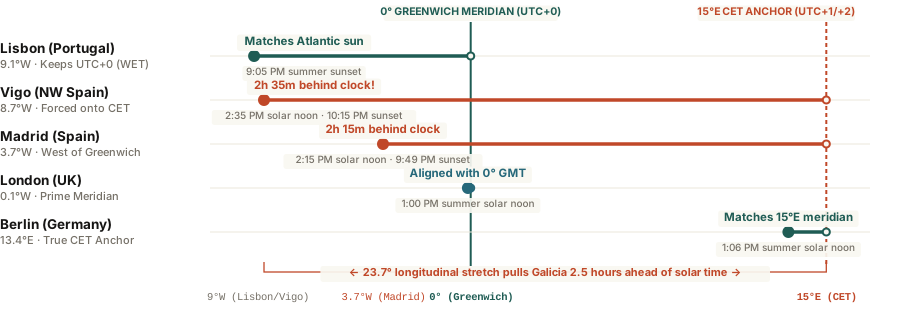
Because Earth rotates 15 degrees per hour (4 minutes per degree of longitude), anchoring Madrid (3.7°W) and Vigo (8.7°W) to the 30°E summer meridian (UTC+2) creates extraordinary daylight distortions:
- 2:35 PM Solar Noon in Galicia: In western cities like Vigo, A Coruña, and Santiago de Compostela, true astronomical midday during summer does not arrive until 2:35 PM on the clock.
- The Myth of the Late Spanish Meal: Tourists often marvel that Spanish restaurants do not open for lunch until 1:30 PM or 2:00 PM and serve dinner between 9:30 PM and 10:30 PM. In reality, when the clock reads 2:15 PM in Madrid, the sun is at its zenith (solar noon)—meaning Spaniards eat at the exact same biological sun angle as a Londoner eating lunch at 1:00 PM.
- The Portugal Border Time Machine: Driving west from Badajoz, Spain, across the Caia River into Elvas, Portugal, rewinds your clock by 60 minutes even though both towns share the exact same solar meridian.
When coordinating cross-border European travel or remote meetings across Madrid, Lisbon, and London, you can Open Tempo in your browser to compare live CET and WET workday overlaps without getting caught off guard by Iberian time shifts.