
Why Is Spain in the Same Time Zone as Berlin Instead of London?
Why Is Spain in the Same Time Zone as Berlin Instead of London?
Look at a map of Western Europe and drop a straight vertical line south from London (0.13°W). That meridian passes east of Madrid (3.70°W), east of Seville (5.98°W), and more than 700 kilometers east of Vigo and A Coruna on Spain's Atlantic coast (8.72°W). Geographically, almost all of Peninsular Spain lies in the Western Hemisphere's Greenwich Mean Time (GMT, UTC±00:00) band alongside the United Kingdom, Ireland, and Portugal. Yet every day of the year, Spain sets its clocks to Central European Time (CET, UTC+01:00 in winter; CEST, UTC+02:00 in summer)—the exact same time zone as Berlin (13.40°E) and Warsaw (21.01°E), more than 2,500 kilometers to the east.
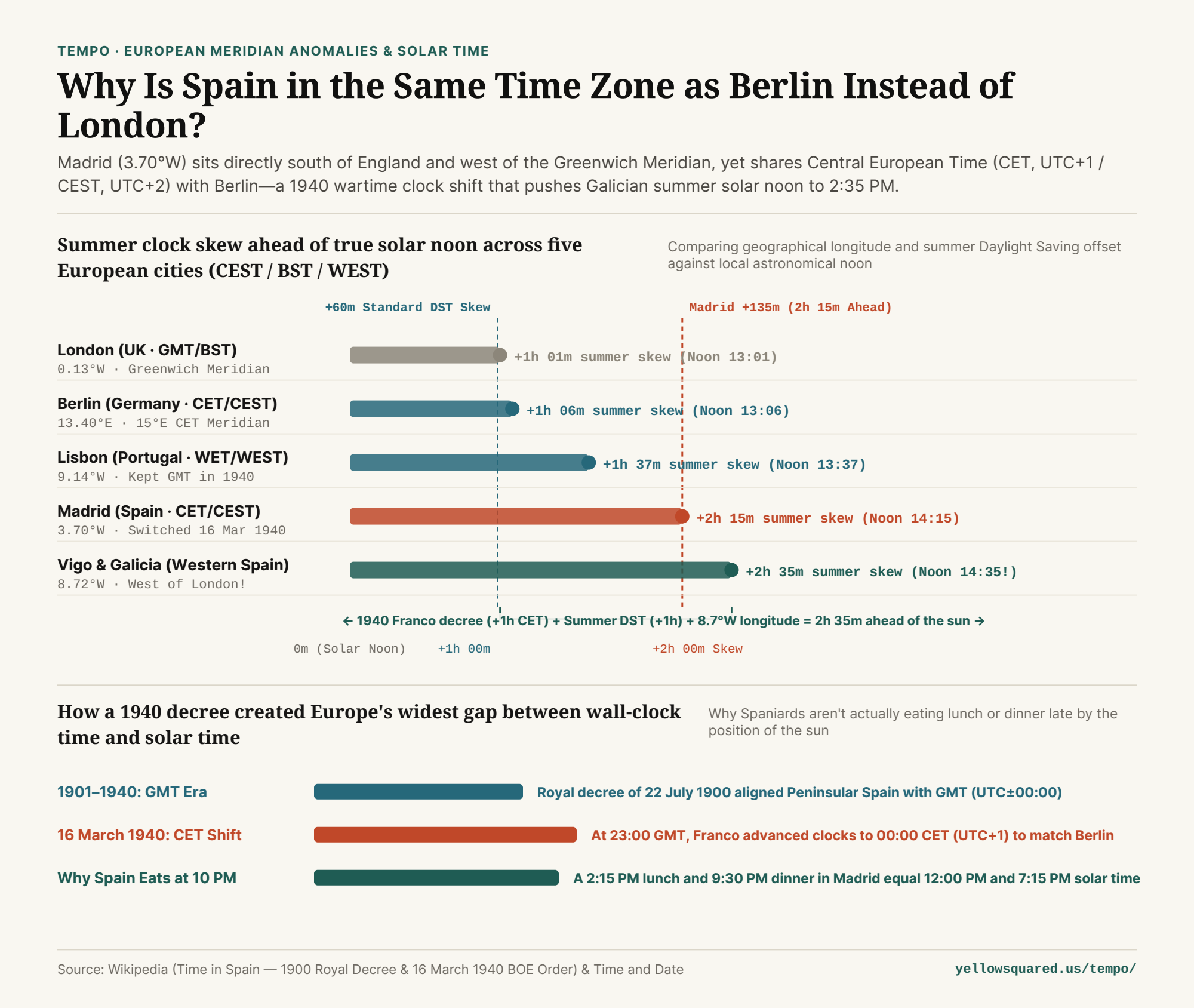
1. From the 1900 Royal Decree (GMT) to 16 March 1940 (CET)
Spain did not always run an hour ahead of its geography. As documented in the historical record of Time in Spain, before 1901 each Spanish province kept local solar time anchored to the Royal Observatory of Madrid (3°41'15"W, or 14 minutes and 45 seconds behind Greenwich). On 22 July 1900, Queen Regent Maria Christina signed a Royal Decree establishing Greenwich Mean Time (UTC±00:00) as the official standard time for Peninsular Spain and the Balearic Islands effective 1 January 1901.
For nearly four decades, Madrid, London, and Lisbon shared the same clock. That ended during World War II. On 7 March 1940, following the end of the Spanish Civil War, Francisco Franco's Ministry of the Presidency published an order in the Boletin Oficial del Estado (BOE) citing the "convenience of the national schedule marching in step with other European countries." At 23:00 GMT on Saturday, 16 March 1940, Spain advanced its clocks by 60 minutes to 00:00 on Sunday, 17 March 1940—aligning Spain with Berlin's Central European Time (UTC+01:00). Although the 1940 order stated the measure was temporary until a permanent return to Greenwich time could be decreed, Spain never turned the clock back.
"When residents of Madrid sit down for lunch at 2:15 PM or dinner at 9:30 PM in the summer, the sun is in the exact same position in the sky as it is at 12:00 PM noon and 7:15 PM in London or Berlin."
2. The Two-Hour-and-35-Minute Summer Solar Skew
Every 15° of longitude corresponds to 1 hour (60 minutes) of Earth's rotation, or 4 minutes per degree. Central European Time (UTC+01:00) is astronomically centered on the 15° East meridian, which runs through eastern Germany, Prague, and southern Italy. When Spain adds another hour for European Summer Time (CEST, UTC+02:00) between late March and late October, Peninsular Spain is locked to the solar time of the 30° East meridian—the longitude of Cairo, Kyiv, and Istanbul:
- Madrid (3.70°W): True solar time is
14 minutes 48 secondsbehind UTC. Under summer CEST (UTC+02:00), wall clocks sit 2 hours and 15 minutes ahead of the sun—meaning solar noon (peak UV and highest sun angle) happens at 14:15 (2:15 PM). - Vigo and A Coruna, Galicia (8.72°W): Located directly north of Portugal, western Galicia sits
34 minutes 53 secondsbehind UTC. Under summer CEST, Galician clocks run 2 hours and 35 minutes ahead of solar time—pushing solar noon to 14:35 (2:35 PM) and June sunsets past 22:15 (10:15 PM). - The Portugal Border Jump: Because Portugal returned to Greenwich time (
WET, UTC±00:00/WEST, UTC+01:00), walking across the short international bridge over the Minho River from Tui (Galicia, Spain) to Valenca (Portugal) shifts your watch back by 1 full hour even though you are walking straight north-south.
3. European Solar Noon vs. Clock Time Comparison Table
The table below compares geographical longitude, true solar offset, winter standard time, and summer Daylight Saving skew across five reference European cities (available in why-does-spain-use-central-european-time-instead-of-gmt.csv):
| European City | Longitude | True Solar Offset vs UTC | Winter Standard Time | Summer Clock Time | Summer Skew vs Solar Noon |
|---|---|---|---|---|---|
| Vigo & A Coruna (Galicia, Spain) | 8.72° W | -0h 34m 53s | CET (UTC+01:00) | CEST (UTC+02:00) | +2h 35m (Noon at 14:35) |
| Lisbon (Portugal) | 9.14° W | -0h 36m 34s | WET (UTC±00:00) | WEST (UTC+01:00) | +1h 37m (Noon at 13:37) |
| Madrid (Central Spain) | 3.70° W | -0h 14m 48s | CET (UTC+01:00) | CEST (UTC+02:00) | +2h 15m (Noon at 14:15) |
| London (United Kingdom) | 0.13° W | -0h 00m 31s | GMT (UTC±00:00) | BST (UTC+01:00) | +1h 01m (Noon at 13:01) |
| Berlin (Germany) | 13.40° E | +0h 53m 36s | CET (UTC+01:00) | CEST (UTC+02:00) | +1h 06m (Noon at 13:06) |
4. Compare Solar vs. Civil Time Zones Live in Tempo
Note that Spainactually has two IANA time zone rules: while Peninsular Spain, Ceuta, Melilla, and the Balearic Islands use Europe/Madrid (UTC+01:00 / UTC+02:00), the Canary Islands (Atlantic/Canary, located near 15.4°W) observe WET/WEST (UTC±00:00 / UTC+01:00), always 1 hour behind Madrid. Whether you are coordinating remote engineering standups across London, Lisbon, Madrid, and Berlin or checking exact Daylight Saving switchover timestamps, Open Tempo in your browser to compare civil clock offsets side-by-side.
Verified Primary Sources
- Wikipedia — Time in Spain (22 July 1900 Royal Decree & 16 March 1940 BOE Clock Shift to CET) (Retrieved 2026-10-31).
- Time and Date — Time Zones in Spain (Europe/Madrid CET/CEST & Atlantic/Canary WET/WEST) (Retrieved 2026-10-31).