
Why Does Spain Use Central European Time (UTC+1) Instead of London Time (GMT)?
Trace your finger straight down the map of Western Europe from London (0.13°W) and you will pass well to the east of Madrid (3.70°W), Seville (5.98°W), and Vigo (8.72°W). In fact, the 0° Greenwich Prime Meridian slices right through eastern Spain near Zaragoza and Castellón de la Plana, placing more than 85% of Spain's landmass in the Western Hemisphere. Yet when you fly due south from London to Madrid—or drive 15 minutes east across the river border from Valença, Portugal into Tui, Spain—you have to set your watch forward by one full hour to Central European Time (UTC+01:00 in winter, UTC+02:00 in summer), putting western Spain on the exact same clock as Warsaw, Berlin, and Belgrade more than 2,500 kilometers to the east.
Why does Spain operate in the wrong geographical time zone—and how does that 60-to-155-minute gap between clock time and solar time explain why Spaniards famously eat lunch at 2:00 PM and dinner at 9:30 to 10:00 PM? Here is the complete historical and astronomical breakdown of Time in Spain.
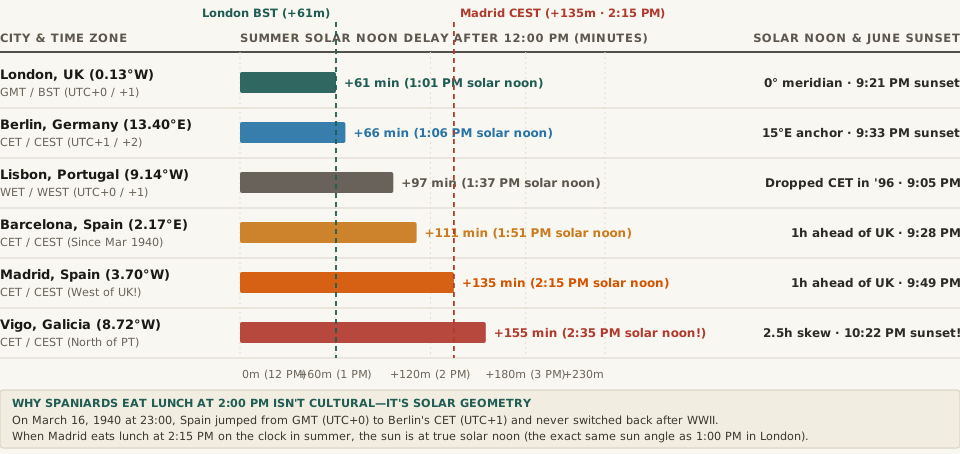
CEST / BST / WEST), showing how Spain's 1940 shift to Central European Time pushes solar noon to 2:15 PM in Madrid and 2:35 PM in Vigo. Download the full dataset: spain-central-european-time-1940-shift-galicia-solar-noon-and-canary-islands.csv.1. From 1901 GMT Standardization to the Night of March 16, 1940
Until the end of the 19th century, Spanish provinces set their clocks to local mean solar time (with Madrid anchored to the Royal Observatory at 3°41'W, running 14 minutes and 45 seconds behind Greenwich). On July 22, 1900, Prime Minister Francisco Silvela signed a Royal Decree (taking effect on January 1, 1901) that placed all of Peninsular Spain and the Balearic Islands on Greenwich Mean Time (UTC±00:00)—the exact natural 15-degree longitudinal band spanning from 7.5°W to 7.5°E. (When officials realized in 1922 that the 1900 decree hadn't explicitly mentioned the Canary Islands near 15.5°W, the archipelago was assigned to UTC−01:00, matching its natural Atlantic meridian.)
For 39 years, Spain, Portugal, Great Britain, France, and Belgium all shared the Greenwich Mean Time zone. Then came World War II. During the spring of 1940, Nazi Germany occupied France, Belgium, the Netherlands, and Luxembourg, forcing those countries onto Berlin's Mitteleuropäische Zeit (Central European Time, UTC+01:00), while Britain itself adopted wartime British Double Summer Time.
As documented in the official Boletín Oficial del Estado (BOE) order cited in Wikipedia's history of time in Spain, the nationalist government of General Francisco Franco published a ministerial decree on March 7, 1940 stating that on Saturday, March 16, 1940 at 23:00 (11:00 PM GMT), clocks across Spain would jump ahead by 60 minutes to 00:00 (midnight CET) on March 17, “in consideration of the convenience of the national horario marching in step with that of other European countries.” Simultaneously, the Canary Islands were shifted 60 minutes forward from UTC−01:00 to UTC+00:00.
Although the March 1940 order explicitly described the advance as a temporary measure until a permanent return to Greenwich time could be decreed, neither Spain nor France ever turned its clocks back after 1945 (whereas the United Kingdom and Portugal returned to GMT).
“At 11:00 PM on March 16, 1940, Spain advanced its clocks by an hour from Greenwich Mean Time to Berlin's Central European Time—and never switched back after World War II.”
2. The Solar Noon Math: Why 2:15 PM in Madrid Is Actually 12:00 Noon by the Sun
Because the Earth rotates 360 degrees in 24 hours—or exactly 15 degrees of longitude per hour (4 minutes of time per degree of longitude)—Central European Time (UTC+01:00) is mathematically anchored to the 15°E meridian (which runs through eastern Germany near Görlitz, Prague, and southern Sweden). During summer Daylight Saving Time (CEST, UTC+02:00, observed from the last Sunday in March to the last Sunday in October), Spanish clocks are anchored to the 30°E meridian—the longitude of Kyiv, Istanbul, and Cairo!
Look at what happens when you apply a 30°E summer clock to cities sitting at 3.7°W to 9.2°W in western Iberia:
| European City or Spanish Region | Longitude | Official Time Zone (Winter / Summer) | Winter Solar Noon Delay (Min After 12 PM) | Summer Solar Noon Delay (Min After 12 PM) | Summer Solar Noon & June Sunset | Historical & Statutory Rule |
|---|---|---|---|---|---|---|
| Berlin, Germany (CET Anchor) | 13.40°E | CET (UTC+1) / CEST (UTC+2) | +6.4 min (~12:06 PM) | +66.4 min (~1:06 PM) | 1:06 PM · ~9:33 PM sunset | Natural 15°E meridian anchor for Central European Time |
| London, UK (Prime Meridian) | 0.13°W | GMT (UTC+0) / BST (UTC+1) | +0.5 min (~12:01 PM) | +60.5 min (~1:01 PM) | 1:01 PM · ~9:21 PM sunset | Natural 0° Prime Meridian; reverted from wartime BDST in 1947 |
| Lisbon, Portugal (Neighbor) | 9.14°W | WET (UTC+0) / WEST (UTC+1) | +36.6 min (~12:37 PM) | +96.6 min (~1:37 PM) | 1:37 PM · ~9:05 PM sunset | Tested CET in 1992–1996; returned to UTC+0 due to 9:00 AM winter dark |
| Barcelona, Spain (East Coast) | 2.17°E | CET (UTC+1) / CEST (UTC+2) | +51.3 min (~12:51 PM) | +111.3 min (~1:51 PM) | 1:51 PM · ~9:28 PM sunset | Adopted GMT in Jan 1901; shifted +1h to CET on Mar 16, 1940 |
| Madrid, Spain (Capital) | 3.70°W | CET (UTC+1) / CEST (UTC+2) | +74.8 min (~1:15 PM) | +134.8 min (~2:15 PM) | 2:15 PM · ~9:49 PM sunset | Sits 3.57° west of London yet runs 60 minutes ahead year-round |
| Vigo / A Coruña (Galicia) | 8.72°W | CET (UTC+1) / CEST (UTC+2) | +94.9 min (~1:35 PM) | +154.9 min (~2:35 PM!) | 2:35 PM · ~10:22 PM sunset! | Directly north of Portugal yet 1h ahead; 2.5-hour summer skew |
| Canary Islands (Tenerife) | 15.43°W | WET (UTC+0) / WEST (UTC+1) | +61.7 min (~1:02 PM) | +121.7 min (~2:02 PM) | 2:02 PM · ~9:00 PM sunset | 1h behind Madrid (Atlantic/Canary); shifted from UTC−1 in 1940 |
Why Spaniards Eat Lunch at 2:00 PM and Dinner at 10:00 PM
Visitors to Madrid or Seville are often astonished that restaurants barely open for lunch before 1:30 or 2:00 PM and don't fill up for dinner until 9:30 or 10:00 PM. Yet when you subtract Madrid's 75-minute winter solar offset (or 135-minute summer solar offset), the mystery vanishes completely: when a Madrileno sits down to lunch at 2:00 PM on the clock, the sun is in the exact same position in the sky (true solar 12:30–12:45 PM) as when an Italian in Rome or a Briton in London eats lunch at 12:45 PM! Spaniards do not eat late relative to the sun; their wall clocks are simply set 75 to 155 minutes ahead of solar time.
3. The Galicia Problem and Portugal's 1992–1996 CET Experiment
Nowhere is this distortion more extreme than in Galicia (northwestern Spain, including Vigo, Santiago de Compostela, and A Coruña at 8.4°W–9.2°W). In June, the sun does not set in Vigo until 10:22 PM (with civil twilight lasting past 11:00 PM), while in December and January, the sun does not rise until nearly 9:05 AM—forcing commuters and schoolchildren to start their day in pitch darkness. Indeed, when neighboring Portugal briefly switched from GMT to CET between 1992 and 1996 to match Spain and Brussels, Portuguese schools and pediatricians documented such severe winter morning sleep deprivation and afternoon heat spikes (with 100°F peak afternoon temperatures hitting at 5:00 PM clock time) that Lisbon repealed the experiment in March 1996 and returned to UTC+00:00.
Don't forget Spain's built-in domestic time-zone rule: whenever Spanish national radio or television announces a schedule, presenters famously add the phrase “una hora menos en Canarias” (“one hour earlier in the Canaries”) because Tenerife, Gran Canaria, and Lanzarote (Atlantic/Canary) run on UTC+00:00 / UTC+01:00, matching London and Lisbon rather than Madrid.
Compare Iberian, Canary, and Global Workday Overlaps in Tempo
Whether you are coordinating a cross-border sprint between Madrid (Europe/Madrid), Lisbon (Europe/Lisbon), London (Europe/London), and remote engineers in Las Palmas de Gran Canaria (Atlantic/Canary), checking live UTC offsets prevents the classic Iberian one-hour calendar mistake. Open Tempo in your browser to compare mainland Spain, Canary Islands, UK, and U.S. time zones side by side.