
Why Does Spinach Make Your Teeth Feel Chalky or Gritty? (And How to Stop 'Spinach Teeth')
Take a bite of a big pan of garlic-sautéed spinach, Swiss chard, or beet greens, rub your tongue across your front teeth, and you will immediately feel a strange, squeaky, sandpaper-like coating—a phenomenon dentists and cooks call "spinach teeth." Why does spinach leave your teeth feeling chalky and gritty within seconds, why does sautéed spinach feel even chalkier than raw baby spinach, and why does curly kale never trigger the effect at all? As documented in Wikipedia's chemical profile of oxalic acid and calcium oxalate, that gritty film is the result of an instantaneous precipitation reaction inside your mouth: soluble oxalic acid from the spinach reacts with free calcium ions in your saliva to form millions of microscopic, water-insoluble crystals on your teeth.
Is the "spinach teeth" coating harmful to tooth enamel, why does spinach contain 57 times more oxalic acid than kale (970 mg vs. 17 mg per 100g), and how do two simple kitchen techniques—blanch-and-drain and in-pan dairy pairing—eliminate the chalky feeling before the food ever reaches your fork? Here is the complete food-chemistry guide—and how to organize your leafy greens and prep methods in Redberi.
The Precipitation Reaction: How Spinach Steals Calcium From Your Saliva
Plants in the Amaranthaceae family (spinach, Swiss chard, beets, quinoa) and Polygonaceae family (rhubarb, sorrel) synthesize high levels of oxalic acid (ethanedioic acid, H2C2O4) and soluble sodium/potassium oxalate salts inside their cellular vacuoles as a natural defense against herbivorous insects and to regulate internal calcium levels.
When you chew spinach—or wilt it in a hot skillet, which bursts the plant cell walls—those soluble oxalate anions (C2O4^2-) dissolve into your saliva. Human saliva is naturally supersaturated with dissolved calcium ions (Ca^2+, roughly 1.2 to 2.0 mmol/L) to remineralize tooth enamel. The moment free oxalate ions meet salivary calcium ions, they snap together:
Ca^2+ (saliva) + C2O4^2- (spinach) -> CaC2O4 (insoluble crystal precipitate)
Because calcium oxalate has an extraordinarily low solubility product in neutral water (K_sp = 2.32 x 10^-9), it precipitates out of your saliva almost instantaneously as microscopic, non-dissolving crystals (whewellite) that stick to the protein pellicle covering your teeth:
- Why Your Teeth Feel "Squeaky" or "Chalky": Normally, salivary mucins lubricate your enamel so your upper and lower teeth glide smoothly past each other. A monolayer of insoluble
CaC2O4micro-crystals disrupts that lubrication boundary, creating high mechanical friction—the exact same physics as chalk on a blackboard. - Does It Damage Tooth Enamel? No. Unlike citrus sodas or vinegar (which erode hydroxyapatite enamel when oral pH drops below
5.5), calcium oxalate crystals are mechanically softer than tooth enamel and sit harmlessly on the surface pellicle. Within30 to 60 minutes, normal salivary turnover and tongue movement wash the crystals away completely.
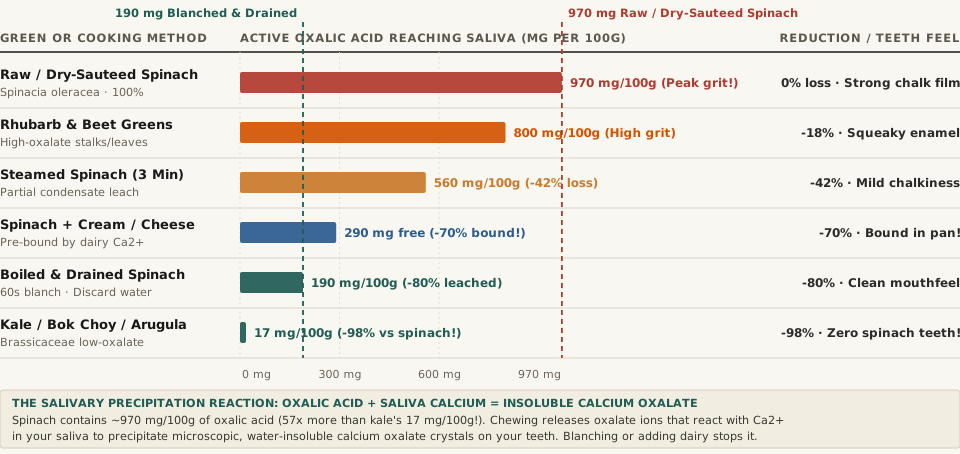
mg per 100g serving) across high-oxalate spinach, rhubarb, and beet greens versus dairy-paired spinach, boiled/drained spinach, and low-oxalate Brassicaceae greens (kale, bok choy, arugula). Source: Wikipedia — Oxalic Acid & Calcium Oxalate.Why Dry-Sautéed Spinach Is Worst (And Why Kale Never Causes "Spinach Teeth")
Many home cooks notice that a cooked side dish of sautéed spinach triggers much stronger "spinach teeth" than a raw spinach salad. Two factors explain why:
- Cell-Wall Rupture + Volume Shrinkage in a Dry Skillet: When you toss a massive
300-grambag of raw spinach into a dry or olive-oil skillet, heat ruptures 100% of the cell vacuoles (releasing all stored soluble oxalic acid), while the leaves wilt to one-fifth of their raw volume. Because you do not drain the skillet, all~2,500+ mgof oxalic acid stays coated right on the wilted leaves you eat in a few bites. - Spinach (
970 mg/100g) vs. Kale (17 mg/100g) and Arugula (2 mg/100g): Cruciferous greens in the Brassicaceae family—including curly kale (15–20 mg/100g), bok choy (10 mg/100g), collard greens (10 mg/100g), and arugula (2 mg/100g)—use sulfur-based glucosinolates for plant defense instead of oxalic acid. Containing 98% less oxalic acid than spinach, they never precipitate calcium oxalate in your saliva.
Dry-sautéing spinach bursts its cell walls and evaporates the water while leaving 100% of its 970 mg/100g oxalic acid on the leaves—whereas boiling spinach for 60 seconds and draining the pot leaches up to 80% of soluble oxalates into the water.
How to Stop "Spinach Teeth" in the Kitchen: 3 Proven Culinary Fixes
You can eliminate 70% to 85% of the chalky tooth coating from spinach using three classic culinary techniques backed by food chemistry:
- 1. Blanch in Boiling Water for 60–120 Seconds and Discard the Water (
-50% to -80%Soluble Oxalate): Because sodium and potassium oxalates are highly soluble in hot water, plunging spinach into a pot of boiling salted water for just 1 to 2 minutes, draining it in a colander, and squeezing out the excess water (the traditional Italian spinaci ripassati prep before tossing with garlic and olive oil) removes up to 80% of the soluble oxalates. - 2. Pair Spinach With Dairy Calcium in the Pan (Saag Paneer, Creamed Spinach, Ricotta, Parmesan): Why do Indian palak paneer, Italian ravioli di magro (spinach and ricotta), and steakhouse creamed spinach feel silky smooth on your teeth? Because when you cook spinach with milk, cream, paneer, ricotta, or Parmigiano-Reggiano, the free
Ca^2+ions in the dairy react with the spinach's oxalic acid inside the cooking pan! Once bound into neutral calcium oxalate particles suspended in the sauce, the oxalate can no longer react with the calcium on your teeth (and is also not absorbed in the gut, reducing kidney-stone oxalate load). - 3. Finish With Fresh Lemon Juice (Citric Acid Competition): Squeezing lemon juice over cooked greens adds citrate ions, which compete with oxalate for calcium binding and stimulate fresh salivary flow to clear the tooth pellicle faster.
Complete Oxalic Acid & Cooking Reduction Table Across Leafy Greens
The table below compares oxalic acid concentrations, cooking reductions, and tooth-feel outcomes across common greens and preparation methods (full dataset in oxalic-acid-levels-in-spinach-greens-and-cooking-reduction-methods.csv):
| Leafy Green or Cooking Method | Active Oxalic Acid (mg / 100g) |
Reduction vs. Raw Spinach | Salivary CaC2O4 Precipitation |
"Spinach Teeth" Sensation & Kitchen Rule |
|---|---|---|---|---|
| Raw or Dry-Sautéed Spinach | 970 mg / 100g |
0% (100% retained) |
Very High | Strong gritty/chalky film; dry-sautéing concentrates oxalates |
| Rhubarb Stalks & Beet Greens | 610–800 mg / 100g |
-18% to -37% |
High | Strong chalky teeth film; classic high-oxalate produce |
| Swiss Chard (Silverbeet) | 700 mg / 100g |
-28% |
Moderate–High | Noticeable squeaky enamel; best blanched or paired with cheese |
Steamed Spinach (2–3 min) |
560 mg / 100g |
-42% leached |
Moderate | Mild chalkiness; partial leaching into steamer water |
| Spinach + Cream / Paneer / Cheese | ~290 mg free |
-70% pre-bound |
Low in saliva | Smooth mouthfeel; dairy Ca^2+ binds oxalate in the pan |
| Boiled / Blanched Spinach (Drained) | 190 mg / 100g |
-80% leached |
Very Low | Virtually zero chalkiness; discard cooking water after 60–90s |
| Kale, Bok Choy & Arugula | 2–17 mg / 100g |
-98% lower |
Zero | Zero "spinach teeth"; Brassicaceae greens lack high oxalates |
Keeping fresh spinach, kale, Swiss chard, and herbs crisp in your fridge and planning the right prep method for each green? Explore storage benchmarks in Redberi with zero waste.