
Why Does Stopping Down to f/16 or f/22 Make Photos Softer? Lens Diffraction and the Airy Disk Explained
Set up a tripod in front of a mountain lake at sunrise, dial your camera's aperture all the way down to f/16 or f/22 so both the wildflowers at your feet and the peaks five miles away are in focus, and inspect the resulting RAW file at 100% magnification on your monitor. Instead of biting, crystalline detail, every pine needle, rock texture, and distant ridge looks slightly veiled — as if shot through a thin smear of petroleum jelly. Your lens isn't defective and your tripod didn't shake: you crossed the diffraction limit.
As derived from wave optics in Wikipedia's Technical Reference on the Airy Disk and Fraunhofer Diffraction and tested across modern camera sensors in Photography Life's Optical Diffraction & Sensor Pixel Pitch Analysis, forcing light through a tiny f/16 or f/22 aperture hole causes light waves to bend and interfere with one another — projecting every point of light as a blurred bullseye pattern called an Airy disk. Before your next landscape shoot, Plan golden-hour landscape shoots in PhotoSpots and pair optimal light angles with your sensor's true sharpest aperture.
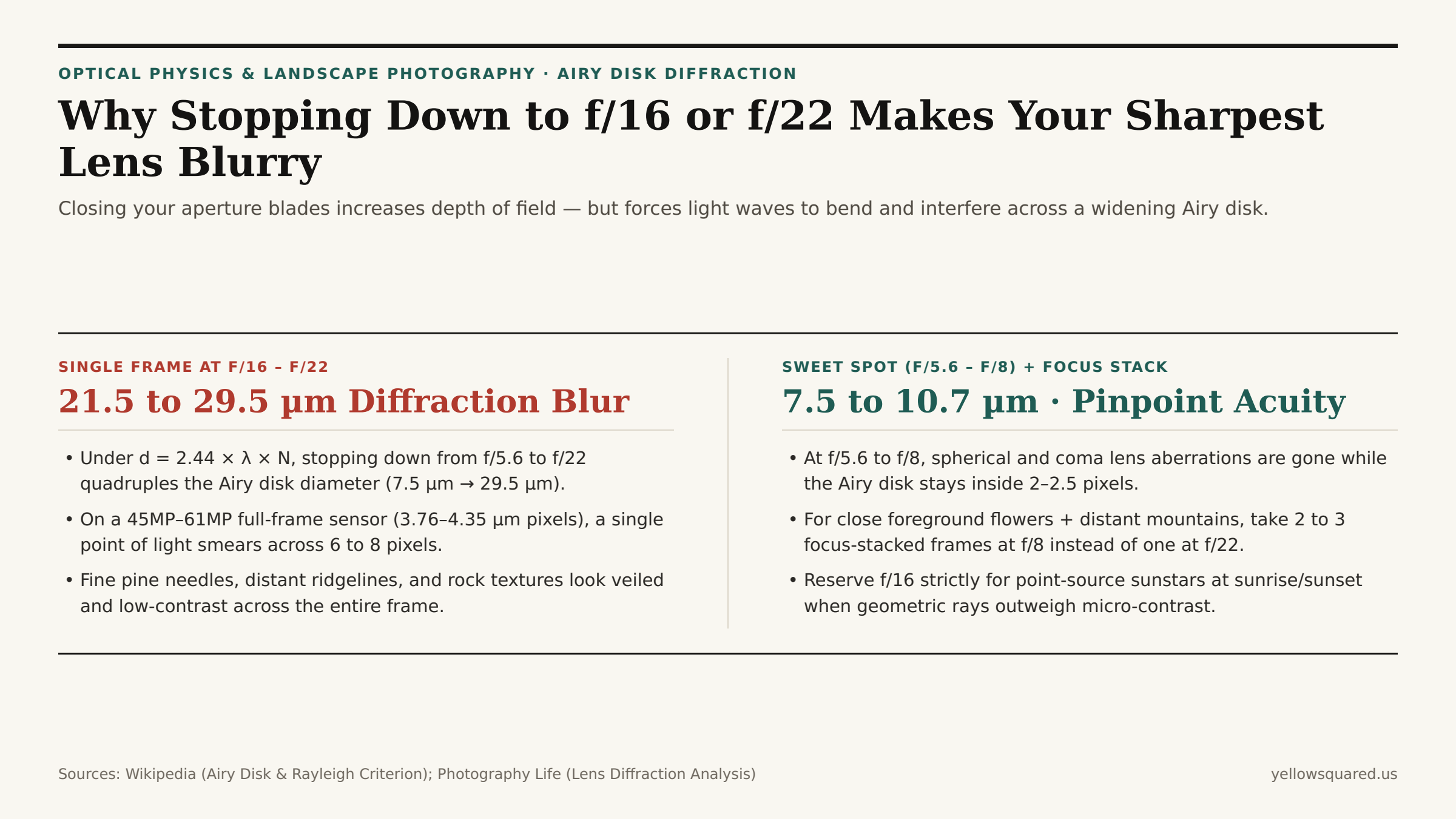
f/5.6 to f/22 quadruples the diameter of the diffraction Airy disk (7.5 µm to 29.5 µm), smearing every fine edge across nearly 8 pixels on a 61-megapixel full-frame sensor.1. The Airy Disk Formula (d = 2.44 × λ × N): Why Smaller Holes Make Bigger Blur Circles
When you stop a lens down from wide open (f/1.4 or f/2.8) to f/5.6, image sharpness across the frame improves because blocking the outer edges of the glass elements eliminates optical imperfections (spherical aberration, coma, and field curvature). However, light is an electromagnetic wave (wavelength λ ≈ 0.55 µm / 550 nm in the middle of the green visible spectrum). When light waves pass through a circular aperture opening, the waves skimming the iris blades diffract (bend outward) and interfere constructively and destructively on the sensor plane.
Even with a mathematically flawless lens, a pinpoint star or pine needle is projected onto your sensor as a bright central spot surrounded by faint concentric rings — the Airy disk (Wikipedia Airy Disk) — whose diameter to the first dark ring is governed solely by wavelength (λ) and f-number (N):
d (micrometers) = 2.44 × λ × N ≈ 1.342 × N (for 550 nm green light)
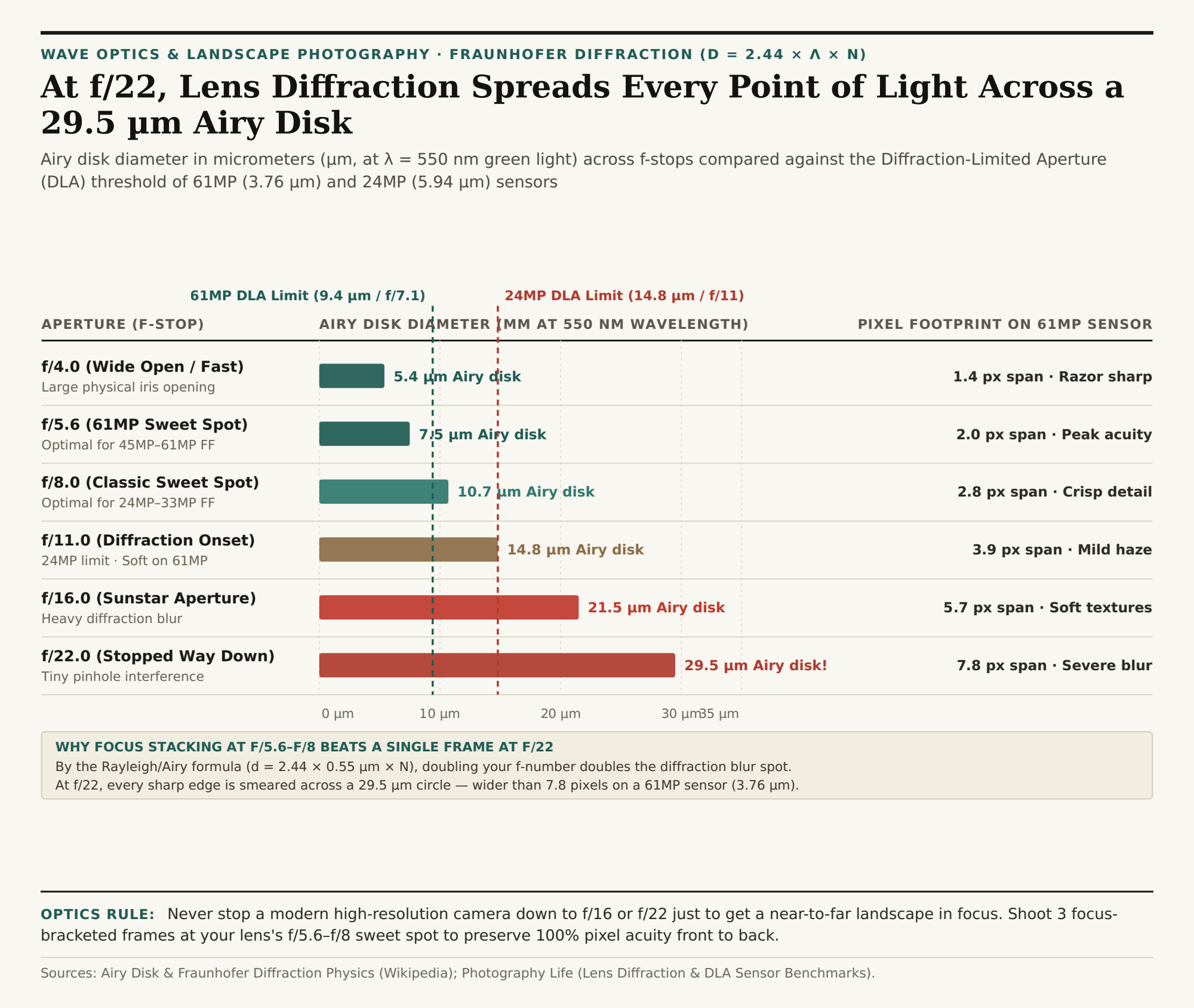
Notice what that equation means: Airy disk size depends only on your f-stop (N), completely independent of focal length! Whether you are shooting a 16mm ultra-wide or a 400mm telephoto, stopping down to f/16 projects a 21.5 µm Airy disk on the sensor, and stopping down to f/22 projects a 29.5 µm Airy disk.
2. Diffraction-Limited Aperture (DLA): Why 45MP–61MP Cameras Show Blur Sooner
Under the Rayleigh criterion, two adjacent points of detail become indistinguishable when the center of one Airy disk falls inside the first dark ring of its neighbor. In digital photography, diffraction begins visibly softening pixel-level micro-contrast as soon as the Airy disk diameter exceeds roughly 2 to 2.5 times your sensor's pixel pitch (p) — a threshold known as the Diffraction-Limited Aperture (DLA) (Photography Life):
- 24MP Full Frame (
p = 5.94 µm, Sony a7 III / Nikon Z6 III): DLA sits nearf/9.5 to f/11(Airy disk = 14.8 µm). You can shoot atf/8orf/11with crisp pixel sharpness, whilef/16(3.6 pixels wide) andf/22(5.0 pixels wide) visibly soften fine textures. - 45MP Full Frame (
p = 4.35 µm, Nikon Z8 / Z7 II / Canon EOS R5): DLA drops tof/7.1 to f/8(Airy disk = 10.7 µm). Byf/11, diffraction is already trimming micro-contrast; byf/16, the Airy disk spans4.9 pixels. - 61MP Full Frame (
p = 3.76 µm, Sony a7R V / Leica M11) & 26MP APS-C (p = 3.76 µm): DLA arrives atf/6.3 to f/7.1. Shooting atf/22smears every point of light across7.8 pixels(29.5 µm ÷ 3.76 µm) — effectively throwing away your high-resolution sensor's resolving power and reducing real detail to that of a 10-megapixel camera!
"Note: A 61MP image shot at f/16 is not 'blurrier' than a 24MP image shot at f/16 when both are printed at the same physical size — because the 21.5 µm Airy disk is the exact same physical size on both sensors. Rather, stopping down to f/16 erases the resolution advantage of the 61MP sensor."
| Lens Aperture | Airy Disk (550 nm) | Span on 24MP (5.94 µm) | Span on 61MP (3.76 µm) | Ideal Sensor Match & Use Case |
|---|---|---|---|---|
f/4.0 |
5.4 µm | 0.9 pixels | 1.4 pixels | Zero diffraction; great for distant subjects |
f/5.6 |
7.5 µm | 1.3 pixels | 2.0 pixels | Peak optical sweet spot for 45MP–61MP sensors |
f/8.0 |
10.7 µm | 1.8 pixels | 2.8 pixels | All-around landscape sweet spot (24MP–45MP) |
f/11.0 |
14.8 µm | 2.5 pixels | 3.9 pixels | Safe ceiling on 24MP; mild softening on 61MP |
f/16.0 |
21.5 µm | 3.6 pixels | 5.7 pixels | Use only for 14-point sunstars or water motion |
f/22.0 |
29.5 µm | 5.0 pixels | 7.8 pixels | Avoid; replace with f/8 focus stacking or ND filter |
When to Focus Stack at f/8 Instead of Stopping Down to f/22
Instead of cranking your aperture to f/22 to force a foreground rock 2 feet away and a mountain 5 miles away into a single frame (or to slow down your shutter speed for silky waterfalls), keep your lens at f/5.6 to f/8: use a 3-stop or 6-stop Neutral Density (ND) filter to lengthen water exposures without aperture diffraction, or shoot 2 to 3 focus-bracketed frames at f/8 (focused at 3 feet, 10 feet, and infinity) and merge them in post. Plan golden-hour landscape shoots in PhotoSpots to map your compositions before sunrise, and download the Airy disk & lens diffraction CSV dataset.