
Why Does the Sun Rise and Set at Different Compass Angles All Year—And How Far North Does It Swing in Summer?
Ask almost anyone where the Sun rises and sets, and they will recite the childhood proverb: "The Sun rises in the East and sets in the West." Yet if you stand on a west-facing beach in Seattle, San Francisco, New York, or London in late June to photograph a summer sunset over the water, the Sun does not set anywhere near due West (270°)—it sinks below the horizon far to the northwest (298° to 310°). Six months later in December, from that exact same tripod spot, the Sun sets far to the southwest (230° to 242°), often hidden behind a completely different headland or city skyline! As derived in standard spherical astronomy references including Harth's Solar Altitude and Azimuth Engineering Guide, SurgePV's Solar Angles Reference, Monash University's Lens, and Wikipedia's Position of the Sun, the Sun rises due East (90°) and sets due West (270°) on only two days of the year—and the further you live from the Equator, the wider the Sun's seasonal compass swing becomes.
Why does a 23.44° planetary tilt produce a 62.6° horizon swing in New York (40°N), a 72.2° swing in Seattle and Paris (47.6°N), and a 130.8° swing in Reykjavik (64.1°N)? Here is the exact equation every portrait and landscape photographer needs.
1. The Sunrise Azimuth Equation: cos(A) = sin(δ) / cos(φ)
In navigation and photography, azimuth (A) is the compass bearing measured clockwise from True North (0° = North, 90° = East, 180° = South, 270° = West). Throughout the year, as Earth orbits the Sun with its rotational axis tilted at 23.44° (Wikipedia; PVEducation), the Sun's declination (δ)—the latitude on Earth where the Sun is directly overhead at solar noon—oscillates smoothly between +23.44° on the June summer solstice, 0.00° on the March and September equinoxes, and -23.44° on the December winter solstice.
As derived from the fundamental spherical law of cosines when the geometric center of the Sun crosses a flat horizon (altitude α = 0°, zenith angle θz = 90°, per Harth and SurgePV), the compass azimuth of sunrise (A_rise) at any observer latitude (φ) simplifies to one elegant ratio:
- The Horizon Azimuth Formula:
cos(A_rise) = sin(δ) / cos(φ)(and because the Sun's daily path is symmetric about due South, the sunset azimuth is simplyA_set = 360° - A_rise). - Why the Equinoxes Always Equal
90°and270°Everywhere: On the March and September equinoxes, solar declination isδ = 0°, sosin(0°) = 0. Regardless of your latitudeφ,cos(A_rise) = 0, which meansA_rise = 90.0°(due East) andA_set = 270.0°(due West) everywhere on Earth outside the poles (Monash Lens).
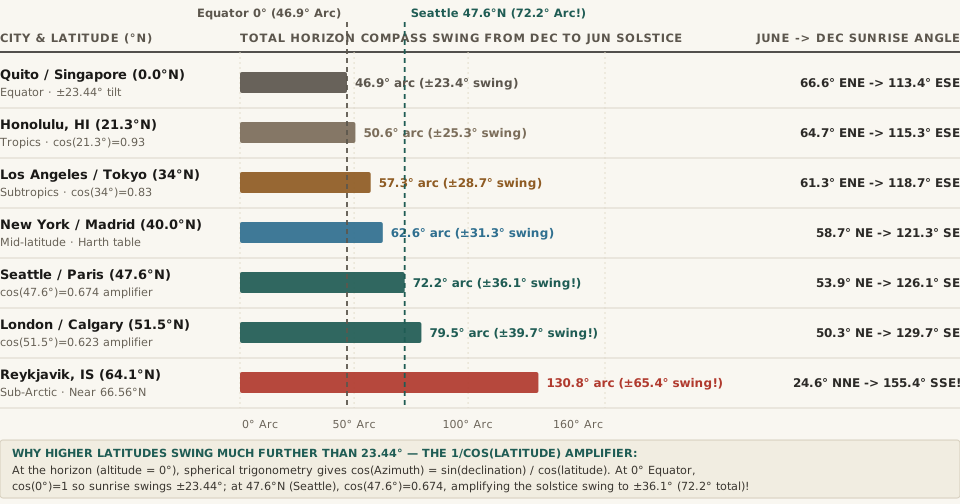
2. The 1 / cos(φ) Latitude Amplifier: Why Seattle Swings 72.2° While the Equator Swings 46.9°
Look closely at the denominator of cos(A_rise) = sin(δ) / cos(φ). Why does the Sun swing so much further north and south along the horizon in Seattle, London, or Reykjavik than it does in Singapore or Honolulu? As Monash University's astrophysical derivation explains, at the Equator (φ = 0°), the celestial sphere rises straight up at a 90° angle to the horizon (cos(0°) = 1.000). At higher latitudes, the Sun's daily path slices across the horizon at a shallow oblique angle (cos(φ) < 1)—acting as a geometric lever that stretches a 23.44° declination shift across a huge horizontal arc:
- At the Equator (
0.0°N— Quito / Singapore): Sincecos(0°) = 1.000, the June solstice sunrise sits at90° - 23.44° = 66.56°(ENE) and the December solstice sunrise sits at90° + 23.44° = 113.44°(ESE)—a total annual horizon arc of46.9°. - At
40.0°N(New York City / Madrid / Beijing): Becausecos(40.0°) = 0.7660, on June 21cos(A_rise) = sin(23.44°) / 0.7660 = 0.3978 / 0.7660 = 0.5193, yielding a sunrise bearing of58.7° NEand a sunset bearing of301.3° NW(Harth worked example). In December, sunrise shifts to121.3° SEand sunset to238.7° SW—a total horizon swing of62.6°. - At
47.6°N(Seattle / Paris / Munich): Becausecos(47.6°) = 0.6743, on June 21cos(A_rise) = 0.3978 / 0.6743 = 0.5899, pushing summer sunrise all the way north to53.9° NEand summer sunset to306.1° NW! On December 21, sunrise drops to126.1° SEand sunset to233.9° SW—a massive72.2°seasonal arc across the Puget Sound and Olympic Mountains! - At
64.1°N(Reykjavik) &66.56°N(The Arctic Circle): At Reykjavik (cos(64.1°) = 0.4368), June sunrise swings to24.6° NNEand sunset to335.4° NNW(a130.8°annual swing). Once you reach the Arctic Circle (φ = 66.56°N),cos(66.56°) = 0.3978 = sin(23.44°), socos(A_rise) = 1.000andA_rise = 0.0°(Due North)—the exact latitude where the midnight sun skims due North on the horizon without setting!
"At the equinoxes the sun rises at about 90 degrees (due east) and sets at about 270 degrees (due west) everywhere. Away from the equinoxes, cos(sunrise azimuth) = sin(declination) / cos(latitude), and sunset is 360 minus the sunrise azimuth. At 40 degrees N the June sun rises at about 58.7 degrees and sets at 301.3 degrees."
3. Complete Data Table: Solstice vs. Equinox Sunrise & Sunset Bearings by Latitude
The reproducible table below—matching the companion CSV (sunrise-and-sunset-compass-azimuth-swing-by-latitude-june-vs-december-solstice.csv)—lists the exact geometric sunrise and sunset compass bearings across seven major latitude bands:
| City / Latitude Band | Latitude (φ) |
June 21 Sunrise / Sunset | Equinox Sunrise / Sunset | Dec 21 Sunrise / Sunset | One-Way Swing | Total Horizon Arc |
|---|---|---|---|---|---|---|
| Quito / Singapore | 0.0°N |
66.6° ENE / 293.4° WNW |
90.0° E / 270.0° W |
113.4° ESE / 246.6° WSW |
±23.4° |
46.9° |
| Honolulu / Mexico City | 21.3°N |
64.7° ENE / 295.3° WNW |
90.0° E / 270.0° W |
115.3° ESE / 244.7° WSW |
±25.3° |
50.6° |
| Los Angeles / Tokyo | 34.0°N |
61.3° ENE / 298.7° WNW |
90.0° E / 270.0° W |
118.7° ESE / 241.3° WSW |
±28.7° |
57.3° |
| New York / Madrid / Beijing | 40.0°N |
58.7° NE / 301.3° NW |
90.0° E / 270.0° W |
121.3° SE / 238.7° SW |
±31.3° |
62.6° |
| Seattle / Paris / Munich | 47.6°N |
53.9° NE / 306.1° NW |
90.0° E / 270.0° W |
126.1° SE / 233.9° SW |
±36.1° |
72.2° |
| London / Calgary / Berlin | 51.5°N |
50.3° NE / 309.7° NW |
90.0° E / 270.0° W |
129.7° SE / 230.3° SW |
±39.7° |
79.5° |
| Reykjavik / Fairbanks | 64.1°N |
24.6° NNE / 335.4° NNW |
90.0° E / 270.0° W |
155.4° SSE / 204.6° SSW |
±65.4° |
130.8° |
4. Why "Manhattanhenge" and Keyhole Arch Alignments Always Happen in Pairs
Because solar declination (δ) follows a symmetric sine-like wave between -23.44° and +23.44°, any street grid, sea arch, or mountain peak whose compass bearing lies between your latitude's winter and summer solstice extremes will align with the rising or setting Sun on two calendar dates every year, spaced equally before and after the solstice! For example, Manhattan's street grid in New York City (40.7°N) is rotated 29° north of due West (299° azimuth)—just inside New York's June 21 solstice sunset maximum of 301.3°—causing the setting sun to align straight down the canyons of 14th, 23rd, 34th, and 42nd Streets roughly three weeks before the June solstice (around May 28–29) and three weeks after the June solstice (around July 12–13).
To check the exact sunrise and sunset compass bearing for any date of the year before scouting a beach, viewpoint, or urban portrait backdrop, Plan natural-light sessions in PhotoSpots.