
Why Does the Sun Set So Early in November? Daylight Saving and the 5 PM Cliff
The sun sets so early in November because a sudden 60-minute Daylight Saving Time clock shift stacks on top of the year's steepest natural daylight loss — dropping local sunsets from nearly 6:00 PM to before 5:00 PM overnight. However, if you dread dark winter afternoons, astronomy offers an unexpected silver lining: the earliest sunset of the year actually arrives around December 8 to December 12 at mid-latitudes, nearly two full weeks before the December 21 winter solstice.
Every autumn, millions of commuters experience the same disorienting shock during the first week of November. In late October, you can still leave work or school with golden twilight on the horizon. Seven days later, it is pitch dark before 5:00 PM. Understanding how human clock rules interact with Earth's axial tilt and elliptical orbit explains both why November feels like a cliff and why your evenings start brightening much earlier in December than most people realize.
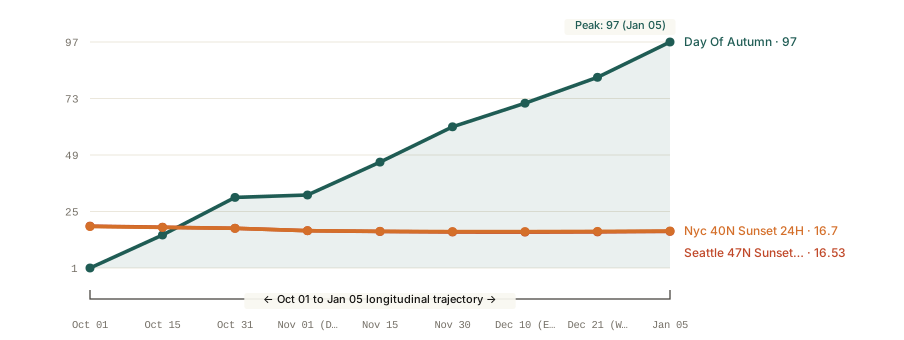
Part 1: How Daylight Saving Time Hides October's Orbital Loss — Then Drops the Bill All at Once
Earth's rotational axis is tilted by 23.44 degrees relative to its orbital plane around the Sun. Between the September autumnal equinox (around September 22) and late November, the Northern Hemisphere tilts rapidly away from direct solar radiation. In fact, solar declination changes fastest near the equinoxes and slows down as it approaches the solstices — a seasonal geometry that also drives how 30-year climate normals step down through autumn.
Throughout October, mid-latitude cities (40°N to 48°N) lose roughly 1.5 to 2.2 minutes of evening sunset time every single day, adding up to 45 to 56 minutes of lost evening light across the month. Because clocks are still set to Daylight Saving Time (UTC-4 on the East Coast, UTC-7 on the West Coast), that gradual erosion stays above the psychological 6:00 PM mark for most of the month.
Then, on the first Sunday in November under the U.S. Energy Policy Act schedule maintained by the U.S. Department of Transportation, clocks shift back 60 minutes to Standard Time at 2:00 AM. That single administrative step shifts an hour of evening daylight into the morning, combining with October's orbital loss to pull sunset from roughly 6:45 PM on October 1 down to 4:50 PM on November 1 — a cumulative nearly two-hour evening drop in just 32 days.
Part 2: Why the Earliest Sunset Happens Around December 10 — Two Weeks Before the Winter Solstice
Most people assume that since the winter solstice (December 21) is the shortest day of the year, it must also have the earliest sunset and the latest sunrise. In reality, those three milestones fall on three different dates nearly a month apart:
- Earliest sunset of the year: Around December 8 to December 12 (for cities between 35°N and 48°N).
- Shortest total daylight (Winter Solstice): December 21 (when the Northern Hemisphere reaches its maximum 23.44-degree tilt away from the Sun).
- Latest sunrise of the year: Around January 2 to January 6.
Why do sunsets start getting later in mid-December while total daylight is still shrinking? The answer is the Equation of Time — the discrepancy between a uniform 24-hour mechanical clock and true solar time, documented by the U.S. Naval Observatory.
Two orbital facts combine in December: first, Earth travels in an elliptical orbit and reaches perihelion (its closest approach to the Sun, where orbital velocity is fastest under Kepler's second law) in early January; second, the Sun's apparent path is tilted steeply at the solstice. Together, these cause true solar noon (the exact moment the Sun crosses your local meridian at its highest point) to drift roughly 30 seconds later on the wristwatch every single day between late November and late December.
By December 10, the rate at which the whole solar day is sliding forward on the clock (+30 seconds per day) overtakes the slowing rate at which total daylight is shrinking (<25 seconds per day at the evening end). As a result, clock sunsets bottom out around December 10 and begin creeping later every afternoon, while mornings continue getting darker until early January.
Autumn and Early-Winter Sunset Milestones by Latitude
The table below compares exact clock sunset milestones for a northern-tier U.S. city (Seattle, 47.6°N) and a mid-latitude city (New York City, 40.7°N):
| Calendar Date | Clock Regime | Seattle (47.6°N) Sunset | New York (40.7°N) Sunset | Seasonal Milestone |
|---|---|---|---|---|
| October 1 | Daylight Saving (PDT/EDT) | 6:48 PM | 6:38 PM | Steepest daily orbital sunset loss (~2 min/day) |
| October 31 | Daylight Saving (PDT/EDT) | 5:52 PM | 5:51 PM | Final evening before Standard Time fallback |
| November 1 | Standard Time (PST/EST) | 4:50 PM | 4:50 PM | The 5 PM Cliff: 60-minute overnight drop |
| November 30 | Standard Time (PST/EST) | 4:18 PM | 4:29 PM | Orbital loss slows to <45 seconds per day |
| December 10 | Standard Time (PST/EST) | 4:16 PM (Earliest) | 4:28 PM (Earliest) | Earliest Sunset: Solar noon shift overtakes tilt |
| December 21 | Standard Time (PST/EST) | 4:20 PM | 4:32 PM | Winter Solstice: Shortest total day, 4 min brighter evening |
| January 5 | Standard Time (PST/EST) | 4:32 PM | 4:42 PM | Latest sunrise occurs; evenings +14 to +16 min brighter |
How to Use Early-December Astronomy to Plan Your Winter Routine
Knowing that the evening darkness floor arrives around December 10 — not late December or January — makes it much easier to pace your autumn routine. Once you get past the four-week stretch between November 1 and December 10, every single afternoon gives back evening light. To compare how seasonal daylight interacts with local temperature norms and winter cold snaps across U.S. stations, check our analysis of winter temperature lows at six U.S. airports or look up your city's daily historical normals inside the Eranorms climate explorer.