
Why Does Turkey Stay on UTC+03:00 Year-Round After Abolishing Daylight Saving Time in 2016?
Look at a standard longitudinal map of Europe and the eastern Mediterranean, and the 30°E meridian—the exact mathematical center of Eastern European Time (EET, UTC+02:00)—runs straight through Izmit, less than 90 kilometers east of downtown Istanbul (28°58'E). For decades, Turkey shared the exact same clock as Athens, Bucharest, Sofia, Cairo, and Helsinki: UTC+02:00 in winter and UTC+03:00 (Eastern European Summer Time, EEST) in summer. Yet if you fly from Athens to Istanbul in January, you cross a one-hour time boundary and land in UTC+03:00—the same winter offset as Moscow and Riyadh.
As documented in records of Time in Turkey and Time and Date's coverage of the September 2016 decree, the Turkish cabinet abolished winter clock returns on September 7, 2016, locking the country onto permanent Daylight Saving Time under the name Turkey Time (TRT, UTC+03:00). When scheduling cross-border calls between Istanbul, London, Berlin, and New York across autumn and spring transitions, you can Open Tempo in your browser to see how Turkey's fixed UTC+03:00 clock shifts relative to Europe and North America twice a year.
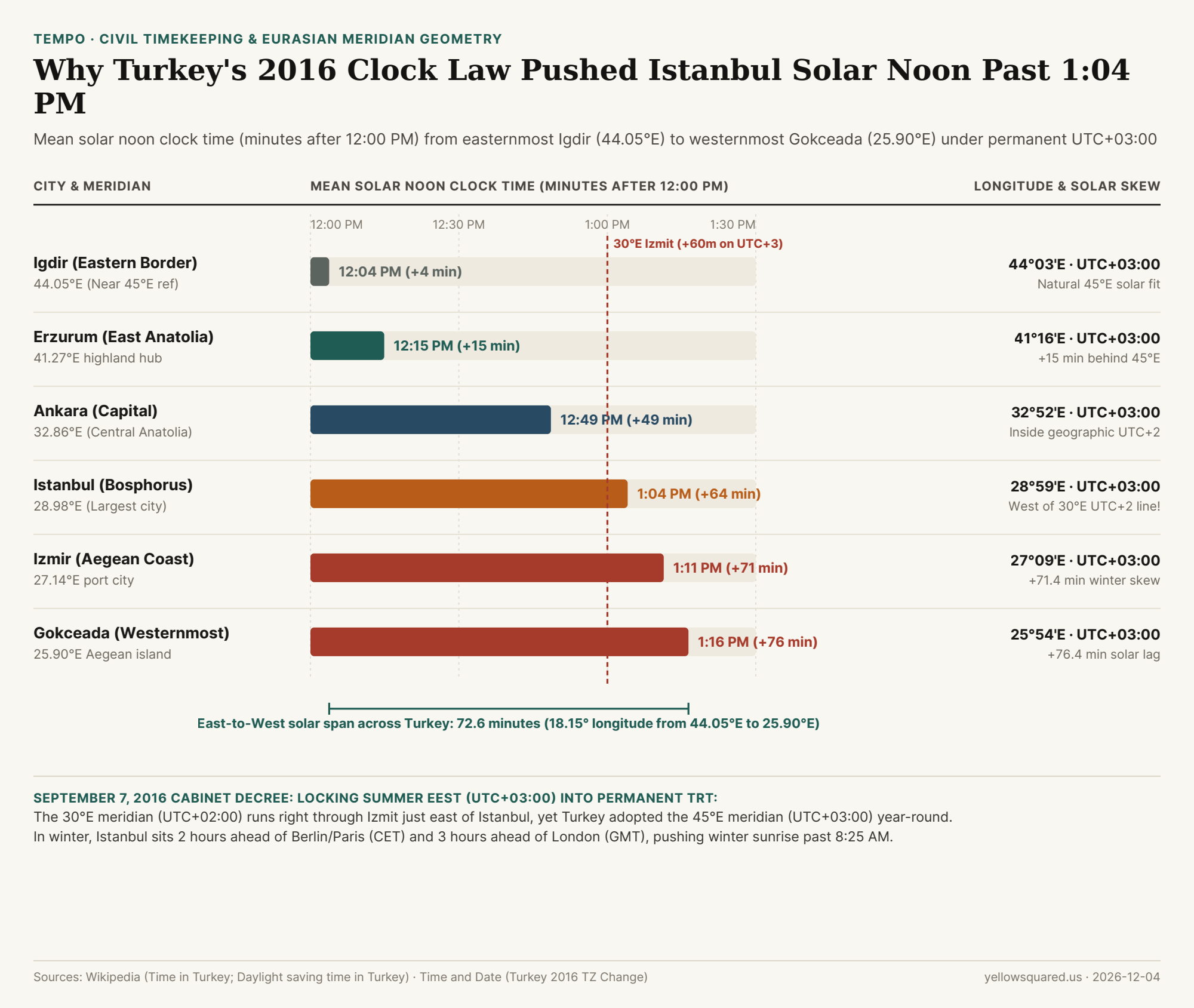
The 18-Degree Longitudinal Span: From Igdir (44.05°E) to Gokceada (25.90°E)
To understand why Turkey's time zone triggers fierce debate every winter, look at the physical geometry of the Anatolian peninsula. Stretching 1,600 kilometers (1,000 miles) from the Armenian and Iranian borders in the east to the Aegean islands in the west, Turkey spans 18.15 degrees of longitude—which equals 18.15° × 4 minutes/degree = 72.6 minutes of solar rotation between its eastern and western borders:
- Eastern Anatolia Fits
UTC+03:00Naturally: The reference meridian forUTC+03:00is45°E(3 hours × 15°/hour). In easternmost Igdir (44.05°E) and highland Erzurum (41.27°E), mean solar noon arrives at12:04 PMand12:15 PM. Under the old pre-2016 winter time (UTC+02:00), sunset in eastern Turkey occurred before4:00 PMin December. - Western Turkey Sits Inside Geographic
UTC+02:00: Nearly70%of Turkey's population and industrial output lives in the western half of the country—including Ankara (32.86°E), Istanbul (28.98°E), and Izmir (27.14°E). Because Istanbul sits1.02 degrees westof the30°E(UTC+02:00) meridian—and16.02 degrees westof the45°E(UTC+03:00) meridian—locking Istanbul toUTC+03:00pushes mean solar noon to1:04 PM(+64.1 minutes), while Izmir (27.14°E) reaches solar noon at1:11 PM(+71.4 minutes) and westernmost Gokceada (25.90°E) reaches solar noon at1:16 PM(+76.4 minutes).
"Because Istanbul (28°58'E) sits slightly west of the 30°E meridian that anchors UTC+02:00, keeping Turkey on permanent UTC+03:00 places Istanbul more than a full hour ahead of local solar time—delaying late-December sunrise past 8:28 AM."
What Happened in October 2016 (and the Northern Cyprus Split)
As chronicled in Daylight saving time in Turkey, the country had already delayed its autumn clock fallback by two weeks in November 2015 to hold a national general election in brighter afternoon light. On September 7, 2016, Cabinet Decree No. 2016/9154 canceled the upcoming October 30, 2016 fallback permanently so that summer time (UTC+03:00) became year-round standard time.
The sudden switch caught operating systems, smartphones, and airlines off guard during the first week of November 2016 when automated tzdb rules briefly turned phones back an hour. Even more unusually, Northern Cyprus initially followed Turkey into permanent UTC+03:00 in autumn 2016—creating a physical time-zone border right through the divided capital of Nicosia (where the Republic of Cyprus in the south returned to EET UTC+02:00). After a year of commuter complaints and dark winter school mornings, Northern Cyprus reverted to standard UTC+02:00 / UTC+03:00 EU transitions in October 2017.
| Turkish City / Landmark | Longitude | Natural Solar Zone | Observed Zone (Since 2016) | Mean Solar Noon | Solar-Clock Skew |
|---|---|---|---|---|---|
| Igdir (Eastern Border) | 44°03'E (44.05°E) |
UTC+03:00 (45°E) |
UTC+03:00 (TRT) |
12:04 PM |
+3.8 min |
| Erzurum (East Anatolia) | 41°16'E (41.27°E) |
UTC+03:00 (45°E) |
UTC+03:00 (TRT) |
12:15 PM |
+14.9 min |
| Ankara (Capital) | 32°52'E (32.86°E) |
UTC+02:00 (30°E) |
UTC+03:00 (TRT) |
12:49 PM |
+48.6 min |
| Istanbul (Bosphorus) | 28°59'E (28.98°E) |
UTC+02:00 (30°E) |
UTC+03:00 (TRT) |
1:04 PM |
+64.1 min |
| Izmir (Aegean Coast) | 27°09'E (27.14°E) |
UTC+02:00 (30°E) |
UTC+03:00 (TRT) |
1:11 PM |
+71.4 min |
| Gokceada (Westernmost) | 25°54'E (25.90°E) |
UTC+02:00 (30°E) |
UTC+03:00 (TRT) |
1:16 PM |
+76.4 min |
How Istanbul's Offset Against Europe Changes Every March and October
Because Turkey stays locked on UTC+03:00 (Europe/Istanbul) while the European Union and United Kingdom still shift their clocks on the last Sunday of March and the last Sunday of October, Istanbul's time difference with Western Europe expands and contracts every six months: from late March to late October, Istanbul is 1 hour ahead of Berlin/Paris (CEST UTC+02:00) and 2 hours ahead of London (BST UTC+01:00); from late October to late March, Istanbul jumps to 2 hours ahead of Berlin/Paris (CET UTC+01:00) and 3 hours ahead of London (GMT UTC+00:00). To avoid missed calendar invites during spring and autumn transitions, Open Tempo in your browser and compare Europe/Istanbul against your team's local zones.