
Why Does Water Boil at a Lower Temperature at High Altitude, and How Much Does Boiling Point Drop by Elevation?
In a national science-literacy survey conducted by the Pew Research Center, only 34% of American adults correctly knew that water boils at a lower temperature in high-altitude Denver than in sea-level Los Angeles (while 39% thought it boiled at the exact same temperature and 26% thought it boiled at a higher temperature because it takes longer to cook pasta in the mountains).
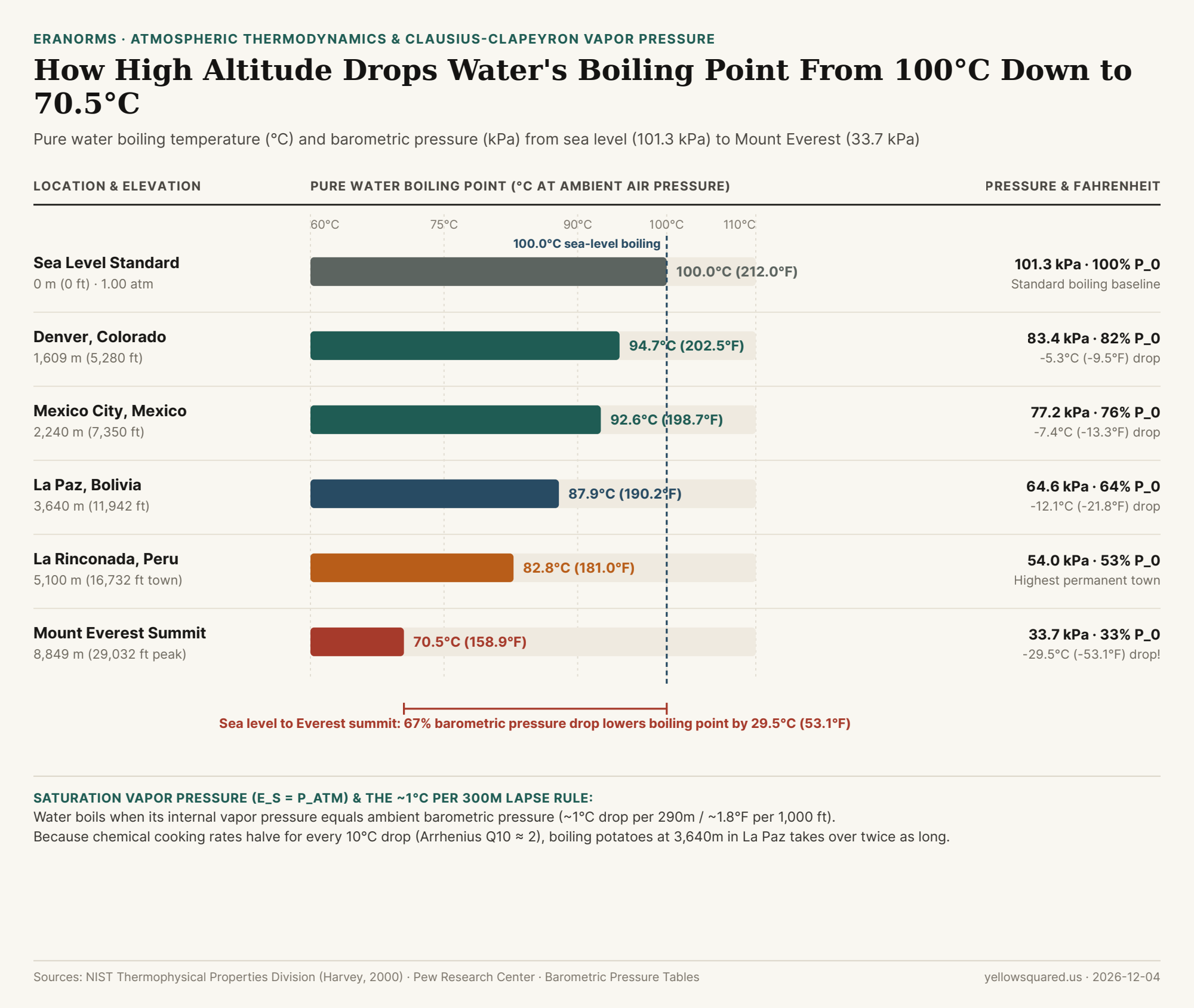
Why does a vigorous, rolling boil in Denver (1,609 m / 5,280 ft) reach only 94.7°C (202.5°F), why does water in La Paz, Bolivia (3,640 m / 11,942 ft) boil at 87.9°C (190.2°F), and why does a pot of boiling water on the summit of Mount Everest (8,849 m / 29,032 ft) top out at a lukewarm 70.5°C (158.9°F)? As explained by physicist Allan Harvey of the NIST Thermophysical Properties Division, boiling is not a fixed property of water alone—it is a mechanical tug-of-war between the liquid's internal saturation vapor pressure and the weight of the overlying atmosphere. To explore how station elevation, barometric pressure, and daily temperature normals interact across North American weather stations, you can Compare daily station temperature anomalies in Eranorms.
The Clausius–Clapeyron Equation: When Vapor Pressure Equals Barometric Pressure
Inside a pot of liquid water, molecules are constantly jostling and colliding. Even at room temperature, a small fraction of surface molecules gain enough kinetic energy to break their hydrogen bonds (latent heat of vaporization L_v ≈ 2,260 kJ/kg) and escape into the air as water vapor—creating an upward pressure known as saturation vapor pressure (e_s(T)). However, bubbles of pure steam cannot form inside the bulk liquid as long as the surrounding atmospheric pressure (P_atm) crushes nascent vapor pockets flat.
A rolling boil begins at the exact temperature where internal saturation vapor pressure equals ambient barometric pressure:
e_s(T_boil) = P_atm
At standard sea level, the column of air above your pot exerts 101.325 kilopascals (1.00 atm = 1,013.25 hPa = 14.696 psi) of downward pressure, and water must be heated to 100.0°C (212.0°F) before its vapor pressure reaches 101.325 kPa. As you climb a mountain, the hydrostatic barometric formula dictates that air pressure drops exponentially (falling by ~50% every 5,500 meters). By the Clausius–Clapeyron relation, lower ambient pressure means water molecules need far less thermal energy to push back the atmosphere—lowering the boiling point by approximately 1.0°C for every 290 to 300 meters of elevation gain (roughly 1.8°F to 1.9°F per 1,000 feet), as tabulated in standard elevation-pressure boiling tables.
"Turning up the stove flame under a boiling pot in Denver or La Paz will never make the water hotter: once water reaches its local boiling point (94.7°C in Denver or 87.9°C in La Paz), every extra watt of heat goes into converting liquid into escaping steam at that exact ceiling temperature."
Why High Altitude Makes Boiling Slower—Even Though Water Boils Faster!
Here lies the culinary paradox that confuses so many people in the Pew survey: at high altitude, a pot of cold tap water reaches a boil faster (because it only has to heat to 94.7°C instead of 100.0°C), yet cooking food in that boiling water takes much longer!
Why? Because a boiling pot is a thermostat locked at T_boil. By the Arrhenius equation (Q10 ≈ 2), the chemical reaction rates of protein denaturation, collagen hydrolysis, and starch gelatinization roughly cut in half for every 10°C (18°F) drop in temperature. Simmering pasta or potatoes in La Paz at 87.9°C (-12.1°C below sea level) runs at less than half the thermal reaction speed of a 100°C sea-level pot. And on the summit of Mount Everest (8,849 m, where ambient pressure is 33.7 kPa—one-third of sea level—and water boils at 70.5°C / 158.9°F), boiling water cannot even coagulate the ovalbumin protein in an egg white (which requires ~80°C) or gelatinize potato starch!
| Location Benchmark | Elevation (m / ft) | Barometric Pressure | % of Sea-Level Air | Boiling Point (°C) | Boiling Point (°F) |
|---|---|---|---|---|---|
| Death Valley, CA (Badwater) | -86 m (-282 ft) |
102.3 kPa |
101.0% |
100.3°C |
212.5°F |
| Sea Level Standard Baseline | 0 m (0 ft) |
101.3 kPa (1 atm) |
100.0% |
100.0°C |
212.0°F |
| Denver, CO ("Mile High City") | 1,609 m (5,280 ft) |
83.4 kPa |
82.3% |
94.7°C |
202.5°F |
| Mexico City, Mexico | 2,240 m (7,350 ft) |
77.2 kPa |
76.2% |
92.6°C |
198.7°F |
| La Paz, Bolivia | 3,640 m (11,942 ft) |
64.6 kPa |
63.8% |
87.9°C |
190.2°F |
| La Rinconada, Peru | 5,100 m (16,732 ft) |
54.0 kPa |
53.3% |
82.8°C |
181.0°F |
| Mount Everest Summit | 8,849 m (29,032 ft) |
33.7 kPa (0.33 atm) |
33.3% |
70.5°C |
158.9°F |
How a Pressure Cooker Restores Sea-Level Physics in the Mountains
The only way to raise the temperature of boiling water at high altitude is to trap the escaping steam inside a sealed vessel. A standard household pressure cooker adds 15 psi (103.4 kPa) of gauge pressure on top of the local atmosphere—bringing total internal pressure in Denver (83.4 + 103.4 = 186.8 kPa) well above sea-level atmospheric pressure and raising the boiling point inside the pot to 118°C (244°F) (or 121°C / 250°F at sea level). To explore station elevation, atmospheric pressure regimes, and historical climate baselines across high-altitude and coastal cities, Compare daily station temperature anomalies in Eranorms.