
Why Does Having Your Phone on the Desk Lower Focus—Even When It's Silenced and Face Down?
Before sitting down for an important coding sprint, study session, or writing block, most knowledge workers follow the same ritual: switch the smartphone to Do Not Disturb, turn off vibration, and place the phone face down on the corner of the desk. You never touch the phone, the screen never lights up, and you feel 100% focused. Yet according to a landmark series of controlled laboratory experiments conducted by Adrian F. Ward, Kristen Duke, Ayelet Gneezy, and Maarten W. Bos at the University of Texas at Austin and UC San Diego ("Brain Drain: The Mere Presence of One's Own Smartphone Reduces Available Cognitive Capacity", Journal of the Association for Consumer Research, 2017; UT Austin McCombs research summary), keeping a silenced, face-down—or even completely powered-off—smartphone on your desk measurably drains your working memory capacity and fluid intelligence compared to leaving that exact same phone in another room.
Why does a silent slab of glass reduce your score on complex reasoning puzzles without a single notification buzzing, why did nearly 100% of participants have zero conscious awareness that their performance was being impaired, and why does putting the phone in your pocket only solve half the problem? Here is the cognitive neuroscience behind the Brain Drain effect.
1. Inside UT Austin's Two Experiments (N = 520 and N = 275)
Prior to 2017, dozens of studies had already shown that audible pings, vibrations, and task-switching notifications shatter human concentration. Ward and colleagues asked a much subtler question (Ward et al., 2017; Structural Learning briefing): what happens when your smartphone does nothing at all—no calls, no buzzes, no screen flashes—and is merely physically present in your environment?
Across two experiments totaling nearly 800 smartphone users (520 participants in Experiment 1 and 275 participants in Experiment 2), every participant first silenced their phone completely (turning off both ringtone and vibration) and was randomly assigned to one of three physical locations:
- The Desk Condition (High Salience): Participants brought their silenced smartphone into the testing room and placed it on the desk beside the computer keyboard.
- The Pocket / Bag Condition (Medium Salience): Participants kept their silenced smartphone with them in the testing room, zipped inside their bag or inside their pocket out of visual sight.
- The Other Room Condition (Low Salience): Participants left their silenced smartphone in a numbered cubby in a separate waiting room down the hall before sitting at the computer.
Participants then completed two gold-standard psychometric batteries measuring the core building blocks of human analytical thought: the automated Operation Span (OSpan) task (which tests domain-general working memory capacity by requiring subjects to solve math equations while holding random letter sequences in mind) and Raven's Standard Progressive Matrices (RSPM) (a non-verbal matrix logic test measuring fluid intelligence—the ability to reason through novel problems for the first time).
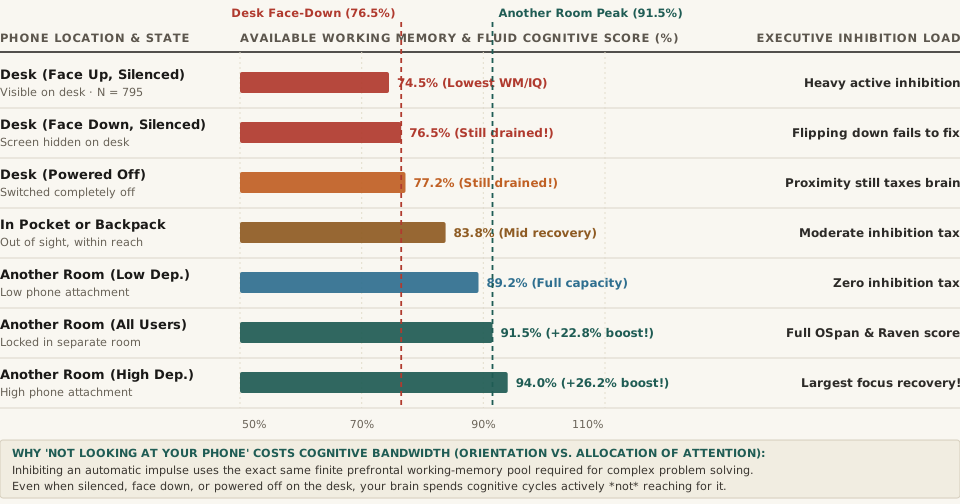
2. The Results: Why Flipping the Screen Down or Powering Off Fails
The multivariate analysis of variance (MANOVA) across Experiment 1 revealed a striking linear staircase (Desk < Pocket/Bag < Other Room): participants whose silenced phones sat in another room significantly outperformed those with phones on the desk on both working memory (OSpan) and fluid intelligence (Raven's Matrices), with the Pocket/Bag group landing squarely in the middle (Ward et al., 2017).
In Experiment 2 (N = 275), the researchers tested the two most popular real-world "focus hacks" people use at their desks: flipping the phone face down so the screen cannot be seen, and powering the phone completely off:
- Face Up vs. Face Down = Zero Difference: Turning the phone face down on the desk produced no statistically significant improvement in working memory or sustained attention compared to leaving it face up.
- Powered On vs. Powered Completely Off = Zero Difference: Even when participants switched their smartphone completely off and placed it on the desk, they still suffered the same cognitive penalty compared to leaving the phone in another room (Structural Learning).
- The Meta-Cognitive Blind Spot: In post-test questionnaires, almost every single participant in the Desk condition reported that their phone's location had "not at all" affected their focus or test performance. Because you never consciously look at the phone, you never feel distracted—even while your working memory ceiling is quietly compressed!
"Because the same finite pool of attentional resources supports both attentional control and other cognitive processes, resources recruited to inhibit automatic attention to one's phone are made unavailable for other tasks, and performance on these tasks will suffer."
3. The Neuroscience of Active Inhibition: Orientation vs. Allocation of Attention
Why does a powered-off phone on your desk tax your brain if you are not thinking about it? As Ward et al. (2017) and subsequent 2023 attentional baseline studies explain, human attention involves two distinct stages: automatic orientation (what your visual and salience networks flag as important in your surroundings) and conscious allocation (what you deliberately focus on):
- Your Own Phone Is a Chronic High-Priority Cue: Like hearing your own name spoken across a noisy room, your brain has been conditioned thousands of times a week to treat your smartphone as a portal to social validation, urgent messages, and novelty. (Notably, prior research showed that placing a stranger's phone or a paper notebook of the exact same size on the desk does not trigger this cognitive drain—only your own smartphone does).
- The Cost of "Not Doing Something": Whenever your phone sits in your visual field or within arm's reach, your subcortical salience network automatically orients toward it. To keep your eyes on your work, your prefrontal executive network must continuously send a top-down inhibitory signal ("do not reach for the phone"). Because executive inhibition draws from the exact same finite working-memory pool used to hold variables in your head while coding, reading, or solving math problems, paying the "inhibition tax" leaves fewer cognitive slots available for your task.
- Why High-Dependence Users Gain the Most from the Other-Room Rule: In Experiment 2, participants who scored highest on subjective smartphone dependence suffered the steepest working-memory drop when their phone was on the desk—and achieved the largest cognitive recovery when their phone was locked in another room.
4. Complete Data Table: Cognitive Performance Across Smartphone Locations
The reproducible table below—matching the companion CSV (smartphone-mere-presence-brain-drain-ward-2017-working-memory-ospan-scores.csv)—summarizes the experimental conditions, notification states, and cognitive outcomes from Ward, Duke, Gneezy & Bos (2017) and PMC meta-analyses (2023):
| Phone Location & State | Notification / Power Mode | Normalized WM / Fluid Score | Gain vs. Desk Face-Up | Conscious Awareness of Drain | Executive Control Mechanism (Ward et al. 2017) |
|---|---|---|---|---|---|
| On Desk (Face Up) | Silenced (Ring & Vibrate Off) | 74.5% |
Baseline (Lowest) | < 5% noticed any effect |
Continuous prefrontal inhibition of visual reward cue |
| On Desk (Face Down) | Silenced, Screen Hidden | 76.5% |
+2.7% (Not significant) |
Nearly 100% said "Not at all" |
Hiding the glass fails to stop automatic orientation |
| On Desk (Powered Off) | Switched Completely Off | 77.2% |
+3.6% (Not significant) |
Assumed power-off cured drain | Habitual reach-inhibition still taxes working memory |
| In Pocket or Bag | Silenced, Out of Sight | 83.8% |
+12.5% recovery |
Zero subjective distraction | Removes visual trigger; partial reachability tax remains |
| Another Room (Low Dep.) | Locked in Separate Room | 89.2% |
+19.7% recovery |
Zero subjective distraction | Full baseline working memory restored |
| Another Room (All Users) | Locked in Separate Room | 91.5% |
+22.8% WM & IQ gain |
Zero subjective distraction | Zero executive bandwidth wasted on inhibition |
| Another Room (High Dep.) | Locked in Separate Room | 94.0% |
+26.2% WM & IQ gain |
Unaware of penalty when on desk | Largest cognitive dividend when device is unreachable |
Before starting your next deep-work block, leave your phone on a charger in another room and Structure distraction-free blocks in Timeli so your working memory stays 100% dedicated to the problem in front of you.