
Why Is Almost All of Alaska in a Single Time Zone?
Look at a map of North America and you will notice a startling geographic paradox: the state of Alaska stretches across 35 degrees of longitude from Ketchikan in the Southeast Panhandle (131.6°W) to the western Aleutian Islands — an east-west span nearly as wide as the contiguous United States — yet more than 99% of Alaska's residents live inside a single time zone: Alaska Time (AKST, UTC-9 / AKDT, UTC-8).
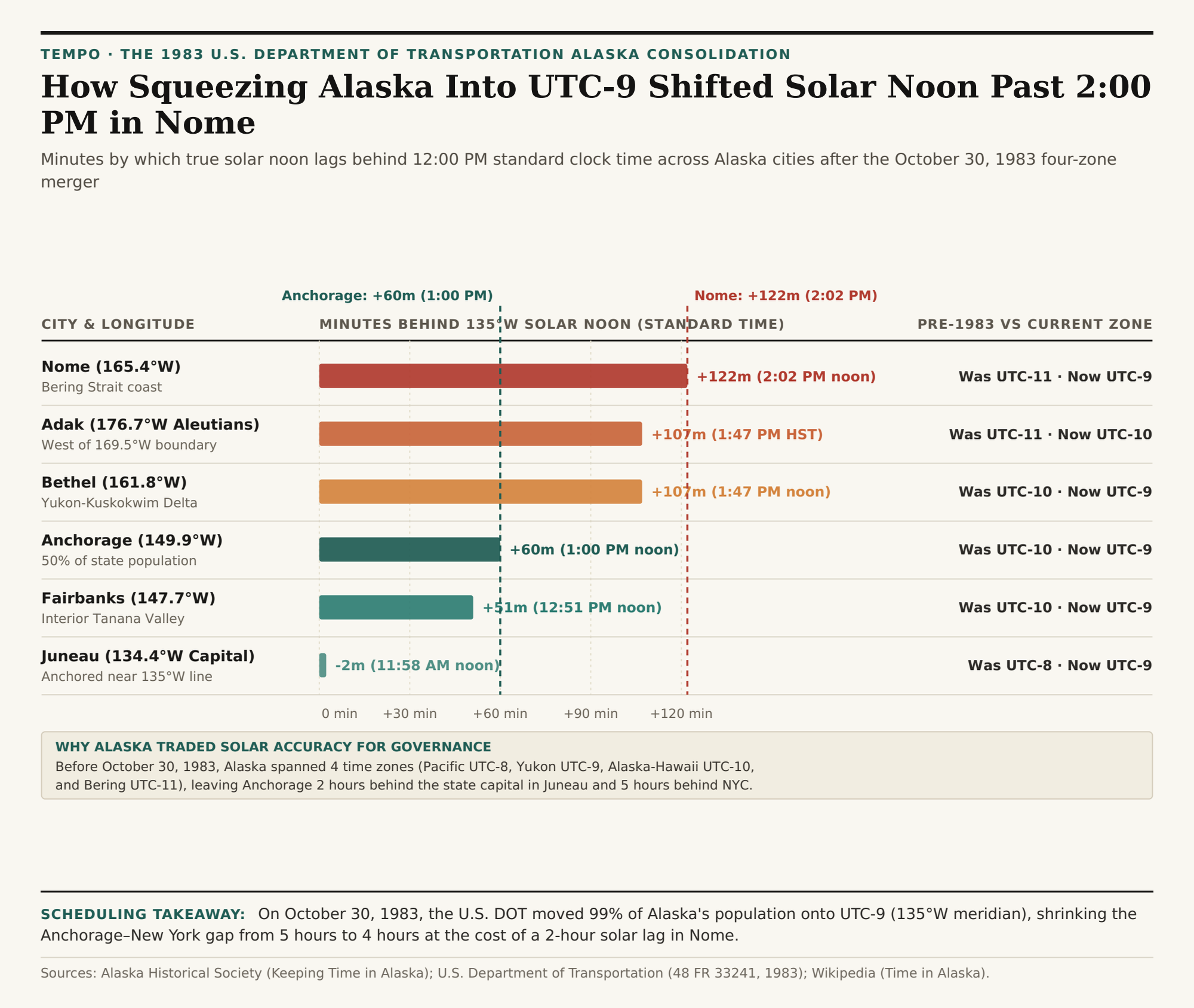
Because Earth rotates 15 degrees of longitude every hour, UTC-9 is mathematically anchored to the 135th meridian west, which passes just four miles east of downtown Juneau (134.4°W). In Juneau, standard-time solar noon arrives right on schedule at 11:58 AM. Travel 570 miles northwest to Anchorage (149.9°W, near the 150°W meridian) and the Sun does not reach its highest point until 1:00 PM in winter and 2:00 PM during summer Daylight Saving Time. Continue to Nome on the Bering Strait (165.4°W) and solar noon lags behind the clock by more than two full hours in winter (2:02 PM) and three hours in summer (3:02 PM). To compare live UTC offsets and solar-to-clock alignment across Alaska and the Lower 48, Open Tempo in your browser.
When Alaska Had Four Time Zones — and a 2-Hour Capital Split
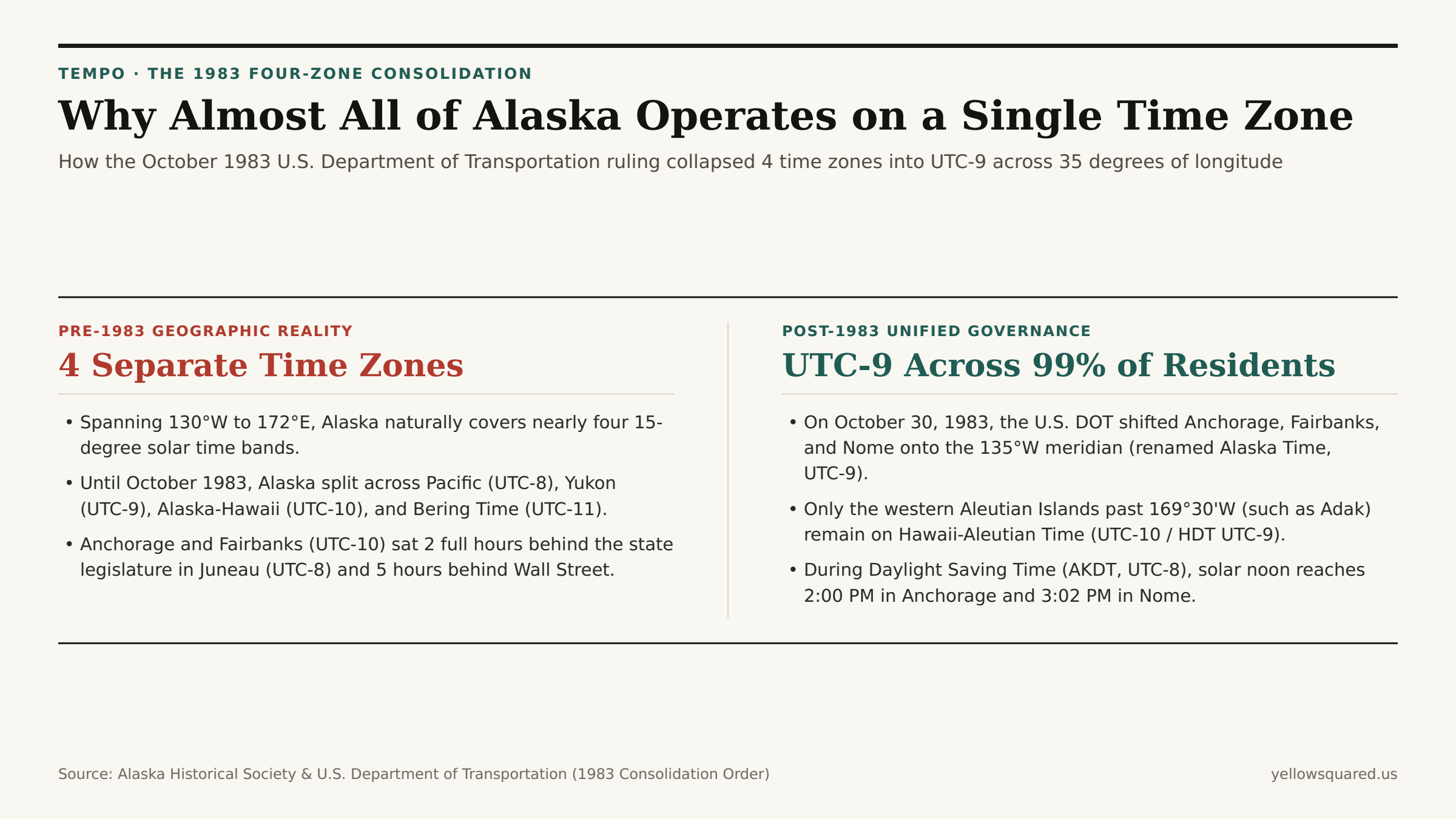
As documented by historian Frank Norris in the Alaska Historical Society's archival study, Keeping Time in Alaska: National Directives, Local Response, and the statutory timeline of Time in Alaska, the state operated across four separate federal time zones prior to October 1983:
- Pacific Time (UTC-8, 120°W meridian): Covered Juneau, Ketchikan, Sitka, and the Southeast Panhandle, matching Seattle and Vancouver.
- Yukon Time (UTC-9, 135°W meridian): Covered only a sparsely populated strip around Yakutat (
139.7°W), housing fewer than 1,000 residents. - Alaska-Hawaii Time (UTC-10, 150°W meridian): Covered Anchorage, Fairbanks, the Kenai Peninsula, and most of the state's population and commerce.
- Bering Time (UTC-11, 165°W meridian): Covered Nome, Bethel, Kotzebue, and the Aleutian Chain.
While those four zones tracked true solar longitude within a few minutes, they created a logistical nightmare for state governance and national commerce. Because Anchorage (UTC-10) sat two hours behind the state capital in Juneau (UTC-8) and five hours behind New York (UTC-5), overlapping business hours between Anchorage offices, state agencies in Juneau, and East Coast banks were compressed into a narrow morning window.
How the October 30, 1983 U.S. DOT Ruling Rewired the State
Following a joint petition by Governor Bill Sheffield and the Alaska Legislature, the U.S. Department of Transportation issued a formal rulemaking in the Federal Register (48 FR 33241) that took effect on October 30, 1983. Instead of shifting Juneau west to Anchorage's UTC-10 clock, the state and federal government shifted Anchorage, Fairbanks, and Western Alaska one to two hours east onto the 135°W UTC-9 zone (renamed from Yukon Time to Alaska Time) and pulled Juneau one hour west from Pacific Time (UTC-8) into UTC-9.
"By moving Anchorage and Fairbanks forward onto the 135th meridian (UTC-9) while pulling Juneau back an hour from Pacific Time, the October 1983 realignment united mainland Alaska on one clock and cut the time gap to Seattle to just one hour."
Today, the only part of Alaska outside UTC-9 is the western Aleutian chain west of 169°30'W (including Adak, America/Adak), which observes Hawaii-Aleutian Time (UTC-10 in winter and UTC-9 during summer Daylight Saving Time). Meanwhile, tiny Metlakatla on Annette Island in Southeast Alaska (America/Metlakatla) famously opted out of Daylight Saving Time for decades to stay aligned with Ketchikan and Prince Rupert workflows.
| Alaska City / Region | Longitude | Pre-1983 Time Zone | Current IANA Zone | Winter Solar Noon | Solar Skew vs. 12:00 PM |
|---|---|---|---|---|---|
| Ketchikan (SE Panhandle) | 131.64°W | Pacific Time (UTC-8) | America/Sitka (UTC-9) |
11:47 AM AKST | -13 min (Sun peaks early) |
| Juneau (State Capital) | 134.42°W | Pacific Time (UTC-8) | America/Juneau (UTC-9) |
11:58 AM AKST | -2 min (Matches 135°W) |
| Yakutat (Gulf Coast) | 139.73°W | Yukon Time (UTC-9) | America/Yakutat (UTC-9) |
12:19 PM AKST | +19 min behind clock |
| Anchorage (Southcentral) | 149.90°W | Alaska-Hawaii (UTC-10) | America/Anchorage (UTC-9) |
1:00 PM AKST | +60 min (+120m in AKDT) |
| Nome (Bering Strait) | 165.41°W | Bering Time (UTC-11) | America/Nome (UTC-9) |
2:02 PM AKST | +122 min (+182m in AKDT) |
| Adak (Western Aleutians) | 176.66°W | Bering Time (UTC-11) | America/Adak (UTC-10) |
1:47 PM HST | +107 min (West of 169.5°W) |
What This Means for Remote Scheduling Across Alaska
When booking calls with teams in Anchorage, Fairbanks, or Juneau, remember that all three cities share the exact same clock (UTC-9 in winter, UTC-8 in summer) — just one hour behind Seattle and Los Angeles (America/Los_Angeles) and four hours behind New York (America/New_York). Only flights or marine operations reaching west of 169.5°W into Adak drop an extra hour to UTC-10. To visualize multi-city overlap windows across Alaska, Pacific, and East Coast time zones instantly, Open Tempo in your browser and download the reproducible Alaska time zone CSV table.