
Why Is India's Time Zone 30 Minutes Off?
India observes a 30-minute fractional time zone—Indian Standard Time (IST, UTC+5:30)—because the country anchored its national clock in 1906 to the 82.5° East longitude meridian passing through the Mirzapur Observatory, splitting the difference between western Mumbai and eastern Kolkata. While international colleagues often assume fractional offsets are clerical mistakes, India’s central meridian provides a balanced solar noon across an 1,800-mile longitudinal landmass without dividing the nation into competing administrative zones.
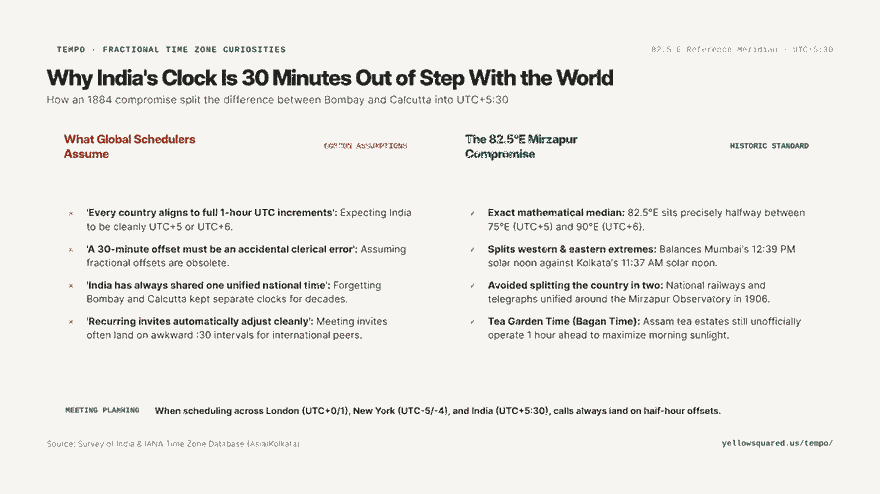
When the International Meridian Conference established Greenwich as the prime meridian in 1884, global planners envisioned 24 clean, one-hour time zones spanning 15 degrees of longitude each. However, geographic reality rarely conforms to neat geometric lines. At the time of the conference, British India operated on two competing, non-standard clocks: Bombay Time (UTC+4:51, based on the Mumbai meridian at 72.9°E) and Calcutta Time (UTC+5:53, based on the Kolkata meridian at 88.4°E).
Time zones are not natural geographic constants; they are nationwide treaties between solar noon and administrative efficiency.
The 1906 Mirzapur Solution: Splitting the Difference
Managing two major commercial hubs separated by 62 minutes of clock drift created severe friction for India’s expanding telegraph and railway networks. In 1905, colonial astronomers selected the 82.5°E meridian as the single national anchor:
- Mathematical Median: 82.5°E sits exactly halfway between 75°E (UTC+5) and 90°E (UTC+6). Multiplying 82.5 degrees by 4 minutes per degree yields exactly 330 minutes—or 5 hours and 30 minutes ahead of Greenwich.
- Passing Through Mirzapur: The line passes through the historic clock tower in Mirzapur, Uttar Pradesh (near Prayagraj / Allahabad), bisecting the country into balanced halves.
- Colonial Resistance: Despite the official adoption of IST on January 1, 1906, local cities clung to their solar clocks. Kolkata did not officially abandon Calcutta Time until 1948, and Mumbai maintained Bombay Time until 1955.
The Continuing Debate: Should India Have Two Time Zones?
Because India spans nearly 30 degrees of longitude from the salt flats of Gujarat to the mountains of Arunachal Pradesh, the sun rises and sets nearly two hours earlier in the northeast than in the west. In eastern Assam, summer sunrise occurs before 4:15 AM, and winter darkness falls by 4:30 PM.
To cope with early darkness, tea plantations across northeastern India have observed an informal convention known as Tea Garden Time (Bagan Time) for over a century, setting their clocks one hour ahead of IST (UTC+6:30) to maximize daylight field work. While researchers at the National Physical Laboratory have proposed splitting India into two zones along the 89.5°E border, the central government has consistently rejected the proposal to prevent railway signaling confusion.
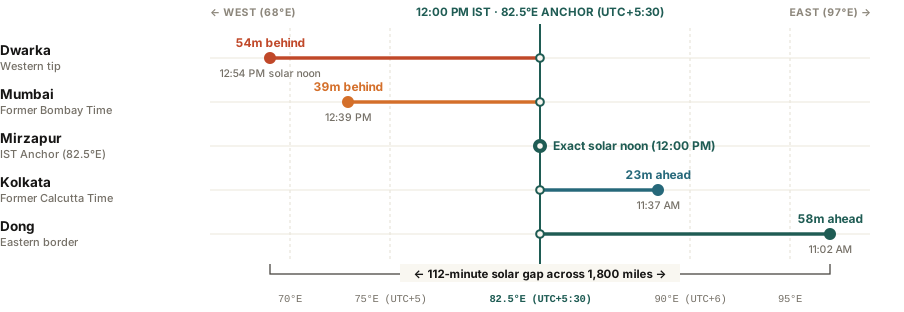
Solar Noon and Time Discrepancies Across India
| City / Region | Longitude | Historical Meridian | Clock Noon (Solar Noon) | Offset from IST |
|---|---|---|---|---|
| Dong (Arunachal Pradesh) | 97.0° E | UTC+6:28 | 11:02 AM (-58 min) | Solar noon arrives 58 minutes early |
| Kolkata (West Bengal) | 88.4° E | UTC+5:53 (Calcutta Time) | 11:37 AM (-23 min) | Solar noon arrives 23 minutes early |
| Mirzapur / Prayagraj | 82.5° E | UTC+5:30 (IST Anchor) | 12:00 PM (Perfect Sync) | Exact astronomical match |
| Mumbai (Maharashtra) | 72.9° E | UTC+4:51 (Bombay Time) | 12:39 PM (+39 min) | Solar noon arrives 39 minutes late |
| Dwarka (Gujarat) | 69.0° E | UTC+4:36 | 12:54 PM (+54 min) | Solar noon arrives 54 minutes late |
How to Schedule Calls with Indian Teams
- Always account for the :30 minute boundary: Because India is UTC+5:30, calls booked on the hour in London (e.g., 2:00 PM GMT) land at 7:30 PM IST; book on the half-hour (e.g., 2:30 PM GMT) to give Indian colleagues clean 8:00 PM starts.
- Remember India does not observe Daylight Saving Time: When the US and Europe spring forward in March, the time difference with India shrinks by one hour; when they fall back in autumn, the gap widens by one hour.
- Check exact multi-city overlaps: You can Open Tempo in your browser to test synchronized interactive time zone dials and plan distributed meetings without fractional calculation errors.