
Why Is Iran on a Half-Hour Time Zone (UTC+03:30) and Why Did It End Daylight Saving Time in 2022?
Look at a time-zone map of the Middle East and one country stands right in the middle on its own 30-minute offset: Iran is the only country on Earth that observes UTC+03:30 (Iran Standard Time, IRST, IANA identifier Asia/Tehran). That places clocks in Tehran 30 minutes ahead of neighboring Iraq, Turkey, and Saudi Arabia (UTC+03:00) and 30 minutes behind the United Arab Emirates, Oman, and Armenia (UTC+04:00).
As documented in Iran Standard Time, UTC+03:30, and Iranian calendars, that half-hour offset is not random: it is anchored to the exact 52.5°E astronomical meridian—the official meridian of Iran that also determines the exact instant of the spring equinox (Nowruz) in the Solar Hijri calendar. Open Tempo in your browser to compare Asia/Tehran (UTC+03:30) with neighboring Middle Eastern, European, and North American time zones.
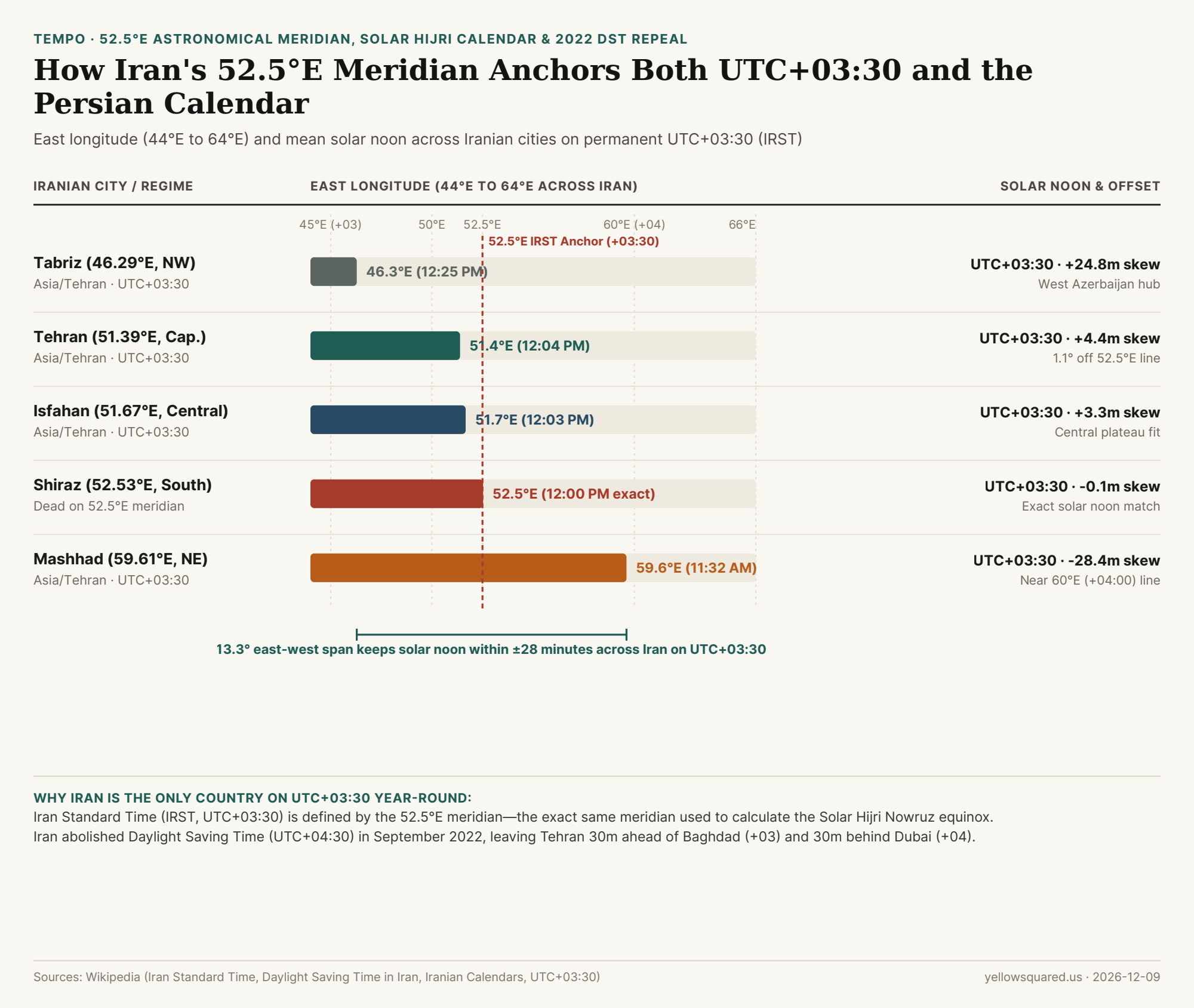
44°E to 66°E) and mean solar noon clock time across five major Iranian cities on permanent UTC+03:30 (IRST). Sources: Iran Standard Time and Iranian Calendars · Download CSV dataset.The 52.5°E Meridian Fit Across Iran
In standard 15-degree solar geometry, UTC+03:00 is centered on 45°E (western Iran/Iraq border) and UTC+04:00 is centered on 60°E (eastern Iran/Afghanistan border). Halfway between them lies 52.50°E—which passes almost directly down the center of the Iranian plateau:
- Tehran (
51.39°E): Sits just1.11°west of52.50°E, giving the capital a mean solar noon of12:04 PM(+4.4 minutesskew). - Isfahan (
51.67°E) & Shiraz (52.53°E): Shiraz sits virtually dead on the52.50°Emeridian, where mean solar noon strikes at12:00 PM(-0.1 minutesskew). - Tabriz (
46.29°E) to Mashhad (59.61°E): Because52.5°Esplits the country's13.3°east-west span right down the middle, solar noon stays within±28 minutesof 12:00 PM from the Turkish border to Khorasan.
"The 52.5°E meridian does double duty in Iran: it anchors civil clocks to UTC+03:30—putting solar noon in Tehran at 12:04 PM—and serves as the official astronomical meridian for calculating the Solar Hijri New Year (Nowruz)."
Why Iran Abolished Daylight Saving Time (UTC+04:30) in 2022
As recorded in Daylight saving time in Iran, Iran spent decades toggling seasonal clock shifts on and off:
1991–2005&2008–2022: Iran observed Iran Daylight Time (IRDT, UTC+04:30) from the start of spring (Farvardin 1/ March 21–22) until the end of summer (Shahrivar 30/ September 21–22), with a brief two-year pause in2006–2007.- September 21, 2022 Repeal: Following legislation passed by Parliament and confirmed by the Guardian Council in May 2022, Iran abolished seasonal clock changes effective September 21, 2022, keeping the country on
UTC+03:30year-round (though local administrative schedule experiments were briefly debated in Tehran in May 2025).
Iranian Cities Solar Noon & Offset Table
The table below details east longitude, official IANA offset, and mean solar noon across Iran (download the raw CSV dataset):
| City or Historical Regime | IANA TZDB Zone | East Longitude | UTC Offset | Mean Solar Noon | Solar Skew | Regional Context |
|---|---|---|---|---|---|---|
| Tabriz (Northwest) | Asia/Tehran |
46.29°E |
UTC+03:30 |
12:25 PM | +24.8 min |
Near 45°E (UTC+03:00) border with Turkey & Iraq |
| Tehran (Capital) | Asia/Tehran |
51.39°E |
UTC+03:30 |
12:04 PM | +4.4 min |
1.11° west of 52.5°E; permanent standard time since 2022 |
| Isfahan (Central) | Asia/Tehran |
51.67°E |
UTC+03:30 |
12:03 PM | +3.3 min |
Central Iranian plateau alignment |
| Shiraz (South) | Asia/Tehran |
52.53°E |
UTC+03:30 |
12:00 PM | -0.1 min |
Sits dead on the 52.50°E meridian |
| Mashhad (Northeast) | Asia/Tehran |
59.61°E |
UTC+03:30 |
11:32 AM | -28.4 min |
Near 60°E (UTC+04:00) eastern border |
| Tehran (2008–2022 DST) | Asia/Tehran (IRDT) |
51.39°E |
UTC+04:30 (Repealed) |
1:04 PM | +64.4 min |
Abolished effective Sept 21, 2022 |
Global Scheduling Tip for Asia/Tehran
Because Iran ended DST in 2022 while Europe and North America still shift clocks twice a year, the time difference between Tehran and Western cities now changes twice annually: Tehran is +3h 30m ahead of London in winter (GMT) and +2h 30m ahead in summer (BST), and +8h 30m ahead of New York in winter vs. +7h 30m in summer. Open Tempo in your browser to track Asia/Tehran alongside your team's local clocks.