
Why Is Nepal on a 45-Minute Time Zone (UTC+05:45)—And 15 Minutes Ahead of India?
If you cross the land border from Raxaul, India, into Birgunj, Nepal—or book a short 90-minute flight from New Delhi (DEL) to Kathmandu (KTM)—your phone clock performs one of the strangest jumps in global aviation: it advances by exactly 15 minutes. While all of India and Sri Lanka observe Indian Standard Time (UTC+05:30) and neighboring Bangladesh and Bhutan sit on UTC+06:00, Nepal operates year-round on Nepal Standard Time (NPT, UTC+05:45). As documented in the UTC+05:45 and Chatham Standard Time Zone historical records and verified by Time and Date's Nepal time zone registry, Nepal is the only sovereign country on Earth whose national clock is set to a 45-minute offset from Coordinated Universal Time.
Why did Nepal abandon the half-hour Indian time zone it had shared for 65 years, how does a sacred 7,134-meter Himalayan peak 100 kilometers east of Kathmandu make UTC+05:45 mathematically more accurate than UTC+05:30, and what happens to timekeeping on the summit ridge of Mount Everest? Here is the complete geographic, astronomical, and software engineering story behind Asia/Kathmandu.
1. Three Eras of Time in Kathmandu: From UTC+05:41:16 to UTC+05:30 to UTC+05:45
To understand why Nepal uses a quarter-hour offset, it helps to trace the three distinct timekeeping regimes recorded in the history of Nepal Standard Time:
- Pre-1920 Local Mean Solar Time (
UTC+05:41:16): Until 1920, Kathmandu did not use an international time zone offset at all. Clocks in the capital were calibrated directly to Kathmandu's local mean solar time at longitude85°19'E(85.32°E). Because Earth rotates360°every 24 hours—or1°of longitude every4 minutes(4 secondsper arcminute)—Kathmandu's true solar meridian sits exactly 5 hours, 41 minutes, and 16 seconds ahead of the Greenwich Prime Meridian (0°). - 1920 to 1985 — The Indian Standard Time Era (
UTC+05:30): In 1920, to simplify telegraph, railway, and commercial coordination with British India, Nepal formally adopted Indian Standard Time (UTC+05:30), which is anchored to the82°30'Emeridian passing near Mirzapur in Uttar Pradesh. Because82°30'Elies nearly three degrees west of Kathmandu and up to six degrees west of eastern Nepal, operating onUTC+05:30meant Kathmandu's civil clocks lagged 11 minutes and 16 seconds behind local solar time, bringing earlier winter dusks across the Kathmandu Valley and eastern Himalayan trekking corridors. - January 1, 1986 — The 15-Minute Sovereign Leap (
UTC+05:45): On January 1, 1986, under the reign of King Birendra Bir Bikram Shah Dev, the Government of Nepal officially advanced national clocks by 15 minutes fromUTC+05:30toUTC+05:45. As noted in Himalayan Dream Team's analysis of Nepal's time standard, the shift served a dual purpose: it asserted Nepal's sovereign national identity distinct from its much larger southern neighbor while anchoring civil time to a sacred meridian inside Nepalese territory.
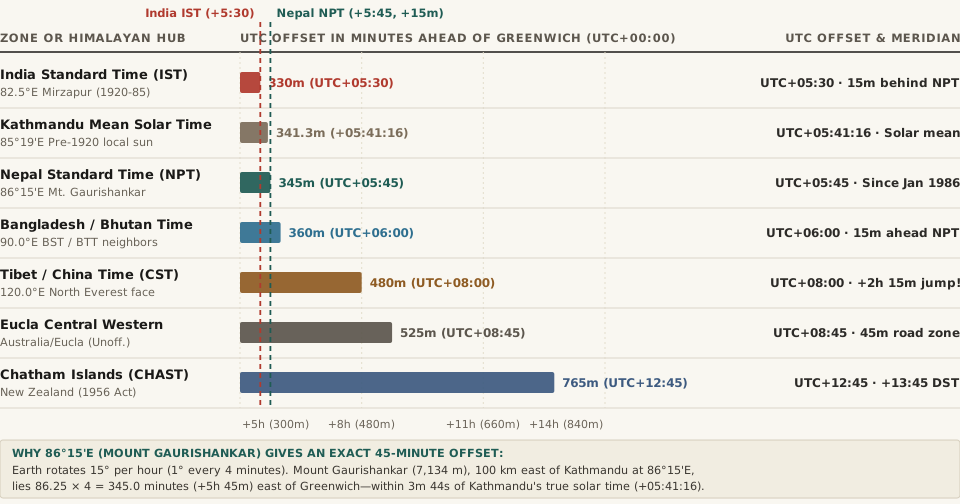
2. The Longitude Math of Mount Gaurishankar (86°15'E)
Why did Nepal choose +05:45 rather than jumping a full 30 minutes to UTC+06:00 like Bangladesh and Bhutan? The answer is pure spherical astronomy. Standard 1-hour time zones are spaced every 15° of longitude (60 minutes), half-hour time zones sit at 7.5° increments (30 minutes), and quarter-hour time zones sit at 3.75° (3°45') increments (15 minutes).
To produce an exact +5 hour 45 minute (345-minute) solar offset from Greenwich, a reference meridian must lie at:
- Exact Target Meridian:
345 minutes ÷ 4 minutes per degree = 86.25°E, which in degrees and arcminutes is86°15'E(86°15'–86°20'E). - The Sacred Peak Anchor: Approximately 100 kilometers (62 miles) east-northeast of Kathmandu in the Rolwaling Himal stands Mount Gaurishankar (
7,134 meters / 23,406 feet), the second-highest peak of the Rolwaling range, revered in both Hindu and Buddhist traditions (named after the goddess Gauri and her consort Shankar/Shiva). As documented by Wikipedia's Nepal Standard Time entry, Nepal designated the meridian passing through the summit of Mount Gaurishankar as its national standard meridian. - 3 Minutes 44 Seconds from Perfect Solar Time: Because Kathmandu's local mean solar time is
UTC+05:41:16, anchoring Nepal Standard Time toUTC+05:45:00places the capital's clocks within just 3 minutes and 44 seconds of true solar noon—roughly three times closer to solar reality than the11 minute 16 seconderror under Indian Standard Time (UTC+05:30) and five times closer than the18 minute 44 seconderror thatUTC+06:00would have imposed.
"NPT is an approximation of Kathmandu mean time, which is 5 hours, 41 minutes, and 16 seconds ahead of UTC. The standard meridian passes through the peak of Gaurishankar mountain about 100 kilometres (62 mi) east of Kathmandu."
3. The World's Only Three 45-Minute Time Zones
According to the UTC+05:45 and Chatham Standard Time Zone registries, out of more than 400 regional zones in the IANA tz database, only three regions on Earth operate on a :45 minute offset—and only two have official statutory status:
- Nepal Standard Time (
NPT,UTC+05:45—Asia/Kathmandu): The only national, country-wide 45-minute time zone on Earth, covering ~30 million residents across all of Nepal since January 1, 1986. As confirmed by Time and Date, Nepal has never observed Daylight Saving Time (DST), soUTC+05:45holds 365 days a year. - Chatham Standard Time Zone (
CHAST,UTC+12:45/CHADT,UTC+13:45—Pacific/Chatham): Used exclusively on New Zealand's Chatham Islands (~800 km east of New Zealand's South Island, population ~800). As documented in Wikipedia's Chatham Standard Time Zone article, the islands have kept time 45 minutes ahead of mainland New Zealand since at least the late 1920s, codified into law by New Zealand's Standard Time Amendment Act 1956. Unlike Nepal, the Chatham Islands observe Daylight Saving Time from the last Sunday in September (02:45) to the first Sunday in April (03:45), shifting toUTC+13:45. - Australian Central Western Time (
ACWST,UTC+08:45—Australia/Eucla): An unofficial but universally observed highway time zone used by fewer than 200 residents at roadhouses along the Eyre Highway in Western Australia (Border Village, Eucla, Madura, Mundrabilla, and Cocklebiddy) between Caiguna and the South Australian border, splitting the 90-minute gap between Western Australia (UTC+08:00) and South Australia (UTC+09:30).
4. Complete Data Table: Himalayan Neighbor Offsets & Global 45-Minute Zones
The dataset below—bundled in the downloadable CSV (nepal-standard-time-utc-05-45-gaurishankar-meridian-and-global-45-minute-zones.csv)—compares Nepal's historical and modern time standards against its immediate South and East Asian neighbors and the two other 45-minute zones worldwide:
| Time Zone or Historical Era | IANA Identifier | Reference Meridian | Solar Offset vs. UTC | Official Civil Offset | Total Offset (Min) | Gap vs. Nepal (UTC+05:45) |
|---|---|---|---|---|---|---|
| Indian Standard Time (IST — Nepal 1920–1985) | Asia/Kolkata |
82°30'E (Mirzapur) |
+5h 30m 00s |
UTC+05:30 (No DST) |
330.0 min |
15 min behind Nepal |
| Kathmandu Local Mean Solar Time (Pre-1920) | Local Solar Time | 85°19'E (Kathmandu) |
+5h 41m 16s |
UTC+05:41:16 |
341.27 min |
3 min 44 sec behind modern NPT |
| Nepal Standard Time (NPT — Since Jan 1, 1986) | Asia/Kathmandu |
86°15'E (Mt. Gaurishankar) |
+5h 45m 00s |
UTC+05:45 (No DST) |
345.0 min |
Baseline (0 min) |
| Bangladesh & Bhutan Time (BST / BTT) | Asia/Dhaka · Asia/Thimphu |
90°00'E |
+6h 00m 00s |
UTC+06:00 (No DST) |
360.0 min |
15 min ahead of Nepal |
| Myanmar Standard Time (MMT) | Asia/Yangon |
97°30'E |
+6h 30m 00s |
UTC+06:30 (No DST) |
390.0 min |
45 min ahead of Nepal |
| China Standard Time (Tibet / Everest North Face) | Asia/Shanghai |
120°00'E (Beijing) |
+8h 00m 00s |
UTC+08:00 (No DST) |
480.0 min |
2 hr 15 min ahead across summit |
| Australian Central Western Time (Eucla) | Australia/Eucla |
131°15'E |
+8h 45m 00s |
UTC+08:45 (Unofficial) |
525.0 min |
3 hr 00 min ahead of Nepal |
| Chatham Standard Time Zone (New Zealand) | Pacific/Chatham |
176°15'W equiv. |
+12h 45m 00s |
UTC+12:45 (+13:45 DST) |
765.0 min |
7 hr 00 min ahead (8 hr in DST) |
5. The Mount Everest Paradox and Software Engineering Pitfalls
Nepal's UTC+05:45 offset creates two famous real-world edge cases for mountaineers and software developers:
- The 2-Hour 15-Minute Jump on the Summit of Mount Everest: Mount Everest (Sagarmatha / Chomolungma,
8,848.86 m) straddles the international border between Nepal on its southern flank and the Tibet Autonomous Region of China on its northern flank. Because all of China uses a single nationwide time zone anchored to Beijing at120°E(UTC+08:00), stepping across the summit ridge from the Nepalese South Col route (UTC+05:45) onto the Tibetan Northeast Ridge route legally advances the clock by 2 hours and 15 minutes in a single stride. - Why Integer-Hour and Half-Hour Cron Parsers Break on
Asia/Kathmandu: In backend engineering, QA teams routinely useAsia/Kathmandu(+05:45) alongsideAsia/Kolkata(+05:30) andPacific/Chatham(+12:45) as unit-test fixtures. Any naive time-zone picker or cron scheduler that stores UTC offsets as an integer number of hours—or even as0.5-hour floats without quarter-hour (0.25-hour /900-second) precision—will corrupt timestamps or misalign meeting invites for users in Nepal.
When you are coordinating remote standups, flights, or expedition logistics across Kathmandu (UTC+05:45), New Delhi (UTC+05:30), London, and Seattle, Open Tempo in your browser to visualize quarter-hour time-zone offsets side by side without mental arithmetic errors.