
Why Is Newfoundland 30 Minutes Ahead of Atlantic Time (UTC-03:30)?
Anyone who has tuned into a Canadian television broadcast or scheduled a call across Atlantic Canada has heard the classic phrasing: "8:00 PM Eastern, 9:00 PM Atlantic, 9:30 in Newfoundland." While most of the world's time zones step in whole 1-hour (15°) increments from Coordinated Universal Time, the island of Newfoundland and the southeastern tip of Labrador observe Newfoundland Standard Time (NST, UTC−03:30, IANA identifier America/St_Johns) in winter and Newfoundland Daylight Time (NDT, UTC−02:30) in summer—exactly 30 minutes ahead of Nova Scotia, New Brunswick, and Prince Edward Island.
Why does Canada's easternmost province run on a half-hour offset? As documented in UTC−03:30 and Time in Canada, the answer combines precise 52.5°W solar meridian geometry with Newfoundland's history as a separate self-governing British dominion before it joined Confederation in 1949. Open Tempo in your browser to check live America/St_Johns clocks alongside Atlantic, Eastern, and European time zones.
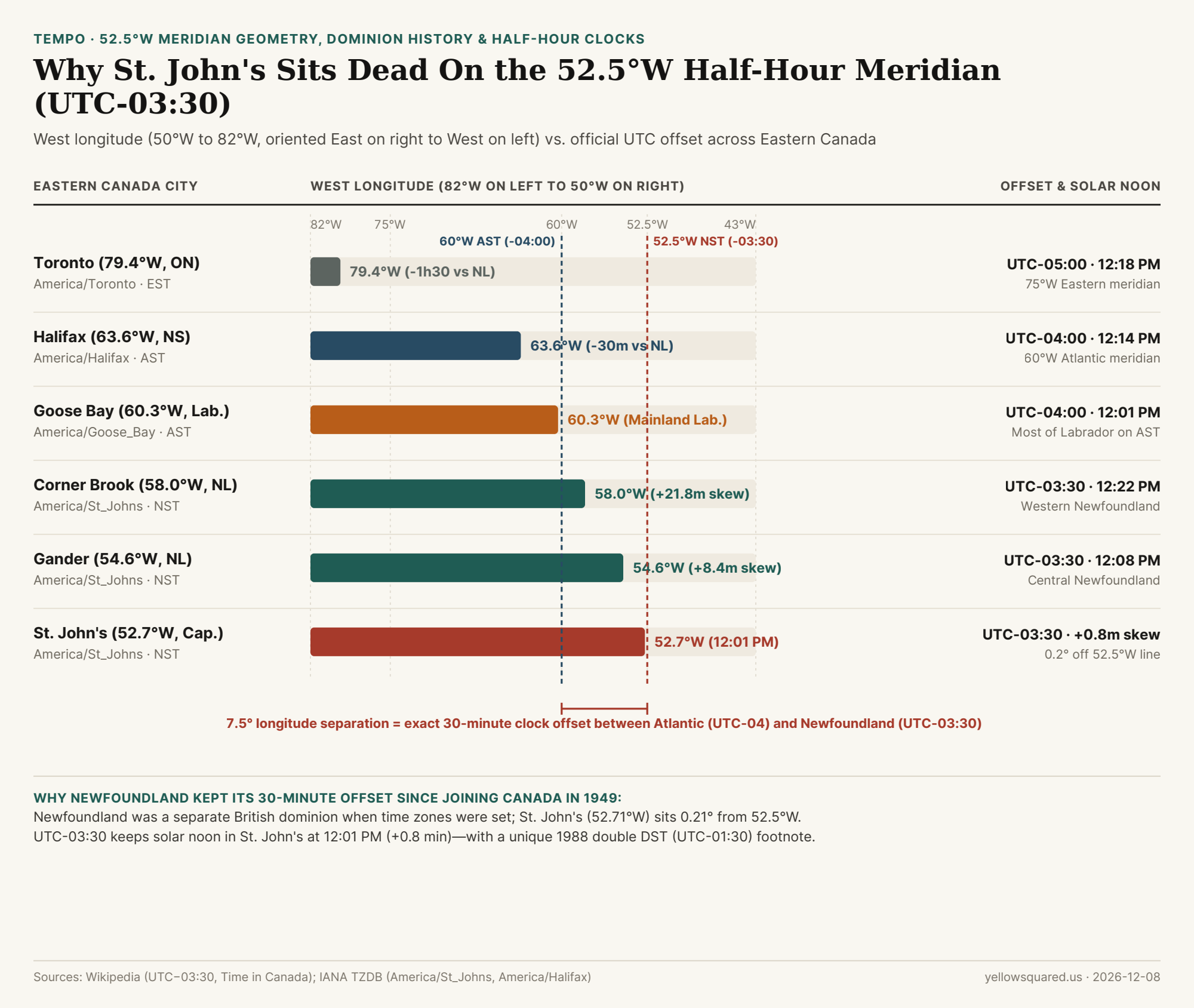
82°W left to 43°W right) and mean solar noon clock time across Eastern Canada, showing how St. John's (52.71°W) sits within 0.21° of the exact 52.5°W meridian for UTC−03:30. Sources: UTC−03:30 and Time in Canada · Download CSV dataset.The 52.5°W Half-Hour Meridian Fit
Standard 1-hour time zones are centered on multiples of 15° longitude: Eastern Time (UTC−05:00) is anchored at 75°W, and Atlantic Time (UTC−04:00) is anchored at 60°W. The next whole-hour meridian eastward is 45°W (UTC−03:00, which crosses southern Greenland in the middle of the North Atlantic Ocean).
Look at where the island of Newfoundland sits: its eastern capital, St. John's, lies at 52°43'W (52.71°W)—almost dead halfway between 60°W and 45°W! Because 7.5° of longitude equals exactly 30 minutes of Earth rotation (7.5° × 4 min/° = 30 min), the exact theoretical meridian for UTC−03:30 is 52.50°W:
- On
UTC−03:30(Newfoundland Standard Time): St. John's sits just0.21°west of52.50°W, placing mean solar noon at12:01 PM(+0.8 minutesskew). Even Corner Brook on the western coast of the island (57.95°W) stays within22 minutesof noon (12:22 PM). - Why It Survived Joining Canada in 1949: When standard time zones were established, Newfoundland was a separate British dominion rather than a Canadian province, so it chose the
UTC−03:30offset tailored to St. John's. After joining Canada in 1949, residents resisted proposals to adopt Atlantic Time (UTC−04:00), which would have pushed St. John's winter sunsets 30 minutes earlier.
"St. John's (52.71°W) sits just 0.21 degrees—less than one minute of solar time—from the exact 52.50°W reference meridian for UTC−03:30, making Newfoundland Time one of the most astronomically accurate half-hour time zones on Earth."
Labrador's Split & The 1988 "Double Daylight Saving Time" Footnote
As noted in Time in Canada, although the province's statutory name is Newfoundland and Labrador, the half-hour clock is not uniform across the mainland:
- Island of Newfoundland + Southeastern Labrador: The entire island plus coastal communities from L'Anse-au-Clair to Norman Bay observe
UTC−03:30/UTC−02:30(America/St_Johns). - Mainland Labrador (Happy Valley-Goose Bay & Labrador City): Most of Labrador sits around
60°W–67°Wand observes Atlantic Time (UTC−04:00 / UTC−03:00,America/Goose_Bay) to stay synchronized with neighboring Quebec and the Maritimes. - The 1988 Double DST Experiment: From April 3 to October 30, 1988, Newfoundland famously experimented with "Double Daylight Saving Time", advancing clocks by 2 full hours to
UTC−01:30before returning to a standard 1-hour summer shift (UTC−02:30) in 1989.
Eastern Canada Solar Noon & Offset Table
The table below compares longitude, IANA identifiers, official offsets, and mean solar noon across Eastern Canada (download the raw CSV dataset):
| City & Region | IANA TZDB Zone | West Longitude | Standard / DST Offset | Mean Solar Noon (Std) | Skew | Scheduling Difference vs. St. John's |
|---|---|---|---|---|---|---|
| St. John's (East NL) | America/St_Johns |
52.71°W |
UTC−03:30 / −02:30 |
12:01 PM | +0.8 min |
Reference (0.21° from 52.5°W) |
| Gander (Central NL) | America/St_Johns |
54.61°W |
UTC−03:30 / −02:30 |
12:08 PM | +8.4 min |
Same clock as St. John's |
| Corner Brook (West NL) | America/St_Johns |
57.95°W |
UTC−03:30 / −02:30 |
12:22 PM | +21.8 min |
Same clock as St. John's |
| Goose Bay (Labrador) | America/Goose_Bay |
60.31°W |
UTC−04:00 / −03:00 |
12:01 PM | +1.2 min |
30 minutes behind St. John's |
| Halifax (Nova Scotia) | America/Halifax |
63.58°W |
UTC−04:00 / −03:00 |
12:14 PM | +14.3 min |
30 minutes behind St. John's |
| Toronto (Ontario) | America/Toronto |
79.38°W |
UTC−05:00 / −04:00 |
12:18 PM | +17.5 min |
1 hour 30 minutes behind St. John's |
Meeting & Travel Tip Across the 30-Minute Boundary
Because Newfoundland observes the same North American DST transition dates (second Sunday in March and first Sunday in November) as Atlantic and Eastern Time, its +30 minute lead over Halifax and +1h 30m lead over Toronto/New York stays constant year-round—unlike regions without DST. Open Tempo in your browser to lock America/St_Johns onto your world clock bar so you never miss a half-hour meeting offset.