
Why Is Relative Humidity Higher at Night Than During the Day?
Why Is Relative Humidity Higher at Night Than During the Day?
Even when absolute water vapor stays completely flat at 9.3 grams per kilogram of air (a constant 55°F dew point), cooling the air from 82°F at 3:00 PM down to 55°F at 6:00 AM shrinks saturation capacity by 61%—driving relative humidity from 39% to 100%.
Open any weather app at 6:00 AM on a clear summer morning and the humidity readout looks alarming: 92% to 100% Relative Humidity. Step outside six hours later at 3:00 PM when the afternoon sun is blazing at `82°F (27.8°C)`, check the exact same weather app, and the Relative Humidity has plummeted to 39%—only to climb right back past 75% after sunset.
Did a massive wave of water vapor roll into your neighborhood overnight and evaporate at lunchtime? Not at all. In a stable air mass without an approaching weather front, the actual mass of water vapor floating in every kilogram of air barely changes between dawn and mid-afternoon. Understanding why Relative Humidity (`RH %`) is an upside-down mirror of the daily temperature curve—and why meteorologists track the Dew Point instead—transforms how you read a weather forecast.
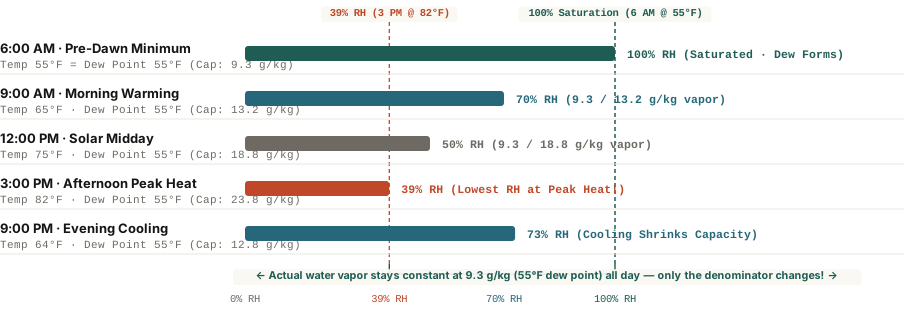
The Thermodynamics of the 'Expanding Bucket': Clausius-Clapeyron
According to the National Weather Service (NOAA), Relative Humidity does not measure how much water is in the air; it measures how full the air's temperature-dependent 'bucket' is at that exact moment:
`Relative Humidity (%) = (Actual Water Vapor Mixing Ratio ÷ Saturation Mixing Ratio at Current Temp) × 100`
Governed by the Clausius-Clapeyron relation, the saturation vapor pressure (the denominator of that fraction) increases exponentially with temperature—roughly doubling for every `20°F` (`11°C`) increase in air temperature. Follow a single parcel of air containing exactly `9.3 grams` of water vapor per kilogram of dry air (a constant `55°F / 12.8°C` dew point) across a clear 24-hour cycle:
- 6:00 AM (`55°F / 12.8°C` — Pre-Dawn Minimum): At `55°F`, a kilogram of air can hold a maximum of `9.3 g` of water vapor before condensation begins. Because the air actually holds `9.3 g/kg`, the bucket is `9.3 ÷ 9.3 = 100% full` (`100% RH`), condensing excess moisture onto grass blades as morning dew.
- 12:00 PM (`75°F / 23.9°C` — Solar Midday): Solar heating warms the air by `20°F`, doubling its saturation capacity to `18.8 g/kg`. With the exact same `9.3 g/kg` of water vapor inside, Relative Humidity drops in half to `9.3 ÷ 18.8 = 50% RH`.
- 3:00 PM (`82°F / 27.8°C` — Afternoon Peak): At `82°F`, the air's capacity expands to `23.8 g/kg`, pushing Relative Humidity down to its daily minimum of `9.3 ÷ 23.8 = 39% RH`.
- 9:00 PM (`64°F / 17.8°C` — Radiational Cooling): Once the sun sets and the ground radiates infrared heat into space, the boundary layer cools back toward `64°F`, shrinking the bucket to `12.8 g/kg` and sending Relative Humidity climbing back to `73% RH`.
Relative humidity goes up at night not because the air gains water, but because cooling air loses its capacity to hold water vapor in gas form.
Why You Should Check the Dew Point Instead of Relative Humidity
Because Relative Humidity changes every time the thermometer moves, a winter morning at `35°F` with `95% RH` contains very little water vapor and feels bone-dry indoors, whereas a `90°F` summer afternoon at `55% RH` (`72°F` dew point) feels oppressive because sweat cannot evaporate rapidly off your skin. Use NOAA's absolute Dew Point scale to judge how the air actually feels:
- Dew Point Below `55°F` (`<12.8°C`): Crisp, dry, and comfortable day and night—even if dawn Relative Humidity hits `100%`.
- Dew Point `60°F–64°F` (`15.6°C–17.8°C`): Noticeably sticky during outdoor exercise.
- Dew Point `65°F–70°F+` (`18.3°C–21.1°C+`): Oppressive, tropical mugginess where overnight temperatures cannot cool below `68°F`.
To inspect diurnal temperature-dewpoint spreads, boundary-layer inversion curves, and historical climate normals across global stations, you can Analyze atmospheric soundings on Eranorms for any season of the year.