
Why Is the Desert So Cold at Night?
Deserts become freezing cold at night because their bone-dry air completely lacks the natural greenhouse "vapor blanket" that keeps humid regions warm, allowing up to 90 percent of daytime ground heat to radiate directly out into space after sunset. Paired with the extremely low specific heat capacity of dry quartz sand — which absorbs heat rapidly at noon but loses it just as quickly by midnight — arid basins like Death Valley routinely experience brutal 35°F to 45°F diurnal temperature swings between daytime scorching heat and nighttime shivering cold.
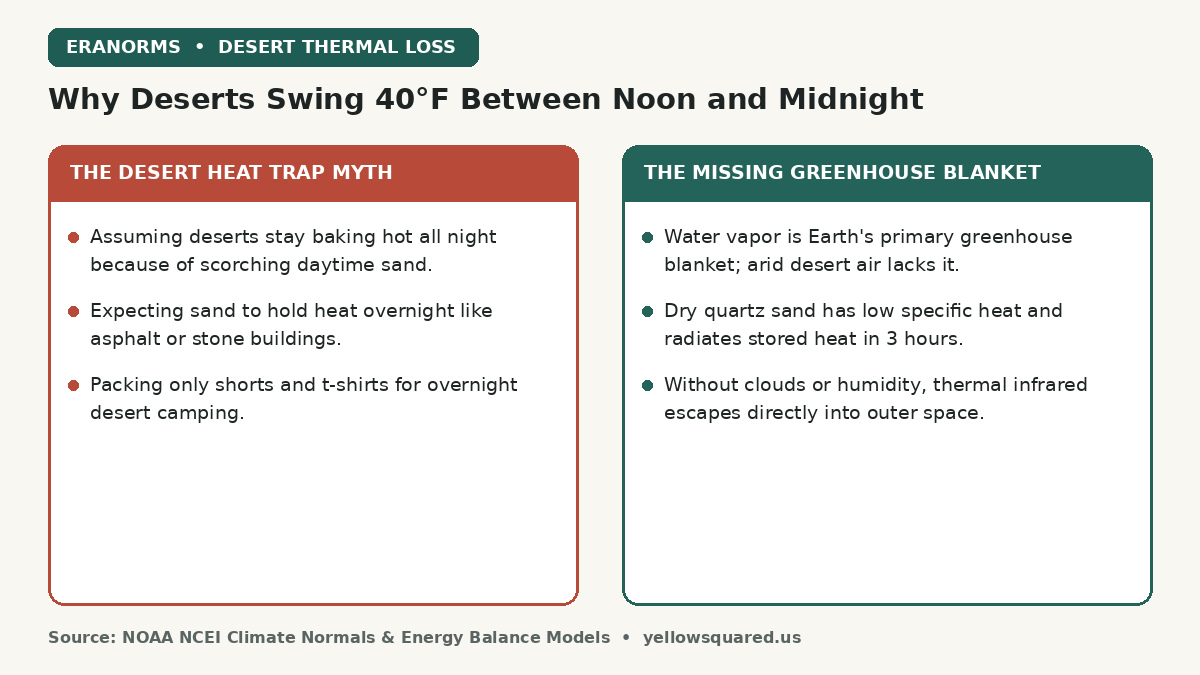
Every year, first-time visitors to the American Southwest, Sahara, or Atacama desert pack lightweight summer clothing, expecting the desert to stay sweltering around the clock. By 2:00 AM, they find themselves shivering in 42°F cold, wondering how a landscape that measured 105°F at 3:00 PM could chill so violently. The secret lies not in the soil, but in the invisible humidity of the atmosphere overhead.
Water vapor is Earth's primary greenhouse gas; when relative humidity drops below 15 percent, the planet's atmospheric thermal blanket vanishes.
The Thermodynamics of the Missing Vapor Blanket
In atmospheric physics, water vapor accounts for roughly 60 percent of Earth's natural greenhouse warming. In a humid coastal city like Miami or Houston, dewpoints hover between 70°F and 76°F. The air column contains up to 20 to 25 grams of water vapor per cubic meter, which absorbs outgoing thermal infrared radiation (λ ∼ 8 to 14 µm) emitted by the cooling ground and re-radiates it back downward, keeping nighttime temperatures locked in the mid-70s.
In an arid desert basin, daytime relative humidity often plummets to 5 to 12 percent with dewpoints well below freezing. The atmosphere overhead contains virtually zero precipitable water vapor. Once the sun dips below the horizon, there is no thermal blanket to reflect longwave infrared radiation back to Earth. The heat escapes unimpeded into the freezing void of space (which rests at 2.7 Kelvin / -455°F), chilling the ground at rates exceeding 5°F to 8°F per hour after dusk.
Sand vs. Water: The Specific Heat Penalty
The ground composition of deserts accelerates this cooling cycle through thermal inertia:
- Specific heat capacity of water: 4.18 Joules per gram per degree Celsius. Water absorbs massive amounts of heat before warming and releases that heat slowly overnight.
- Specific heat capacity of dry quartz sand: Only 0.80 Joules per gram per degree Celsius — less than one-fifth that of water.
- Shallow heat storage: Because dry sand is an exceptional thermal insulator, daytime heat does not penetrate deep into the subsoil. Only the top two to three inches bake in the sun. Once radiation ceases, that paper-thin surface heat dissipates within two to three hours.
Diurnal Temperature Swings Compared by Climate Zone
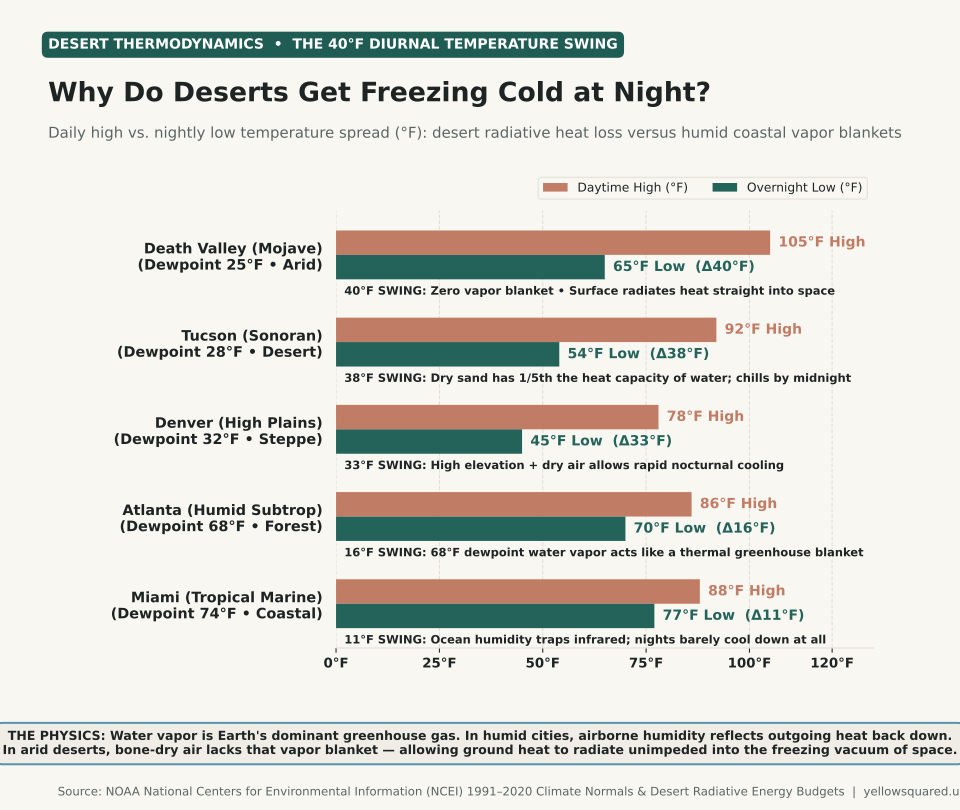
The table below illustrates the stark contrast between arid desert basins and humid coastal environments from official NOAA climate normals:
| Reporting Station & Climate | Average Dewpoint | Typical Summer High | Typical Summer Low | Average 24h Diurnal Swing |
|---|---|---|---|---|
| Death Valley, CA (Arid Low Desert) | 25°F (-4°C) | 105°F | 65°F | 40°F (22°C) Swing |
| Tucson, AZ (Sonoran Desert) | 28°F (-2°C) | 92°F | 54°F | 38°F (21°C) Swing |
| Denver, CO (High Plains Steppe) | 32°F (0°C) | 78°F | 45°F | 33°F (18°C) Swing |
| Atlanta, GA (Humid Subtropical) | 68°F (20°C) | 86°F | 70°F | 16°F (9°C) Swing |
| Miami, FL (Tropical Maritime) | 74°F (23°C) | 88°F | 77°F | 11°F (6°C) Swing |
To inspect 30-year diurnal temperature curves, seasonal frost risk dates, and daily normals across U.S. reporting stations, explore the interactive Eranorms climate explorer.