
Why Do UTC and GMT Differ?
Most people use Greenwich Mean Time (GMT) and Coordinated Universal Time (UTC) as interchangeable labels for 0° longitude, yet they measure two fundamentally different physical systems. GMT—modernized in astronomy as UT1—is tied to the irregular spin of the Earth, while UTC is generated by a global weighted average of cesium-133 atomic clocks and hydrogen masers maintained by the Bureau International des Poids et Mesures (BIPM).
Why Earth's Rotation and Atomic Clocks Diverged
In 1958, when International Atomic Time (TAI) was initialized, it was set equal to GMT. However, the U.S. Naval Observatory (USNO) notes that the SI atomic second is fixed at exactly 9,192,631,770 radiation cycles of cesium-133, whereas Earth's mean solar day fluctuates due to tidal friction, seasonal mass transport, and core-mantle dynamics.
To keep broadcast clocks aligned with daylight without altering the length of the SI second, the International Radio Consultative Committee introduced leap seconds in 1972. Under ITU-R Recommendation TF.460, the International Earth Rotation and Reference Systems Service (IERS) inserts a positive 1-second step whenever needed to keep UTC within 0.9 seconds of UT1.
"Coordinated Universal Time (UTC) differs from TAI by an integral number of seconds... UTC has replaced Greenwich Mean Time (GMT) as an international standard." — U.S. Naval Observatory, Definitions of Systems of Time
How the Major Timescales Compare Today
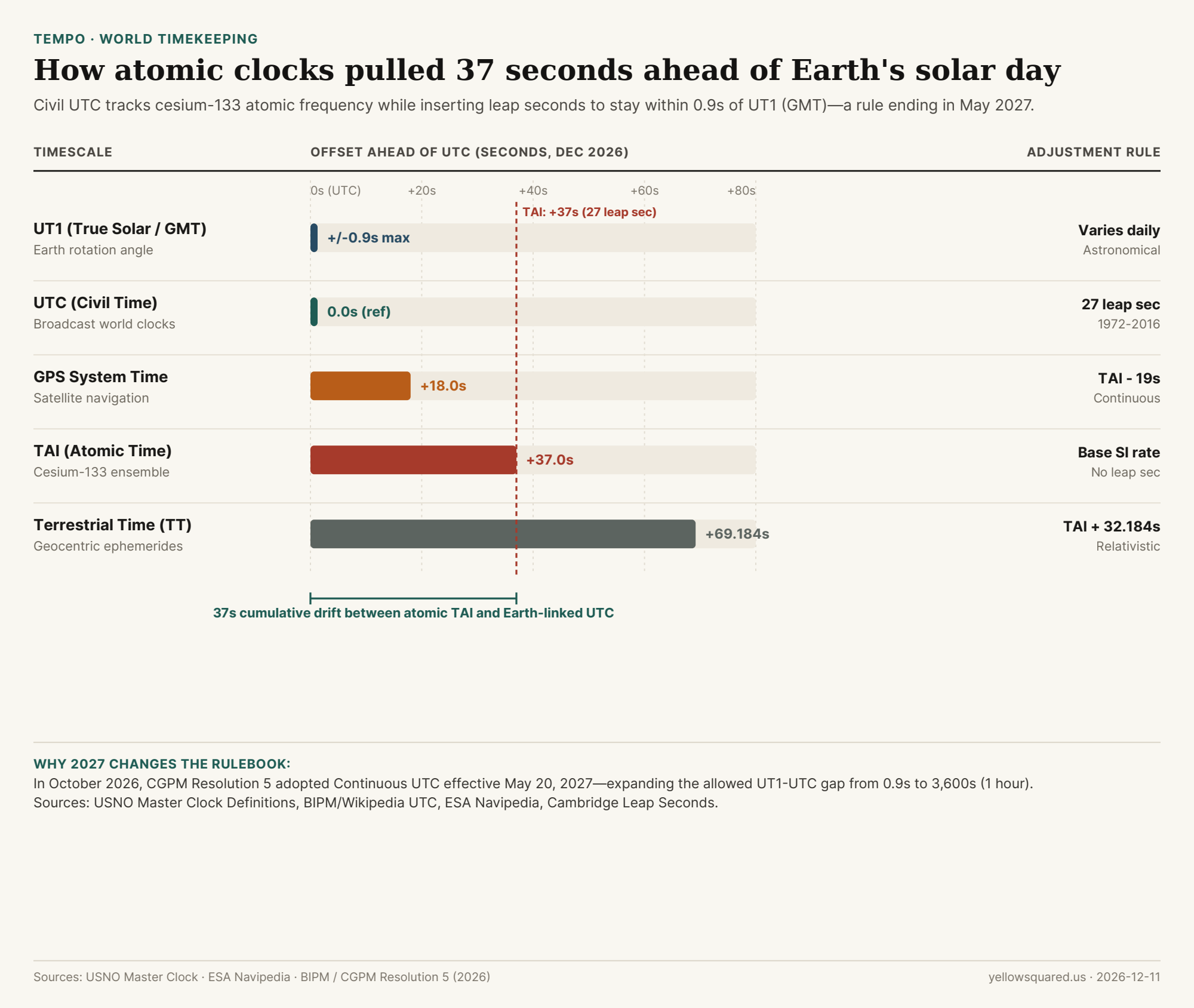
Because leap seconds are applied to civil UTC—and never to pure atomic or satellite timescales—different engineering systems now sit dozens of seconds apart, as documented by University of Cambridge timekeeping records and ESA Navipedia:
| Timescale | Offset vs. UTC (Dec 2026) | Physical Basis | Leap Second Handling |
|---|---|---|---|
| UT1 (True GMT) | Within ±0.9s | Mean solar time at 0° longitude | Continuous Earth rotation |
| UTC (Civil Standard) | 0.0s (Reference) | TAI + integral steps | 27 positive leap seconds (1972–2016) |
| GPS System Time | +18.0s | TAI minus 19.0s fixed | Continuous; ignores post-1980 leap seconds |
| TAI (Atomic Time) | +37.0s | ~250 cesium clocks & masers | Continuous; never adjusted |
| Terrestrial Time (TT) | +69.184s | TAI + 32.184s on Earth's geoid | Continuous astronomical ephemeris |
What Changes on May 20, 2027
Because Earth's rotation temporarily accelerated after 2015, no leap second has been required since December 31, 2016. More importantly, server outages caused by rare 23:59:60 timestamps pushed standards bodies to retire the mechanism. Following the 27th General Conference on Weights and Measures (CGPM) in 2022, Resolution 5 of the 28th CGPM (October 2026) formally established Continuous UTC effective May 20, 2027—raising the maximum allowed |UT1 - UTC| drift from 0.9 seconds to 3,600 seconds (1 hour) so civil clocks can run uninterrupted for centuries.
When coordinating meetings across UTC offsets, standard time zones, and daylight saving transitions without manual arithmetic, Open Tempo in your browser to convert live local times worldwide.