
How Cash Taxes and Carrier Surcharges Change Your Cents-Per-Point Redemption Value
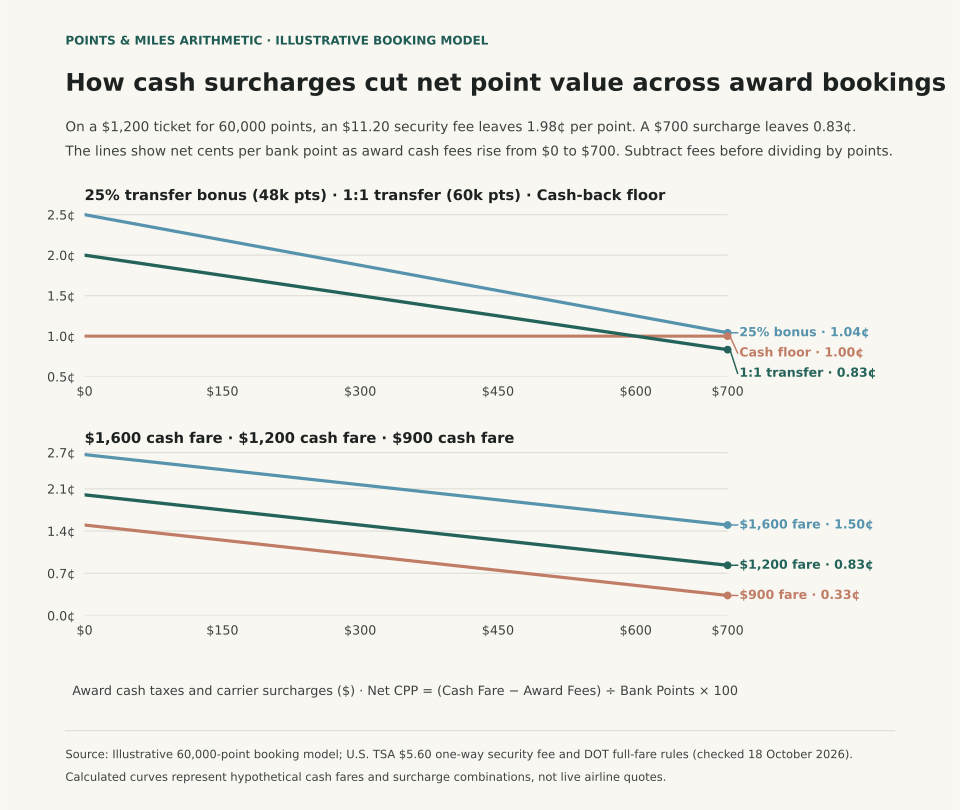
To measure what your points actually save on an award flight or hotel stay, subtract the mandatory cash taxes and carrier surcharges on the award booking from the cash fare of the same trip before dividing by the points required: Net Cents Per Point (CPP) equals (Cash Fare minus Award Cash Fees) divided by Bank Points Used, multiplied by 100. In an illustrative comparison for a $1,200 round-trip ticket costing 60,000 points, paying the statutory U.S. domestic security fee of $11.20 saves $1,188.80 and yields 1.98 cents per point, whereas paying $700 in transatlantic carrier surcharges reduces the cash saved to $500 and cuts the redemption value to 0.83 cents per point.
A traveller comparing two transfer partners with three browser tabs open often divides the $1,200 cash ticket price straight by 60,000 points and sees 2.00 cents per point in both windows. That headline ratio treats an $11.20 government security fee and a $700 carrier surcharge as if both cost zero cash. Checking the net figure before moving points from Chase Ultimate Rewards, American Express, Citi, or Capital One shows when a high-copay award drops below the 1.0-cent-per-point floor you could get from cash back.
Why Cash Tickets Include Surcharges That Award Tickets Bill Separately
When you shop for a paid airline ticket in the United States, U.S. Department of Transportation (DOT) full-fare advertising rules require airlines and travel agencies to include all mandatory government taxes, airport fees, and carrier-imposed surcharges in the prominent total price. When you redeem miles for an award seat, however, the points cover only the base fare while the checkout screen bills government taxes and any carrier-imposed charges in cash.
Government fees follow statutory schedules that apply no matter which airline program issues your ticket. On flights originating in the United States, the Transportation Security Administration (TSA) September 11 Security Fee is $5.60 per one-way trip, or $11.20 for a round trip (TSA Passenger Fees FAQ). International itineraries add customs, immigration, and foreign departure taxes such as the UK Air Passenger Duty. Carrier-imposed surcharges—often labeled YQ or YR on the tax breakdown—work differently: programmes such as The British Airways Club pass along hundreds of dollars in carrier charges on long-haul redemptions, while another alliance partner may price the same route with government taxes alone.
Worked Comparison: One $1,200 Ticket Across Five Fee Structures
The table below holds the illustrative $1,200 round-trip cash price and 60,000-mile award price constant while varying the cash copay from $11.20 to $700. One row adds a 25% bank transfer bonus (1:1.25 ratio), which lowers the bank points required for a 60,000-mile award to 48,000 points (see How to Judge a Points Transfer Bonus Before Moving Points). These rows are calculated examples rather than live route quotes:
| Illustrative Booking Scenario | Cash Fare | Award Cash Fees | Net Cash Saved | Bank Points Used | Headline CPP (No Fee Deducted) | Net CPP (After Fees) |
|---|---|---|---|---|---|---|
| U.S. Domestic Round Trip ($11.20 TSA fee) | $1,200.00 | $11.20 | $1,188.80 | 60,000 | 2.00¢ | 1.98¢ |
| International Low-Fee Partner ($85 government taxes) | $1,200.00 | $85.00 | $1,115.00 | 60,000 | 2.00¢ | 1.86¢ |
| Moderate Carrier Charge ($300 taxes + surcharges) | $1,200.00 | $300.00 | $900.00 | 60,000 | 2.00¢ | 1.50¢ |
| Moderate Charge + 25% Transfer Bonus (1:1.25 ratio) | $1,200.00 | $300.00 | $900.00 | 48,000 | 2.50¢ | 1.88¢ |
| High Carrier Surcharge ($700 taxes + surcharges) | $1,200.00 | $700.00 | $500.00 | 60,000 | 2.00¢ | 0.83¢ |
Keeping the Cash Benchmark Honest Before You Transfer
The net formula is only as realistic as the cash price you put in the numerator. On transatlantic and transpacific routes, full-service airlines frequently price a one-way cash ticket higher than a round trip; if a round trip costs $1,100 ($550 each way) while a standalone one-way ticket lists for $1,800, using $1,800 inflates the apparent point value beyond what you would actually spend in cash. Check whether two programmes sharing the same bank currency price the route differently (as shown in Avios Transfers: Compare the Booking, Not Just the Bonus), and include optional fees such as checked bags or seat selection under DOT optional-service rules only when the award ticket covers a fee you would otherwise pay out of pocket. If you are short a few thousand miles after checking transfer increments, compare the out-of-pocket surcharge against the cost of topping up your balance in Buying Points to Top Up an Award.
Pointsuno calculates net cents-per-point values after subtracting taxes and carrier fees, applies transfer ratios and active bonuses side by side, and lets you compare airline and hotel partners before moving bank points. Open Pointsuno in your browser, Download Pointsuno for iPhone, or Get Pointsuno on Android.