
Olivia Kept First Place. Charlotte Nearly Closed the Gap.
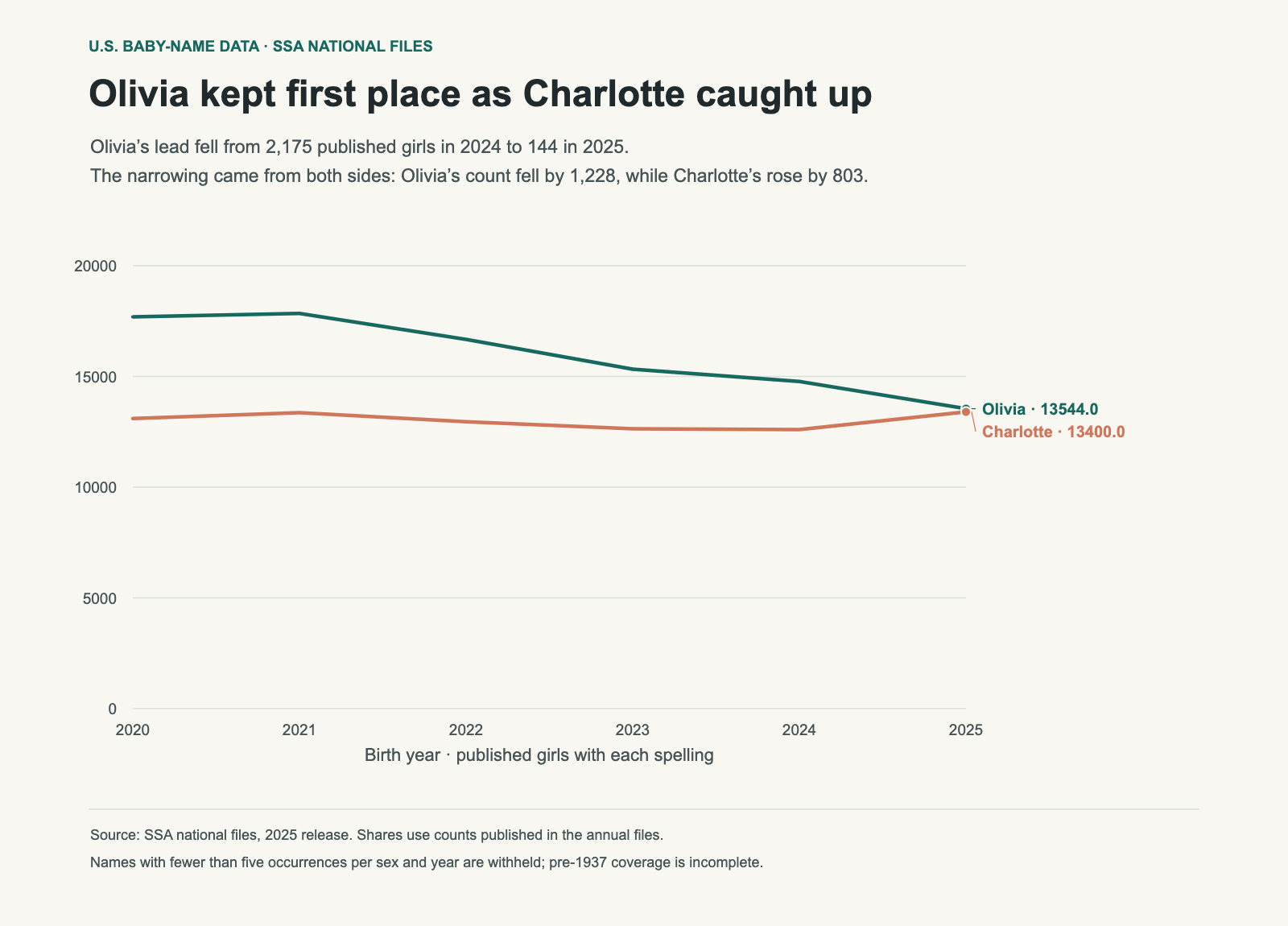
Olivia remained the leading girls’ name in the U.S. in 2025, but Charlotte was only 144 published occurrences behind. In 2024 the gap was 2,175. The number-one position stayed the same while the distance between these two names changed substantially.
Two movements narrowed the gap: Olivia’s count fell by 1,228, while Charlotte’s rose by 803. Together they reduced the difference by 2,031. Looking only at Olivia’s rank would miss both changes.
The gap changed more than the leading rank
| Name | 2024 count · rank | 2025 count · rank | Count change |
|---|---|---|---|
| Olivia | 14,772 · #1 | 13,544 · #1 | −1,228 |
| Charlotte | 12,597 · #4 | 13,400 · #2 | +803 |
Charlotte’s move from fourth to second place is visible in the ranking. Olivia’s decline in count is not: it retained first place. A name can remain first because all the names below it also have lower counts, even when its own use falls.
The 2025 difference is about 1.1% of Olivia’s count. It does not predict a switch next year; future counts could rise or fall in either direction.
The longer view changes the interpretation
Olivia’s count was 17,691 in 2020 and 13,544 in 2025. Charlotte’s was 13,100 in 2020 and 13,400 in 2025. Over that longer comparison, Olivia’s decline did more to close the gap than Charlotte’s relatively small net increase.
Charlotte’s path was also uneven. Its count fell from 13,368 in 2021 to 12,597 in 2024 before rising in 2025. A single latest-year increase should not be described as an uninterrupted climb.
Counts, shares and ranks answer different questions
A count tells you how many occurrences are published. A share places that count within the year’s published girls’ total. A rank puts the names in order.
Olivia accounted for 0.84% of the published female count in 2025; Charlotte accounted for 0.83%. Their positions near the top do not mean either name belongs to a large fraction of every local classroom. State patterns, nearby spellings and the size of the group matter too.
How to use a close contest when choosing a name
- Compare several years. A short series separates a persistent direction from one annual change.
- Check the exact spelling. Related spellings have separate counts, even when their sound is similar.
- Look at local use. National figures describe the whole published file, not your neighbourhood.
- Keep preference in the decision. A difference of one rank is rarely a sufficient reason to choose a name you like less.
For a wider historical view, read how to compare decades. The top-ten concentration analysis explains why being first today represents a smaller share than it did in many earlier cohorts.
Data and method
All counts and ranks above are calculated from the SSA’s 2025 national release, including its files for earlier birth years. Counts can be revised between releases, so using one bundle keeps the comparison consistent. Shares divide each count by all published female counts that year; names with fewer than five occurrences are omitted from the files.
Download the six-year comparison (CSV), or consult the SSA files and documentation.