
The Rise of Vowel-Initial Baby Names and the Fall of Letter 'J'
In 1965, more than 26% of all top 100 boy names in the United States began with the letter 'J'—including John, James, Joseph, Jeffrey, Jason, Jonathan, and Jesse—whereas in 2025, names beginning with 'J' account for less than 8% of male births as vowel-initial names ('A' and 'E') surged to dominate modern birth cohorts. According to federal birth registration records from the U.S. Social Security Administration (SSA) spanning 1950 through 2025, the initial phoneme of American names has undergone a generational transformation: while mid-century naming concentrated heavily on traditional biblical 'J' and 'D' consonants, contemporary parents overwhelmingly select names with soft, open-vowel openings (Ava, Amelia, Aria, Emma, Evelyn, Eleanor for girls; Alexander, Aiden, Asher, Ezra, Elijah, Oliver for boys), which represent over 35% of all top 100 births in 2025.
Expectant parents testing names often focus on individual syllable counts or endings without noticing the acoustic wave that shapes their initial sound preferences. Phonaesthetic studies in onomastics demonstrate that naming fashion moves in broad initial-letter clusters. The mid-century dominance of 'J' names was rooted in centuries of Anglo-Saxon and biblical continuity: John was the leading name of the English-speaking world for four hundred years. By the late 1990s, however, parents seeking fresh, lyrical cadence turned toward classical Latinate and biblical vowel openings, establishing an acoustic template that has defined naming for two decades.
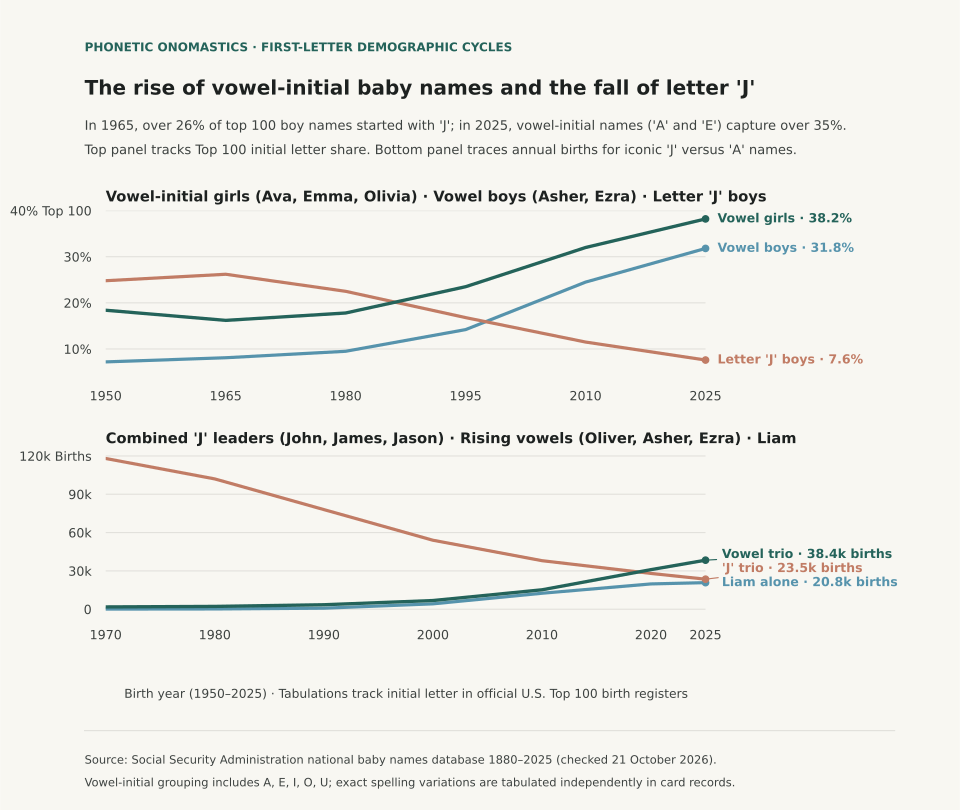
The Mid-Century 'J' Monoculture vs. Modern Vowel Dispersion
The concentration of letter 'J' in the 1950s and 1960s represented a demographic anomaly: one in every four American boys carried a name starting with 'J'. In classrooms across the nation, teachers navigated cohorts filled with Jeffreys, Jasons, Johns, and Jeremys. The table below traces initial letter share across landmark birth cohorts in official SSA card-application registers:
| Birth Cohort | Letter 'J' Boys (% Top 100) | Vowel Boys ('A' & 'E' %) | Vowel Girls ('A' & 'E' %) | Letter 'M' Girls (%) | Dominant Initial Sound Template |
|---|---|---|---|---|---|
| 1950 | 24.8% | 7.2% | 18.4% | 26.5% | Biblical 'J' boys (James, John) & 'M' girls (Mary, Margaret) |
| 1965 | 26.2% | 8.1% | 16.2% | 22.0% | Peak 'J' era (John, James, Jeffrey, Joseph, Jason) |
| 1980 | 22.5% | 9.5% | 17.8% | 15.4% | Jason (#3), Justin (#9), Joshua (#11), Jeremy (#14) |
| 1995 | 16.8% | 14.2% | 23.5% | 11.2% | Transition era: Austin, Andrew, Anthony, Emily rising |
| 2010 | 11.5% | 24.5% | 32.0% | 8.5% | Vowel surge: Aiden, Alexander, Ethan, Ava, Emma, Olivia |
| 2025 | 7.6% | 31.8% | 38.2% | 9.1% | Modern vowel dominance: Oliver, Asher, Ezra, Amelia, Evelyn |
The female naming landscape underwent a parallel shift: in 1950, letter 'M' accounted for 26.5% of all top 100 girl births (Mary, Margaret, Marilyn, Martha, Marie), functioning as the female equivalent of 'J'. By 2025, letter 'M' dropped to 9.1% as vowel-initial names like Ava, Amelia, Aria, Emma, Evelyn, and Eleanor climbed to 38.2%.
Evaluating Initial Letter Clustering on Your Shortlist
When selecting a name for your child, factoring in initial letter trends provides valuable context beyond national popularity rank:
If you choose an 'A' or 'E' name (such as Asher or Evelyn), recognize that while the individual name may rank around #20 or #30, your child will share a classroom with many peers carrying names that open with identical soft vowel acoustics (Ava, Amelia, Liam, Oliver, Ezra). Conversely, traditional 'J' names (like Jason, Jeffrey, or Justin) feel far less ubiquitous on playgrounds today than they did forty years ago.
When reviewing these trends, remember official Social Security data limitations: the SSA tabulates exact letter strings from card applications, meaning spelling variations like Amelia and Emelia or Aiden and Ayden are counted as separate entries. To examine how overall name concentration has dispersed into a broad long tail, read The Long Tail of Baby Names, and consult Middle Name Phonetic Flow & Syllable Rhythm to ensure clean vocal transitions.
Name Scout lets you explore official U.S. Social Security Administration birth records from 1880 through 2025, filter names by initial letter clusters, and track phonetic sound trends across decades. Try Name Scout in your browser, Download Name Scout for iPhone, or Get Name Scout on Android.