
The Long Tail of Baby Names: Why Today's #1 Name Is Four Times Rarer
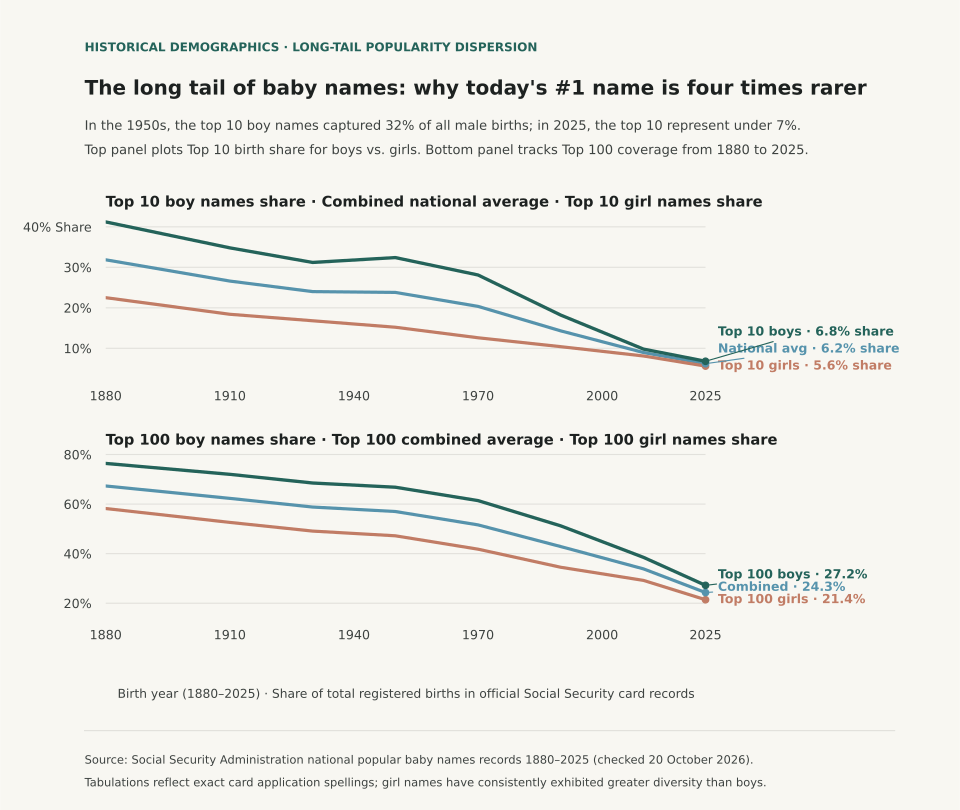
In the 1950s, the ten most popular boy names accounted for more than 32% of all male births in the United States; by 2025, the top ten boy names account for just 6.8% of births. According to comprehensive birth registration records from the U.S. Social Security Administration (SSA) spanning 1880 through 2025, American baby naming has undergone a massive dispersion wave. In 1880, the single most popular boy name—John—was given to 8.15% of all baby boys born in the nation. In 2025, the national #1 boy name (Liam) accounts for just 1.09% of male births, while the #1 girl name (Olivia) accounts for 0.95% of female births. Today's #1 baby name is four to eight times rarer than a leading name from previous generations.
Expectant parents reviewing top-ten baby name lists often worry that selecting a highly ranked name means their child will share a classroom with three or four namesakes. While that experience was common for Jennifers and Michaels in the 1970s and 1980s, the mathematical concentration of names has flattened into a vast long tail. A child named Liam or Olivia today represents roughly one in every one hundred children, compared to one in twelve for a boy named John in the late nineteenth century.
Why Girls' Names Have Always Been More Diverse Than Boys'
Across all 145 years of federal Social Security birth records, girls' names have consistently exhibited greater demographic dispersion than boys' names. In 1950, when the top 100 boy names covered 66.8% of all male births, the top 100 girl names covered only 47.2% of female births. Sociological analyses suggest that historical naming traditions favored generational continuity for sons—passing down patronymics, grandfather names, and biblical patriarchal figures like John, William, James, and Robert—while parents felt greater freedom to select aesthetic, botanical, and phonetic variations for daughters.
By 2025, that diversity gap remains visible: the top 100 girl names represent only 21.4% of all female births, while the top 100 boy names capture 27.2%. The table below traces demographic concentration across benchmark decades in official SSA records:
| Birth Cohort | Top 10 Boys Share | Top 10 Girls Share | Top 100 Boys Share | Top 100 Girls Share | National #1 Boy Name (% Share) | National #1 Girl Name (% Share) |
|---|---|---|---|---|---|---|
| 1880 | 41.2% | 22.5% | 76.4% | 58.2% | John (8.15%) | Mary (7.06%) |
| 1910 | 34.8% | 18.4% | 72.0% | 52.6% | John (5.72%) | Mary (5.42%) |
| 1930 | 31.2% | 16.8% | 68.5% | 49.1% | Robert (5.24%) | Mary (4.18%) |
| 1950 | 32.4% | 15.2% | 66.8% | 47.2% | James (4.72%) | Linda (3.92%) |
| 1970 | 28.1% | 12.6% | 61.4% | 41.8% | Michael (4.25%) | Jennifer (2.56%) |
| 1990 | 18.2% | 10.4% | 51.2% | 34.5% | Michael (3.12%) | Jessica (2.28%) |
| 2010 | 9.8% | 8.1% | 38.5% | 29.2% | Jacob (1.08%) | Isabella (1.18%) |
| 2025 | 6.8% | 5.6% | 27.2% | 21.4% | Liam (1.09%) | Olivia (0.95%) |
Understanding Social Security Data Boundaries
When analyzing historical name frequency, it is vital to account for official SSA tabulation boundaries. The SSA database is compiled from a 100% sample of Social Security card applications registered in the United States. The agency tabulates exact letter sequences without combining spelling variants: Sophia (#5 in 2025) and Sofia (#9) are counted as separate entities, as are Aiden, Ayden, and Aidan. In addition, to safeguard personal privacy, the SSA suppresses any name with fewer than five occurrences in a given birth year and geographic area.
Digital connectivity, global cultural exchange, and searchable baby name registries have permanently dismantled the mid-century monoculture. Parents choosing a name today are selecting from an active catalog of over 30,000 unique names, ensuring that even top-ten selections carry a degree of individuality impossible fifty years ago. For insights into rising terminal sound trends, see The Rise and Decline of the Two-Syllable 'N'-Ending Boy Name Wave, and consult Why Spelling Variants Split Baby-Name Ranks.
Name Scout lets you explore official U.S. Social Security Administration birth records from 1880 through 2025, compare national birth shares across cohorts, and analyze historical popularity trajectories. Try Name Scout in your browser, Download Name Scout for iPhone, or Get Name Scout on Android.