
The Rise and Decline of the Two-Syllable 'N'-Ending Boy Name Wave
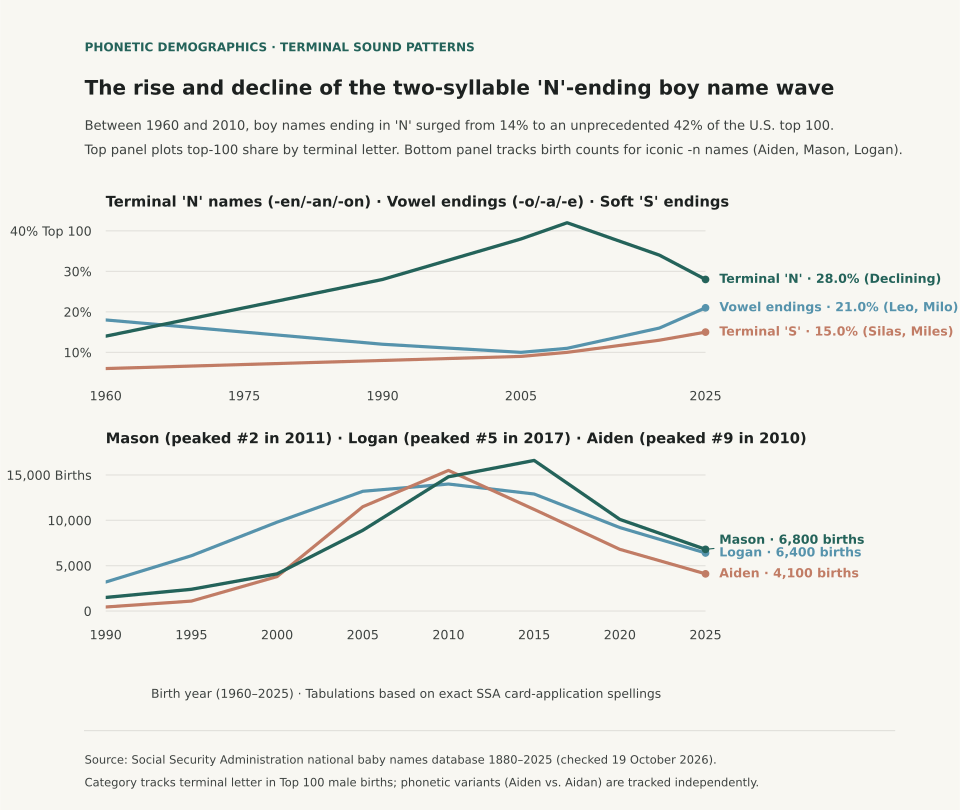
Over the past sixty years, the phonetic structure of American boy names underwent an unprecedented demographic wave dominated by two-syllable names ending in the letter 'N'. According to official birth application records from the U.S. Social Security Administration (SSA), only 14% of the national top 100 boy names in 1960 ended in the letter 'N'. By 2010, names ending in 'N' reached an all-time peak of 42% of the national top 100—powered by the massive convergence of the -aiden rhyming cohort (Aiden, Jayden, Kayden, Brayden) alongside two-syllable staples like Mason, Ethan, Logan, and Jackson. By 2025, SSA data shows the terminal 'N' wave declining to 28% as parents increasingly favor vowel endings (-o, -a) and soft sibilant endings (-s).
Sociolinguists and onomasticians analyze name trends by examining phonaesthetic components rather than individual names in isolation. In the mid-twentieth century, male naming conventions were dominated by single-syllable or hard-consonant classical names: John, Robert, James, William, David, and Richard. Beginning in the 1970s and accelerating through the 1990s, parental preference shifted toward softer, trochaic (stressed-unstressed) two-syllable patterns with liquid consonants and nasal endings. That acoustic template felt modern, energetic, and distinct from mid-century traditionalism.
The Anatomy of the Trend: The -Aiden Cluster and Surnames
The acceleration of the -n sound was amplified by two distinct naming movements: the adoption of Anglo-Celtic surnames as given names and the explosive diversification of the -aiden rhyming cluster. Surnames ending in -son (Jackson, Mason, Harrison, Carson) and -an/-on (Logan, Nolan, Landon) provided rooted, masculine associations that transitioned seamlessly into first-name usage.
Meanwhile, the -aiden cluster represented one of the fastest phonetic expansions in modern U.S. demographic history. When evaluating these trends, it is essential to remember the limitations of official SSA data: the agency tracks exact letter sequences from Social Security card applications, meaning that spelling variants are split across separate rows. In 2010, the spelling Aiden ranked #9 nationally with 15,500 births. When combined with its common phonetic variants—Ayden (#33 with 9,200 births), Aidan (#63 with 6,200 births), and Aden (#264 with 1,300 births)—the single spoken sound exceeded 32,000 births, outranking the official national #1 name Jacob (22,100 births) by a wide margin.
| Birth Year | Terminal 'N' Names (% Top 100) | Terminal Vowel Names (% Top 100) | Terminal 'S' Names (% Top 100) | Representative Top 10 Names |
|---|---|---|---|---|
| 1960 | 14.0% | 18.0% | 6.0% | John, Brian, Glenn, Kevin, Steven |
| 1975 | 21.0% | 15.0% | 7.0% | Jason (#2), Brian (#4), Kevin (#11), Ryan (#13) |
| 1990 | 28.0% | 12.0% | 8.0% | Brandon (#6), Justin (#9), Ryan (#11), Christian (#26) |
| 2005 | 38.0% | 10.0% | 9.0% | Ethan (#5), Logan (#19), Dylan (#24), Aiden (#40) |
| 2010 (Peak) | 42.0% | 11.0% | 10.0% | Aiden (#9), Jayden (#8), Logan (#13), Mason (#12) |
| 2020 | 34.0% | 16.0% | 13.0% | Liam (#1), Noah (#2), Oliver (#3), Elijah (#4) |
| 2025 | 28.0% | 21.0% | 15.0% | Leo (#12), Milo (#34), Ezra (#18), Silas (#38) |
What Sounds Are Replacing the 'N' Ending in the 2020s
As the -n ending became ubiquitous, prospective parents began gravitating toward alternative phonaesthetic structures to avoid classroom saturation. In the 2020s, two distinct sound families have captured the momentum previously held by the -n cluster:
First, boy names ending in open vowels—particularly the sharp, upbeat '-o' ending (Milo, Leo, Arlo, Otto, Enzo) and biblical '-a' endings (Ezra, Luca)—have doubled their share of the top 100 since 2005. These names offer an airy, modern cadence with classic roots.
Second, softer sibilant endings in '-s' (Silas, Miles, Brooks, Hayes, Elias) have expanded rapidly, pairing vintage heritage with relaxed, contemporary phrasing. For analysis of how gender perception alters crossover name viability, see The Unisex Baby Name Tipping Point, and explore Why Spelling Variants Split Baby-Name Ranks in U.S. Data.
Name Scout lets you filter official U.S. Social Security Administration birth records by sound endings, syllable length, and historical popularity trajectories. Try Name Scout in your browser, Download Name Scout for iPhone, or Get Name Scout on Android.