
The Unisex Baby Name Tipping Point: When Crossover Names Turn Permanently Feminine
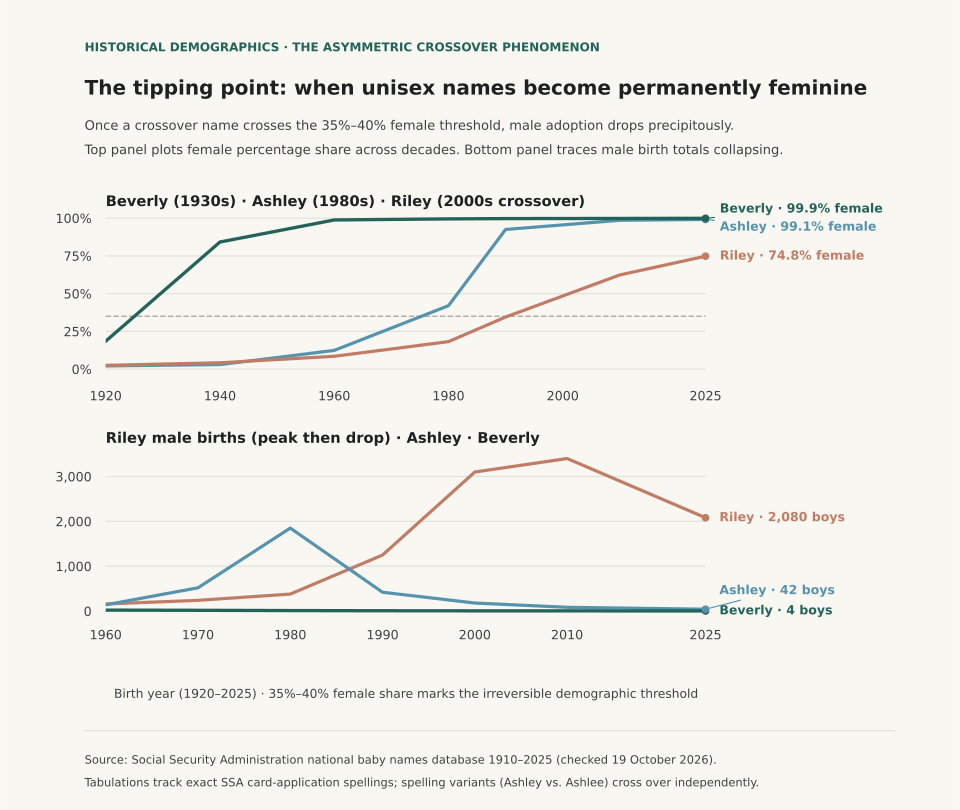
In historical baby name demographics, the crossover of a traditionally masculine name into unisex usage operates as an asymmetric one-way ratchet: once female births exceed 35% to 40% of total annual registrations, male adoption drops precipitously and rarely recovers. According to national birth records from the U.S. Social Security Administration (SSA) spanning 1910 through 2025, names like Beverly, Shirley, Leslie, and Ashley followed identical trajectories. Ashley, which began as an English masculine place name, saw male births drop by over 97% between 1980 and 2000 as female popularity exploded, transforming the name into an exclusively feminine identifier within a single generation.
Expectant parents selecting a gender-neutral name often seek modern balance, aiming for a choice that feels flexible and free of rigid stereotypes. Historical data indicates that true unisex equilibrium—where a name hovers near a 50/50 split across multiple decades—is demographically fragile. In Western naming conventions documented by sociologists, parents of baby girls readily adopt names with masculine or surname origins, perceiving them as strong, modern, and confident. Parents of baby boys, however, rapidly abandon names once those names become associated with girls, driven by persistent cultural asymmetries around gender signaling.
Historical Precedents: The 20-Year Transition Window
The transition from unisex to feminine typically completes within 15 to 25 years once the tipping point is reached. The table below traces demographic shifts across four notable crossover names in official SSA records:
| Name | Original Gender Dominance | Year Reached 35% Female | Year Reached 90% Female | Peak Male Births (Year) | 2025 Male Births | Current Gender Split (2025) |
|---|---|---|---|---|---|---|
| Beverly | 100% Masculine (1900) | 1926 (38.2% F) | 1942 (91.4% F) | 1,240 (1920) | 4 | 99.9% Female |
| Ashley | 98% Masculine (1965) | 1978 (37.1% F) | 1988 (91.2% F) | 1,850 (1980) | 42 | 99.1% Female |
| Avery | 95% Masculine (1985) | 2001 (36.8% F) | 2018 (88.5% F) | 2,410 (2007) | 1,320 | 84.2% Female |
| Riley | 92% Masculine (1985) | 1991 (36.2% F) | Pending (74.8% F) | 3,400 (2010) | 2,080 | 74.8% Female |
The progression of Riley illustrates the contemporary dynamic. Riley entered the national top 100 for boys in 2002, supported by traditional Irish surname appeal. In 2003, however, female adoption surged following popular media representations, crossing 50% female share in 2004. Male birth numbers continued to grow on demographic momentum until 2010, peaking at 3,400 births. Over the subsequent fifteen years, male registrations dropped by 39% while female births stabilized above 6,000 annually, pushing Riley past the 74% female mark.
Evaluating Gender-Neutral Names on Your Shortlist
Parents evaluating candidate names can calculate the current gender ratio from the latest annual SSA tables. A few modern names have maintained a genuine 50/50 balance over consecutive birth cohorts: Rowan (approximately 55% male / 45% female), River (58% male / 42% female), and Charlie (52% female / 48% male). If a name sits between 30% and 40% female and is rising rapidly on girl charts, demographic precedent suggests it will tilt predominantly feminine over the child's school years.
For a different look at naming cycles, read how old baby names can return without a universal 100-year clock. State Baby Name Outliers in 2025 shows how regional preferences alter local classroom frequency.
Name Scout lets you inspect official U.S. Social Security Administration birth records from 1910 through 2025, calculate precise gender-ratio splits across decades, and track crossover trends. Try Name Scout in your browser, Download Name Scout for iPhone, or Get Name Scout on Android.