
How to Find the Best Meeting Time Across US, Europe, and Asia
Mathematically, any two cities separated by 8 or more hours of time-zone offset share zero overlap during strict 9:00 AM to 5:00 PM working hours. However, expanding the acceptable meeting window slightly to 8:00 AM to 7:00 PM local time unlocks 2 to 3 daily "golden hours" for U.S. West Coast to Europe and U.S. West Coast to East Asia — while teams spanning all three regions simultaneously (U.S., Europe, and Asia) must replace punishing 1:00 AM all-hands calls with rotating two-hub handoffs.
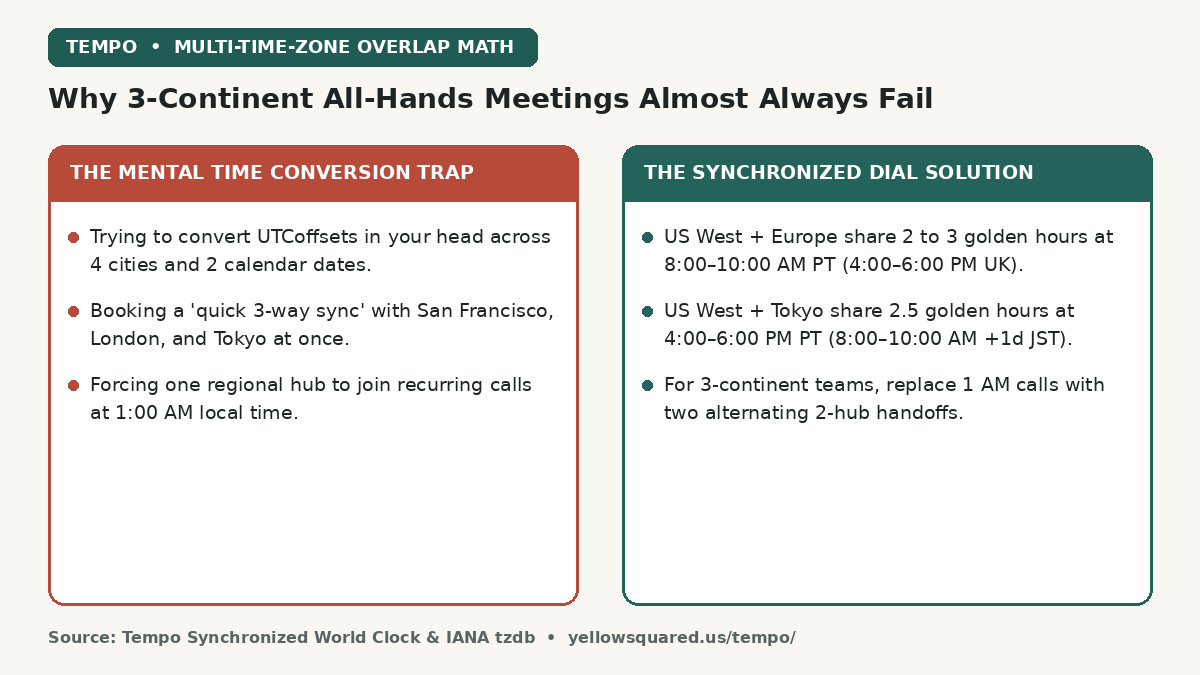
When distributed engineering, design, or operations teams collaborate across North America, Europe, and Asia-Pacific, scheduling a live meeting often feels like solving a Rubik's cube in the dark. Trying to do mental arithmetic across four UTC offsets and the International Date Line inevitably leads to calendar invites that land at 11:30 PM in Berlin or 6:00 AM in Seattle. Mapping the 24-hour clock geometry across the world's primary work corridors reveals exactly where humane overlap exists — and where it is physically impossible.
On a 24-hour planet, three regions spaced 8 hours apart (San Francisco, London, and Tokyo) form an equilateral triangle with zero shared daytime hours.
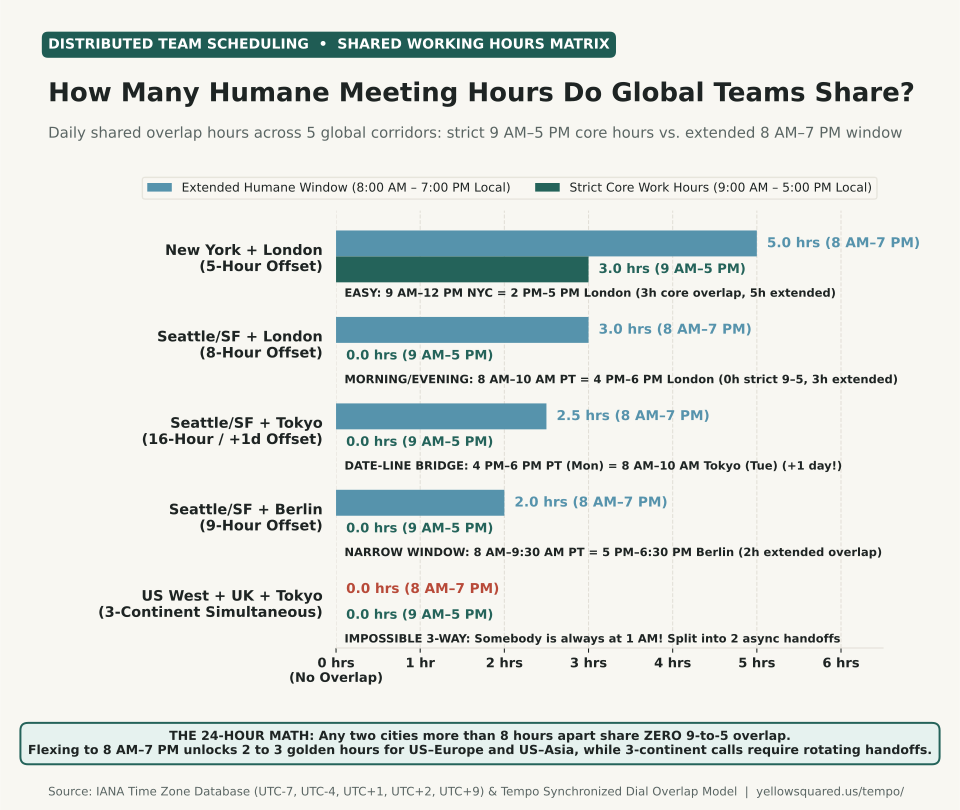
The Golden Overlap Windows for Every Major Two-Region Corridor
When you coordinate between two regions at a time, every major global pair has a reliable 90- to 180-minute sweet spot where one hub is starting its morning and the other is wrapping up its afternoon:
| Global Corridor | Typical Offset | Golden Meeting Window (Hub A) | Golden Meeting Window (Hub B) | Date Change? |
|---|---|---|---|---|
| U.S. East (NYC) + UK (London) | 5 hrs (4h in gap) | 9:00 AM – 12:00 PM EDT | 2:00 PM – 5:00 PM BST | Same calendar day |
| U.S. West (Seattle/SF) + UK (London) | 8 hrs (7h in gap) | 8:00 AM – 10:00 AM PDT | 4:00 PM – 6:00 PM BST | Same calendar day |
| U.S. West (Seattle/SF) + Central Europe (Berlin) | 9 hrs (8h in gap) | 8:00 AM – 9:30 AM PDT | 5:00 PM – 6:30 PM CEST | Same calendar day |
| U.S. West (Seattle/SF) + Japan (Tokyo) | 16 hrs (Winter 17h) | 4:00 PM – 6:00 PM PDT (Mon) | 8:00 AM – 10:00 AM JST (Tue) | Tokyo is +1 Day! |
| UK / Europe (London/Berlin) + Japan/China | 7 to 8 hrs | 8:30 AM – 10:30 AM BST | 4:30 PM – 6:30 PM JST / CST | Same calendar day |
Why the Date-Line Trap Catches U.S.–Asia Invites
When scheduling between North America and East Asia or Oceania (Tokyo at UTC+9, Shanghai/Singapore at UTC+8, or Sydney at UTC+10/+11), the biggest source of missed calls is not the hour — it is the calendar day boundary.
Because Tokyo is 16 hours ahead of Seattle/San Francisco during Daylight Saving Time (and 17 hours ahead in winter), a Monday 5:00 PM Pacific afternoon call lands at 9:00 AM Tuesday morning in Tokyo. Most people mentally calculate "Tokyo is 8 hours behind minus a day," accidentally sending a Friday afternoon U.S. invite that lands on Saturday morning in Japan. Always verify the "+1d" midnight boundary marker before locking in a Thursday or Friday afternoon Pacific slot.
How to Run 3-Continent Teams Without Burning Out Your Staff
If your team has members in Seattle/San Francisco (UTC-7), London/Berlin (UTC+1/+2), and Tokyo/Singapore (UTC+8/+9), those three hubs sit roughly 8 hours apart around the globe (`8 + 8 + 8 = 24 hours`). At any given hour of the day, one of those three cities is guaranteed to be between 11:00 PM and 7:00 AM:
- Replace 3-way status calls with a Relay Handoff: Have Europe and Asia meet during Europe's morning / Asia's late afternoon (e.g., 9:00 AM London / 5:00 PM Tokyo), record a 5-minute summary or shared doc, and hand off to North America during Europe's late afternoon / America's morning (9:00 AM Seattle / 5:00 PM London).
- Use a 2-Slot Rotation for mandatory quarterly all-hands: If everyone must attend live once a month, alternate between Slot A (7:00 AM PT / 3:00 PM London / 11:00 PM Tokyo) and Slot B (4:00 PM PT / 12:00 AM London / 8:00 AM +1d Tokyo) so the late-night burden is never permanent for one office.
- Visualize highlight blocks before sending the invite: Instead of trading five emails asking what time works, drag a candidate block across synchronized city columns and check the overlap shading. You can Open Tempo in your browser to align your team's cities, test future dates across US-UK Daylight Saving Time transitions, and find your cleanest meeting window in seconds.