
Distance Bands vs. Dynamic Pricing: Why Short-Haul Flights Beat Cash Surges
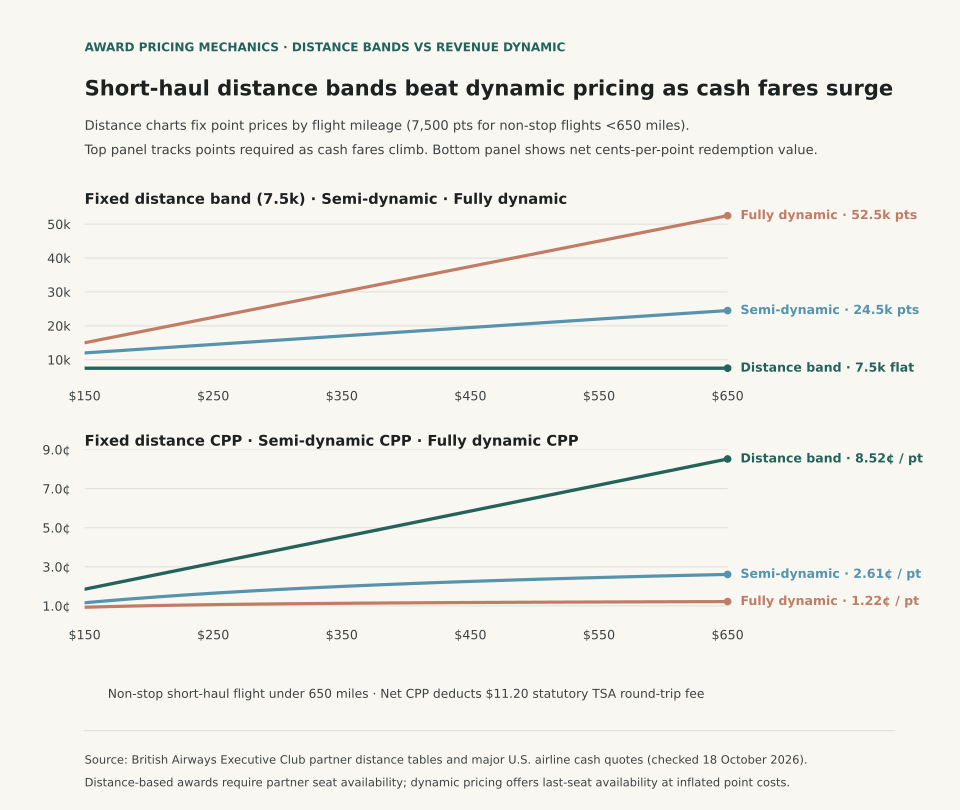
When last-minute airline ticket prices surge from $150 to $650, distance-based loyalty programs like British Airways Executive Club and Air Canada Aeroplan charge the exact same fixed point price, while dynamic programs like Delta SkyMiles and United MileagePlus raise award rates in lockstep with the cash fare. For a non-stop economy flight under 650 flight miles (such as Seattle to San Francisco, Boston to Washington D.C., or Miami to the Bahamas), British Airways charges a flat 7,500 Avios on partner American Airlines or Alaska Airlines flights. On an off-peak $150 cash ticket, redeeming 7,500 Avios yields 1.85 cents per point; when that same flight spikes to $650 during holiday periods, the net value surges to 8.52 cents per point.
Many credit card points holders assume that booking directly through a U.S. carrier's domestic frequent flyer program is the simplest route for domestic travel. Major U.S. carriers transitioned to revenue-based dynamic pricing models, tying the points required directly to the cash price of the seat at an effective redemption value around 1.1 to 1.3 cents per point. When high demand pushes cash fares into the $500 range, a dynamic award that cost 12,000 miles last month suddenly requires 45,000 miles. By booking partner awards through an international alliance carrier with a distance-based chart, you insulate your point balances from cash price volatility.
How Distance Bands Separate Flight Mileage from Revenue Spikes
Under distance-based award charts, itineraries are segmented into geographic distance tiers calculated from airport-to-airport great circle mileage. In the British Airways Executive Club Partner Award Chart, Zone 1 covers non-stop flights up to 650 miles (7,500 Avios in economy), while Zone 2 covers flights between 651 and 1,150 miles (9,000 to 11,000 Avios). The table below compares award costs and net values across cash fare tiers for an illustrative Zone 1 short-haul flight:
| Cash Ticket Price | Statutory TSA Fee | Net Cash Saved | Fixed Distance Band (Avios) | Distance Net CPP | Dynamic Revenue Program | Dynamic Net CPP |
|---|---|---|---|---|---|---|
| $150.00 | $11.20 | $138.80 | 7,500 pts | 1.85¢ | 15,000 pts | 0.93¢ |
| $250.00 | $11.20 | $238.80 | 7,500 pts | 3.18¢ | 22,500 pts | 1.06¢ |
| $350.00 | $11.20 | $338.80 | 7,500 pts | 4.52¢ | 30,000 pts | 1.13¢ |
| $450.00 | $11.20 | $438.80 | 7,500 pts | 5.85¢ | 37,500 pts | 1.17¢ |
| $550.00 | $11.20 | $538.80 | 7,500 pts | 7.18¢ | 45,000 pts | 1.20¢ |
| $650.00 | $11.20 | $638.80 | 7,500 pts | 8.52¢ | 52,500 pts | 1.22¢ |
The math reveals why short-haul domestic flights offer some of the highest cents-per-point redemptions in credit card travel. When emergency business travel or peak holiday schedules inflate an 80-minute regional hop to $550, spending 7,500 points saves $538.80 out of pocket—delivering a 7.18¢/pt return that outpaces standard long-haul business class valuations.
Understanding Partner Capacity Constraints and Segment Surcharges
While distance-based pricing provides outstanding point leverage, partner bookings carry two specific limitations:
First, partner airlines only release a fraction of total seat inventory to alliance members. British Airways can only book American or Alaska seats when those operating carriers make saver inventory (typically T-fare or U-fare classes) accessible to Oneworld partners. If a flight has only three cash seats remaining, dynamic pricing will let you purchase those seats at exorbitant point rates, while distance-based partner search results will show zero availability.
Second, distance-based charts price per individual flight segment rather than the origin-to-destination journey. If your trip from Portland to Spokane connects in Seattle, British Airways prices the Portland-to-Seattle leg (7,500 pts) and the Seattle-to-Spokane leg (7,500 pts) separately, totaling 15,000 Avios. Distance sweet spots are therefore most effective on non-stop regional corridors. For strategies on maximizing points through transfer bonuses, see Avios Transfer Bonus Arbitrage and How Cash Taxes and Surcharges Change Cents-Per-Point Value.
Pointsuno tracks distance charts and partner redemption rules, computes net cents-per-point returns after deducting mandatory cash fees, and models transfer bonus arbitrage. Open Pointsuno in your browser, Download Pointsuno for iPhone, or Get Pointsuno on Android.