
Heat Index vs. Wet-Bulb Temperature: Why 95°F Wet-Bulb Is Universally Lethal
A 95°F heat index warning signals oppressive discomfort where sweating still dissipates metabolic heat, whereas a 95°F wet-bulb temperature (35°C Tw) defines the absolute thermodynamic ceiling of human survivability. According to research published by the Science Advances global heat stress study and the National Weather Service (NWS) Heat Index Methodology, human skin maintains a mean temperature of 35°C (95°F). When atmospheric moisture and temperature combine to produce a wet-bulb reading of 35°C, the vapor pressure gradient between human skin and ambient air collapses to zero. In that environment, even a healthy adult resting in the shade in front of an electric fan cannot reject metabolic heat through sweat evaporation and inevitably experiences fatal hyperthermia within four to six hours.
Outdoor organizers often conflate dry-bulb temperature, heat index, and wet-bulb temperature when evaluating summer heat risk. The NWS Heat Index (derived from Robert G. Steadman's 1979 physiological model) calculates subjective "feels-like" temperature under shaded, light-wind conditions, assuming continuous sweat evaporation from an active individual. Wet-bulb temperature, by contrast, is measured directly by wrapping a thermometer bulb in a water-saturated cloth exposed to airflow. It indicates how cool an object can become solely through water evaporation. When wet-bulb readings exceed 85°F (29.4°C), evaporative cooling efficiency drops so drastically that heavy physical labor induces rapid heat exhaustion regardless of water intake.
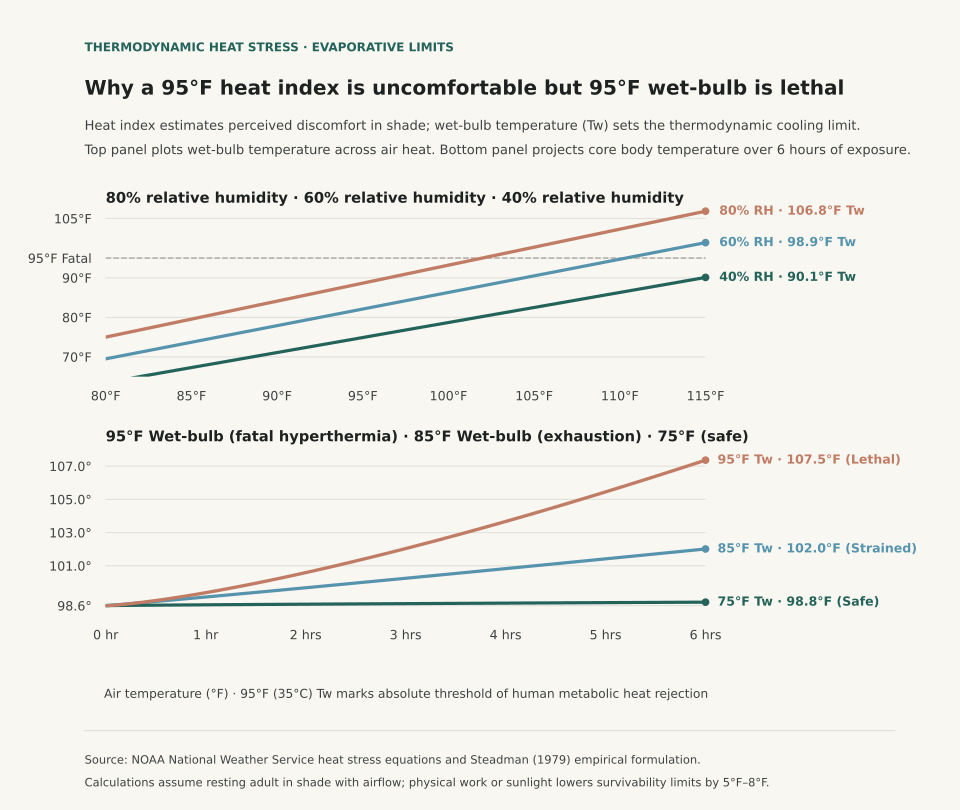
Thermodynamic Limits: Why Sweat Stops Working at 35°C Wet-Bulb
The human body generates approximately 100 watts of metabolic heat at rest, increasing to 500–1000 watts during moderate physical exertion. To prevent core body temperature from rising above its safe 98.6°F (37°C) setpoint, the cardiovascular system pumps blood to cutaneous capillaries while eccrine glands secrete sweat across the skin. Each gram of evaporated water removes roughly 2.4 kilojoules of heat. The rate of this cooling depends entirely on the difference between the water vapor pressure at the warm skin surface and the water vapor pressure of the surrounding atmosphere.
When relative humidity is low, sweat evaporates rapidly even at 105°F dry-bulb temperatures, keeping skin temperature near 88°F–90°F. When high humidity pushes the wet-bulb temperature to 95°F, the ambient air is saturated relative to skin temperature. Sweat continues to pour from pores but rolls off the body as liquid without evaporating, removing zero latent heat. The table below traces calculated wet-bulb and heat index values across air temperatures and relative humidity levels:
| Air Temp (°F) | Relative Humidity | Calculated Heat Index | Wet-Bulb Temp (Tw) | Human Physiological Status |
|---|---|---|---|---|
| 90°F | 50% | 95°F (Caution) | 76.4°F | Safe equilibrium; sweating provides effective thermal regulation |
| 95°F | 40% | 98°F (Caution) | 77.5°F | Elevated sweat rate; evaporative cooling maintains normal core temperature |
| 95°F | 60% | 114°F (Danger) | 84.8°F | Severe thermal strain; exceeds OSHA continuous heavy work limit |
| 95°F | 80% | 136°F (Extreme Danger) | 90.6°F | Critical hyperthermia risk; core temperature climbs during light activity |
| 105°F | 40% | 123°F (Extreme Danger) | 84.5°F | High subjective discomfort; dry air allows partial sweat evaporation |
| 105°F | 60% | 151°F (Extreme Danger) | 93.1°F | Approaching fatal wet-bulb limit; cellular heat-shock response initiated |
Practical Guidelines for Summer Outdoor Safety
Wet-bulb temperatures approaching 95°F have historically occurred only in brief, localized coastal pockets along the Persian Gulf, the Red Sea, and the Indus River Valley. Lower wet-bulb thresholds are common across North America: wet-bulb readings of 82°F to 86°F occur frequently during midsummer humidity surges across the Gulf Coast, the Mississippi Valley, and the mid-Atlantic.
When planning road races, construction shifts, or youth sports tournaments, monitor the Wet Bulb Globe Temperature (WBGT), which incorporates direct solar radiation and wind speed alongside temperature and humidity. At a WBGT of 85°F to 88°F, sports medicine protocols mandate frequent rest breaks and hydration pauses; above 90°F WBGT, outdoor activities should be suspended. For insights into how air moisture shifts between morning and afternoon hours, read Dew Point vs. Relative Humidity and explore What Are Climate Normals? to compare local station extremes against 30-year seasonal baselines.
Eranorms contextualizes real-time station weather against decades of climate records, historical temperature soundings, and seasonal extremes. Open Eranorms in your browser, Download Eranorms for iPhone, or Get Eranorms on Android.