
How to Read Fruit PLU Codes: 4-Digit Conventional vs. 9-Digit Organic Stickers
A four-digit Price Look-Up (PLU) sticker in the 3000 or 4000 range identifies conventionally grown bulk produce, while a five-digit code starting with 9 identifies the organic version of that same item. A standard yellow Cavendish banana carries PLU 4011; an organically grown Cavendish banana carries 94011. In the International Federation for Produce Standards (IFPS) database, which administers more than 1,500 global produce codes, the five-digit 83000 and 84000 series are reserved for routine conventional expansion as four-digit numbers fill up. They do not indicate genetically modified (GMO) fruit.
Supermarkets introduced standardized PLU stickers in 1990 so cashiers and self-checkout scales could price loose produce accurately without guessing varieties at the register. When you pick up an apple or an avocado in the aisle, the sticker answers a specific retail question: whether a small Hass avocado (4046) rings up at a different per-piece price than a large Hass avocado (4225), or whether a large Fuji apple is conventional (4131) or organic (94131). That number identifies the cultivar, size tier, and growing method recorded for checkout. It does not measure when the fruit was harvested, where it was grown, or whether it is ripe enough to eat tonight.
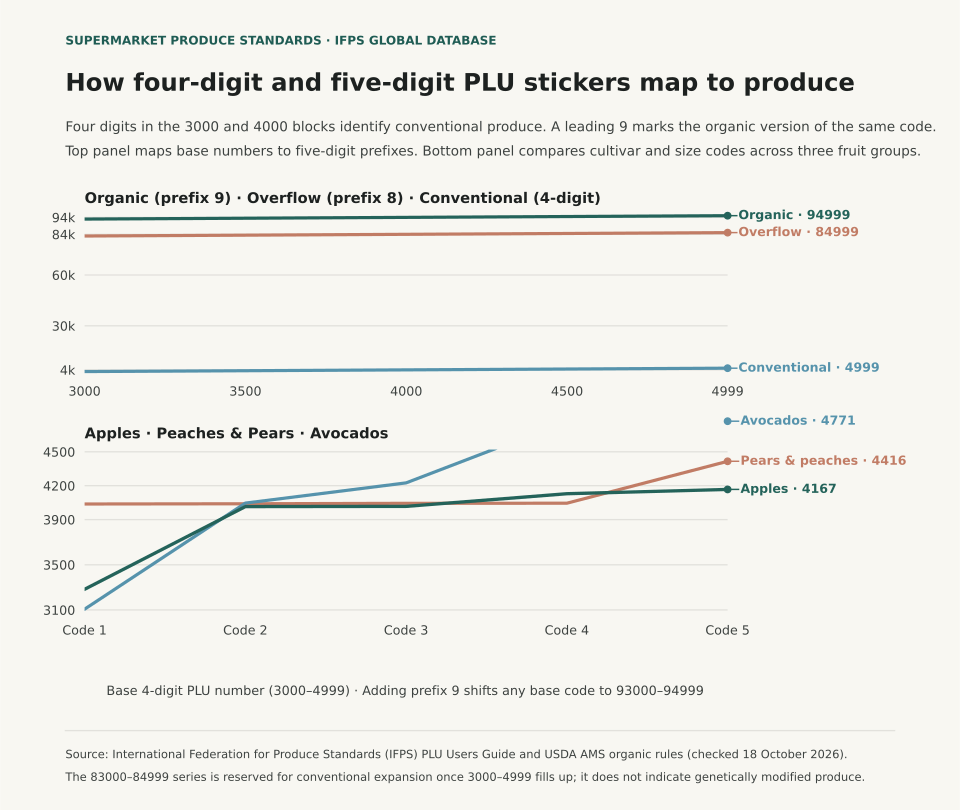
How the Four-Digit and Five-Digit Series Are Assigned
In 2001, national produce associations formed the IFPS to harmonize PLU assignments across countries. Participation is voluntary rather than mandated by a government regulator, and retailers use the shared list to keep bulk inventory and checkout pricing consistent. Within the four-digit 3000 and 4000 blocks, IFPS assigns numbers randomly as applications are approved. Aside from the leading 9 on five-digit organic stickers, individual digits inside the four-digit core carry no embedded code: a 3000-series apple such as 3283 is just as conventional as a 4000-series Granny Smith (4017).
Because every five-digit organic PLU is built by placing a 9 in front of the four-digit conventional code, the IFPS master catalog lists only the four-digit base numbers. Once you know that 4038 is a yellow-fleshed peach and 4044 is a white-fleshed peach, you also know that 94038 and 94044 are their organic counterparts.
A persistent grocery rumour claims that a five-digit PLU starting with 8 warns shoppers that a fruit is genetically engineered. IFPS had originally set aside the 8 prefix for genetically modified produce, but growers and supermarkets never adopted that sticker convention at retail. As recorded in the IFPS PLU Users Guide and retail ERP documentation, IFPS retired the unused GMO prefix and reopened the 83000–84999 ranges for ordinary produce as the 3000 and 4000 series approach capacity. Shoppers looking for organic verification in the United States should check for the 9-prefix PLU alongside the regulated seal defined under the USDA Agricultural Marketing Service (AMS) organic labeling rules, which prohibit genetic engineering, ionizing radiation, and sewage sludge in certified organic crops.
Why One Fruit Carries Multiple Base Codes in the Aisle
A single fruit species often appears under several different four-digit numbers because supermarkets separate small and large fruit or distinguish cultivars that look similar in a bin. Checking the four-digit base code tells you which variety and size class you are holding before you test for ripeness:
| Produce Item | Cultivar or Size Tier | Conventional PLU | Organic PLU | What the Code Separates in the Aisle |
|---|---|---|---|---|
| Banana | Yellow Cavendish | 4011 | 94011 | Standard yellow banana vs. plantain (4235) or red banana (4236) |
| Avocado | Hass, Small | 4046 | 94046 | Smaller per-piece or per-pound Hass tier vs. large Hass (4225) |
| Avocado | Hass, Large | 4225 | 94225 | Large Hass vs. green-skinned Florida or West Indian varieties (3107) |
| Apple | Granny Smith | 4017 | 94017 | Firm, tart green baking apple vs. Golden Delicious (4136) |
| Apple | Fuji, Large | 4131 | 94131 | Large sweet red-blushed Fuji vs. Gala (4129) or Red Delicious (4015) |
| Peach | Yellow Flesh | 4038 | 94038 | Traditional yellow peach vs. lower-acid white peach (4044) |
| Pear | Bartlett | 4045 | 94045 | European pear that softens off the tree vs. Bosc (4416) |
| Melon | Cantaloupe / Muskmelon | 4031 | 94031 | Netted cantaloupe vs. smooth-skinned honeydew (4050) |
Knowing the cultivar code helps you apply the right selection and storage rule at home. A pear labeled 4045 is a European Bartlett that softens on the counter after harvest, whereas an Asian pear stays crisp when ripe and should be chosen ready to eat (see Why Asian Pears Stay Crisp: When to Eat, Wait or Refrigerate). Once you know which variety is in your basket, use physical cues—such as stem-end yield, background color, and aroma—from the Supermarket Produce Ripeness Guide rather than relying on the sticker alone. Note also that under USDA AMS exemptions, small farms marketing less than $5,000 of organic produce annually are not required to carry formal certification (though they must follow organic production rules and cannot use the USDA seal), and farmers-market fruit rarely carries IFPS stickers. In addition, IFPS reserves blocks of "Retailer Assigned" numbers that individual grocery chains map to local specialties, so a store-assigned number at one chain can refer to a different regional variety across town.
When a bin sign is missing or two apple varieties look alike under grocery lighting, Redberi (In Season) lets you match PLU numbers to variety profiles, check counter-versus-refrigerator storage rules, and look up USDA nutrition reference values per 100 grams offline. Open Redberi in your browser, Download Redberi for iPhone, or Get Redberi on Android.